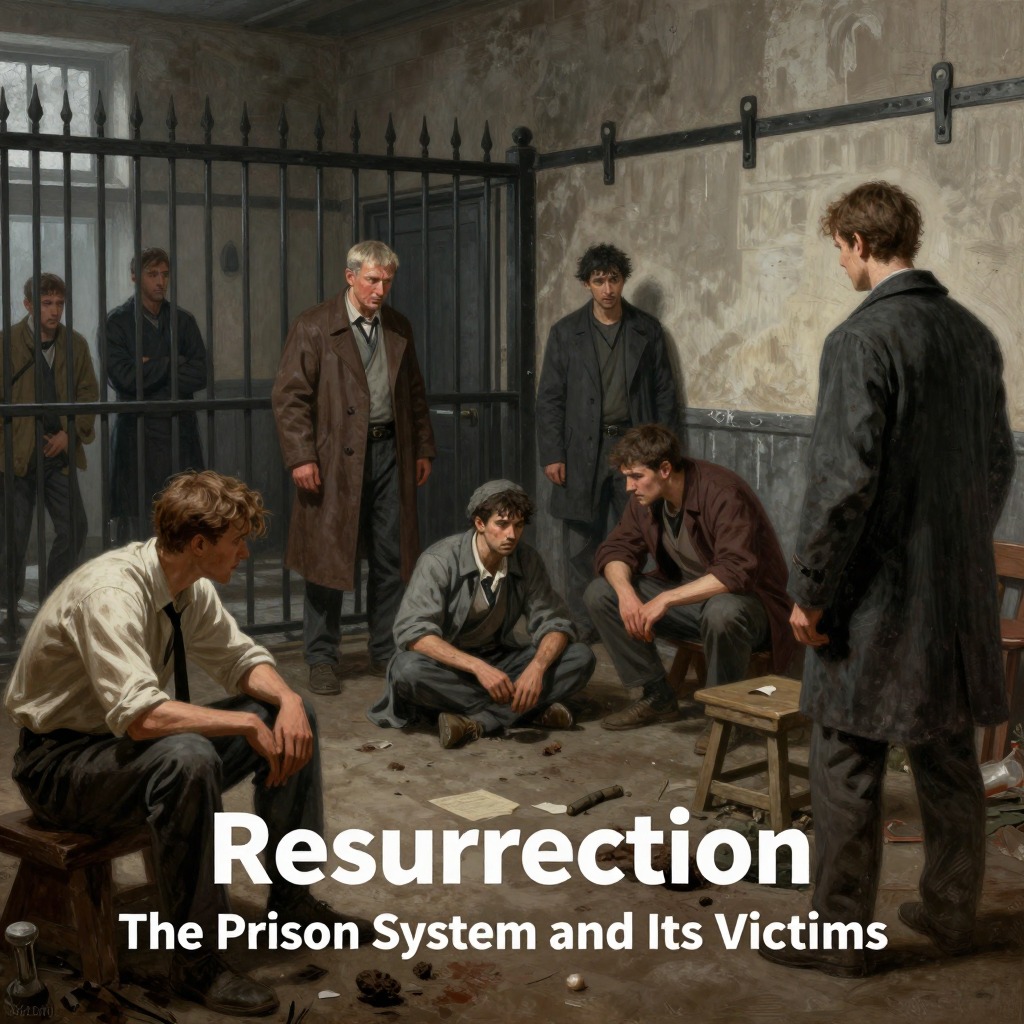
Nabatoff
ResurrectionNabatoff is a peasant-born revolutionary whose practical, cheerful communism and deep attachment to the land make him a distinctive figure among the political exiles. Unlike the doctrinaire ideologues around him, he believes the revolution should preserve the fundamental forms of peasant life while removing the gentry and officials, and he brings an unflagging energy and moral simplicity to every task, whether organizing a prison cell or debating the future of Russia.
Identity and Background
Nabatoff came from the peasantry. After leaving the village school, his exceptional talents won him a place at the gymnasium, where he supported himself entirely by giving lessons and graduated with a gold medal. He chose not to enter the university because, while still in the seventh class, he resolved to go among the people and enlighten his neglected brethren. He first took a post as a Government clerk in a large village, but was soon arrested for reading to the peasants and organizing a co-operative industrial association. After eight months in prison he was released under police supervision, only to move to another village, become a schoolmaster, and repeat the same work. He was arrested again, spent fourteen months in prison—where his convictions grew stronger—and was then exiled to the Perm Government, from which he escaped. Further imprisonment and exile to Archangel followed; there he refused to take the required oath of allegiance and was condemned to exile in the Yakutsk Government. As a result, half his adult life was spent in prison and exile.
Character and Convictions
Nabatoff was a communist who wanted nothing for himself and contented himself with very little, yet demanded a great deal for the group of his comrades and could work for it physically or mentally day and night, without sleep or food. He never repented of anything, never looked far ahead, and used all his powers—his cleverness, his practical knowledge—to act in the present. When free, he worked toward enlightening and uniting working men, especially country labourers; when in prison, he was just as energetic and practical in arranging his own life and the life of his group as comfortably as conditions allowed. He was a lively young fellow with a splendid digestion, always active, gay, and vigorous. As a peasant he was industrious, observant, clever at his work, and naturally self-controlled, polite without any effort, and attentive not only to the wishes but also to the opinions of others. His widowed mother, an illiterate, superstitious old peasant woman, was still living, and Nabatoff helped her and went to see her whenever he was free; at home he entered into all the interests of her life, helped her in her work, and continued his intercourse with former playfellows, smoking cheap tobacco with them in so-called "dog's feet" and taking part in their fist fights, while explaining to them how they were all being deceived by the State.
Views on Revolution and Religion
When Nabatoff thought or spoke of what a revolution would do for the people, he always imagined the people from whom he had sprung left in very nearly the same conditions as they were in, only with sufficient land and without the gentry and without officials. The revolution, according to him—and in this he differed sharply from Novodvoroff and Novodvoroff's follower Markel Kondratieff—should not alter the elementary forms of the people's life, should not break down the whole edifice, but should only alter the inner walls of the beautiful, strong, enormous old structure he loved so dearly. He was also a typical peasant in his views on religion, never thinking about metaphysical questions, the origin of all origin, or the future life. God was to him an hypothesis he had had no need of up to now. He had no business with the origin of the world, whether Moses or Darwin was right; Darwinism, which seemed so important to his fellows, was only the same kind of plaything of the mind as the creation in six days. The question of how the world had originated did not interest him, because the question of how it would be best to live in this world was ever before him. He never thought about a future life, always bearing in the depth of his soul the firm and quiet conviction inherited from his forefathers and common to all labourers on the land: that just as in the world of plants and animals nothing ceases to exist but continually changes its form—manure into grain, grain into food, tadpole into frog, caterpillar into butterfly, acorn into oak—so man also does not perish but only undergoes a change. He believed this, and therefore always looked death straight in the face and bravely bore the sufferings that lead toward it, but did not care and did not know how to speak about it.
Role Among the Exiles
On the journey, Nabatoff was the one who went about all over the place, got to know everybody, and noticed everything. It was he who discovered the note on the wall revealing that the revolutionary Petlin had passed this way and that Neveroff had hanged himself in the lunatic asylum in Kazan. When the political prisoners were crowded into the halting station, Nabatoff was one of those who fetched boiling water and provisions, carrying two steaming teapots and a loaf wrapped in a cloth, and announced cheerfully, "We have bought wonderful things." He was the one who, after the incident with the child and the officer, went up to Bousovkin, slapped him on the shoulder, and asked directly about the rumored exchange of identities with Karmanoff. In the debates that divided the group, Nabatoff took the side of Kryltzoff and Maslova, declaring, "The common people are dreadfully wronged, and they must not be wronged, and therein lies the whole of our task." When Kryltzoff grew agitated and spoke of destroying the authorities like bugs, Nabatoff tried to dispel the general depression with his characteristic cheerfulness, saying that he used to be glad when they locked him up because all responsibility was at an end and he could rest. He also ran to get ice when Kryltzoff began coughing blood. His relations with Emily Rintzeva were marked by a devoted, pure love that he tried to treat as brotherly, but something more appeared in his behaviour to her, and this something frightened them both yet gave colour to their life of hardship.