Dmitri Ivanovitch Nekhludoff
ResurrectionDmitri Ivanovitch Nekhludoff, a prince and former lieutenant of the Imperial Guard, is introduced on the morning of 28 April as a man of luxurious habits: he lies late in a fine linen nightshirt, smokes a cigarette, and considers his social engagements. His dressing-room contains perfumed soap, a marble washstand with a cold-water spray, and a shower bath; his dining table is laid with a starched cloth, a silver coffee-pot, and the latest number of the Revue des Deux Mondes. He is a juryman at the Criminal Court, and the prisoner in the dock is Katerina Maslova — the Katusha he had loved and betrayed when he was a university student staying with his aunts, Sophia Ivanovna and Maria Ivanovna, at their estate, Panovo.
Identity and Background
Nekhludoff is the only son of a wealthy family; his mother, Princess Elena Ivanovna, left him large estates, including Kousminski in the black-earth district. As a third-year university student, he had been an ardent admirer of Herbert Spencer and Henry George, and had given the small estate inherited from his father to the peasants because he considered private landholding unjust. During that first summer at Panovo, he lived a pure, blissful life — rising at three in the morning, bathing in the river, writing an essay on land tenure, and falling in love with the half-ward, half-servant Katusha. Their love was innocent: he gave her books by Dostoevsky and Turgenev, and they talked in the room of the old servant Matrona Pavlovna. On Ascension Day, during a game of gorelki, he kissed her for the first time behind a lilac bush. When he left, Katusha stood in the porch with tears in her eyes, and he felt he was leaving something precious that would never recur.
Life Trajectory and the Fall
After three years in the army, Nekhludoff returned to his aunts' house a changed man. Military life in the Guards, with its idleness, luxury, and proximity to the Imperial family, had fostered in him what the novel calls a "chronic mania of selfishness." He had ceased to believe himself and begun to believe others — that is, to follow the easy, animal path approved by his set. He now spent 1,500 roubles a month, smoked, drank, and looked on women as instruments of enjoyment. On Good Friday, he arrived at Panovo in the rain, and when Katusha brought him soap and towels, his old feelings awoke. An inner struggle between the spiritual man and the animal man lasted two days. On Easter eve, he attended the midnight mass; the church was full of peasants in holiday dress, and Katusha, in a white dress with a blue sash and a red bow in her black hair, seemed to him the centre of all that was beautiful. He kissed her three times in the churchyard. But the next day, when she came to his room to call him to dinner, he put his arm round her waist; she pushed him away, blushing to tears. That night, driven by the animal man, he followed her to the maids' room and, in the fog and the sound of breaking ice on the river, he took her. The next morning, his friend Schonbock — a brilliant, debt-ridden officer — arrived, and Nekhludoff, feeling that the parting was convenient, thrust a 100-rouble note into Katusha's apron and left. He tried to forget the act, and for nine years succeeded.
Key Actions and Objectives
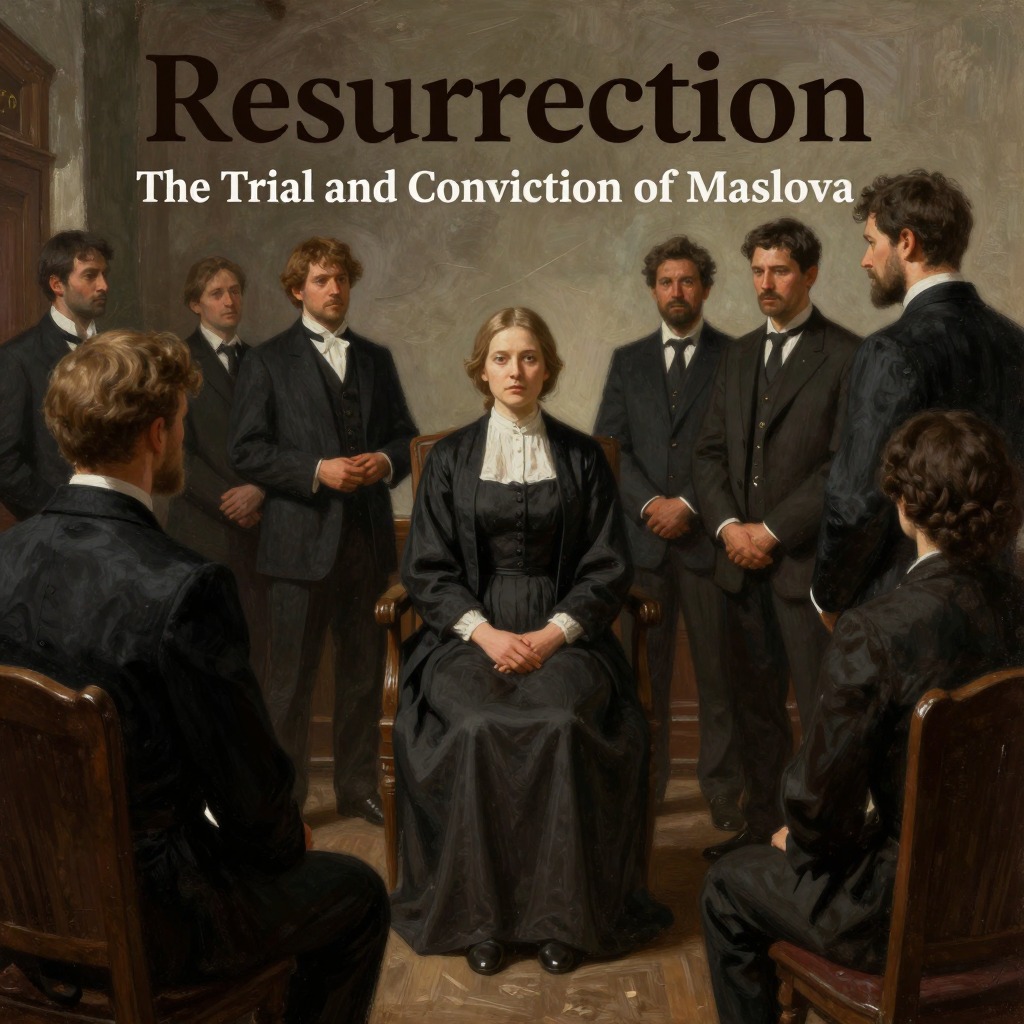
When Nekhludoff recognises Maslova in the prisoners' dock, a complicated and fierce struggle begins in his soul. He is horrified, ashamed, and afraid that his past will be exposed. During the trial, he watches her squinting black eyes and remembers the Easter night; he feels like a puppy whose master rubs its nose in its own mess. After the jury — through a careless omission — returns a verdict that condemns her to four years' penal servitude in Siberia, Nekhludoff is overwhelmed. He follows the president of the court to protest, then consults the advocate Fanarin. He goes to the Procureur and confesses that he betrayed Maslova and intends to marry her. He obtains a pass to visit the prison, and at their first interview, through the double wire netting, he asks her forgiveness. She does not recognise him at first, then smiles a luring, piteous smile and asks for ten roubles. He is repelled, but resolves to awaken her soul. He tells her he will marry her; she refuses angrily, saying, "Your price is a ten-rouble note." He persists, and after a third interview, when she has been removed from the hospital for an alleged intrigue with a medical assistant (a false charge), he forgives her and feels a love that is not for his own sake but for hers and for God's.
Relationships and Conflict
Nekhludoff's relationships with the people around him are transformed by his awakening. He breaks off his ambiguous engagement to Princess Mary Korchagin (Missy), telling her nothing definite but making it clear he cannot marry her. He ends his liaison with Mary Vasilievna, the wife of the Marshal of Nobility, by receiving a letter from her that grants him freedom. He quarrels bitterly with his brother-in-law, Rogozhinsky, a conservative judicial official, over the nature of law and punishment — Nekhludoff calls the legal system an instrument for upholding class interests, and Rogozhinsky is reduced to tears of injured pride. He gives up his luxurious town house, dismisses his servants, and arranges to let his land to the peasants at a low rent, first at Kousminski and then at Panovo, though the suspicious peasants at Panovo initially refuse his offer. In Petersburg, he petitions the Senate, the Committee of Petitions, and various high officials — including the drunken General who commands the fortress and the cynical Senator Wolf — but achieves little: the Senate rejects Maslova's appeal. He meets his old friend Selenin, now a public prosecutor, and finds him changed, sad, and entangled in religious hypocrisy. He is drawn to the beautiful, coquettish Mariette, but resists the temptation, recognising that her world is built on the same cruelty he now abhors.
Change and Ending
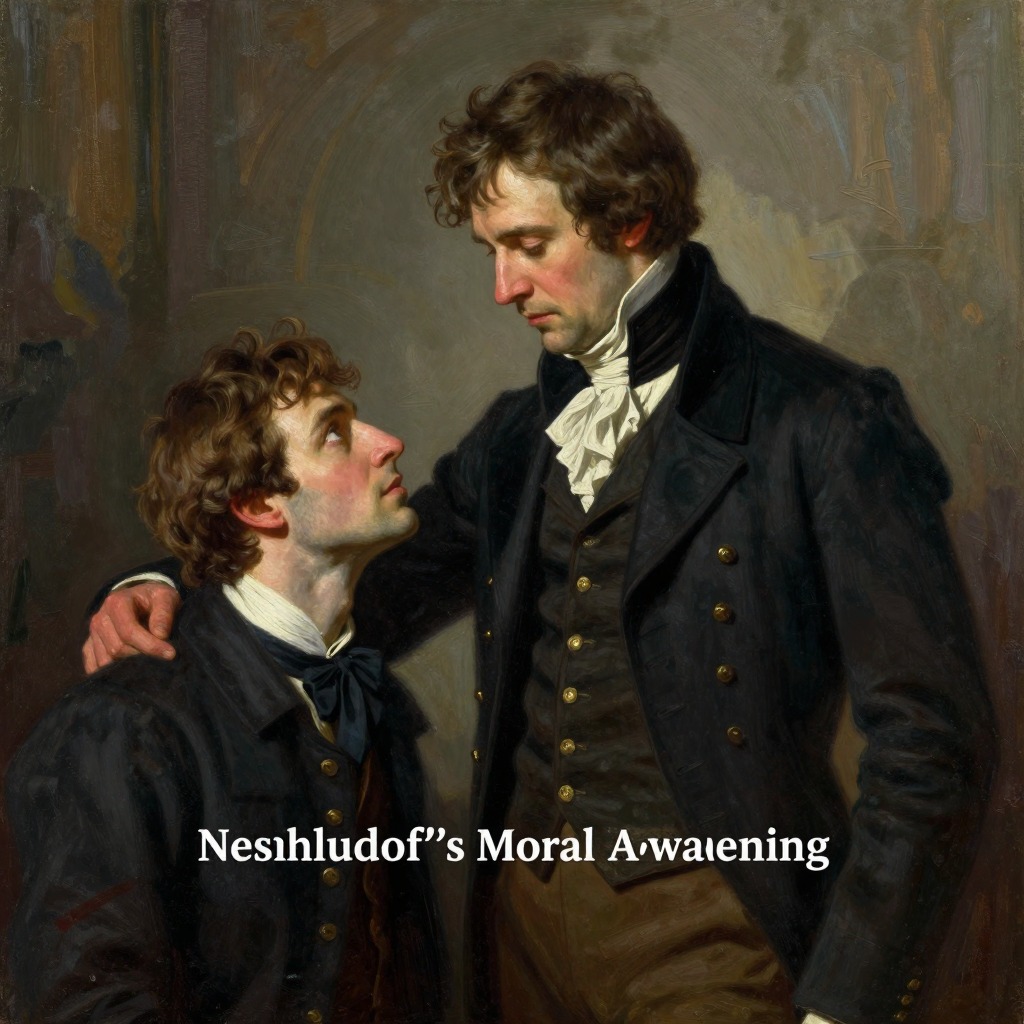
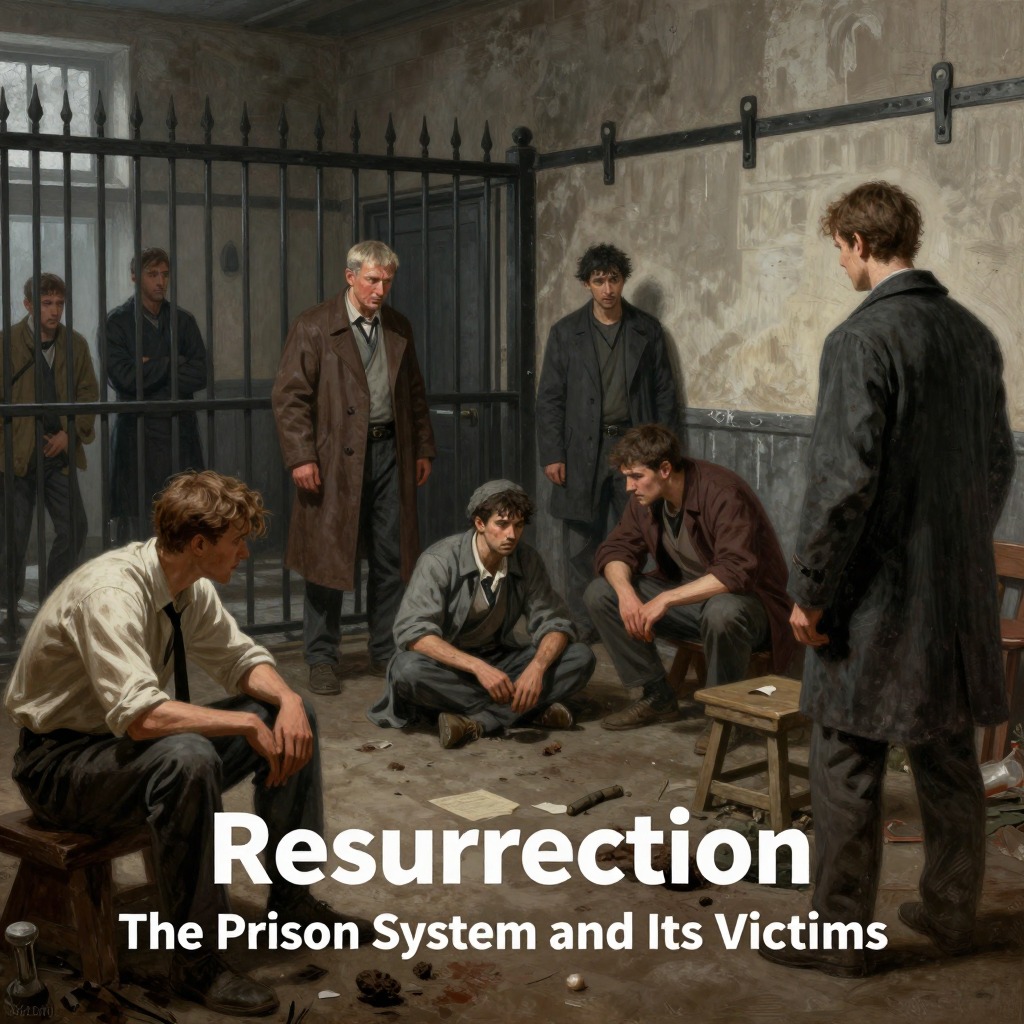
The decisive change in Nekhludoff occurs during the long journey to Siberia. He travels third-class with the peasant Taras, and his impressions of the convicts — the sunstroke deaths, the stinking halting stations, the flogging of prisoners, the dying revolutionary Kryltzoff — deepen his conviction that the entire system of punishment is a monstrous evil. He becomes acquainted with the political prisoners, especially the gentle, principled Simonson and the selfless Mary Pavlovna. Simonson tells Nekhludoff that he loves Maslova and wishes to marry her. Nekhludoff, after a moment of jealousy and shame, gives his consent. When the mitigation of Maslova's sentence arrives — commuting hard labour to exile — she tells Nekhludoff that she will follow Simonson. He understands that she is refusing him to save him from the burden of marrying her, and he feels both sorrow and relief. That night, alone in his hotel room, he opens the New Testament given him by an English traveller and reads the Sermon on the Mount. For the first time, he sees the five commandments — not to be angry, not to commit adultery, not to swear oaths, to turn the other cheek, to love one's enemies — not as abstract ideals but as practical, achievable laws that would establish the Kingdom of Heaven on Earth. He realises that the only reasonable meaning of life is to fulfil these laws, and that the only way to end the evil he has witnessed is to forgive always, because no man is without sin and therefore no man has the right to punish another. A perfectly new life dawns for him.
Thematic Significance
Nekhludoff's arc embodies the novel's central theme of resurrection — the possibility of moral and spiritual rebirth even after a long period of spiritual death. His journey from the "animal man" to the "spiritual man" is not a smooth conversion but a painful, halting process marked by relapses into pride, jealousy, and self-admiration. Tolstoy uses Nekhludoff's changing perceptions to expose the hypocrisy of the legal system, the Church, the aristocracy, and the prison administration. The character functions as a moral lens through which the reader sees the suffering of the peasants, the degradation of the convicts, and the emptiness of the privileged classes. His final turn to the Gospels is not a retreat into otherworldly piety but a radical, practical programme for social transformation: he concludes that the only place befitting an honest man in Russia is a prison, and that natural love is the fundamental law of human life. Nekhludoff's story is thus both a personal confession and a social indictment, and his incomplete but genuine awakening leaves the reader with the question of whether such a transformation can be sustained.