Princess Mary Korchagin
ResurrectionPrincess Mary Korchagin, known to her circle as Missy, is the daughter of Prince Ivan Korchagin and Princess Sophia Vasilievna Korchagin, and the woman whom everyone expects Dmitri Nekhludoff to marry. She embodies the polished, comfortable, and utterly hollow world of the Petersburg and Moscow aristocracy from which Nekhludoff is gradually alienated. Her presence in the novel serves as a foil to Katerina Maslova and as a measure of Nekhludoff's moral trajectory: the more he awakens to his own guilt and to the suffering of others, the more intolerable Missy and her milieu become to him.
Identity and Social Position
Missy is a young woman of good family, and Nekhludoff acknowledges that she differs from common people "in everything, manner of speaking, walking, laughing" — not by anything exceptional, but by what he calls "good breeding," a quality he prizes very highly. She is twenty-seven years old, and Nekhludoff's pride is wounded by the thought that she may have loved someone else before him, even in the past. Her mother, Princess Sophia Vasilievna, is a recumbent invalid who receives only "intimate friends" — those who stand out from the common herd — and who considers Nekhludoff one of these because he is clever, because his mother was an intimate friend of the family, and because it is desirable that Missy should marry him. Missy herself is very anxious to get married, and as Nekhludoff is a suitable match and she also likes him, she has accustomed herself to the thought that he should be hers. Her mother, too, maneuvers to bind him closer with invisible threads, sending him a perfumed note on thick grey paper with rough edges, written in an English-looking hand, reminding him of his duty as a juryman and inviting him to dinner.
Life and Plot Trajectory
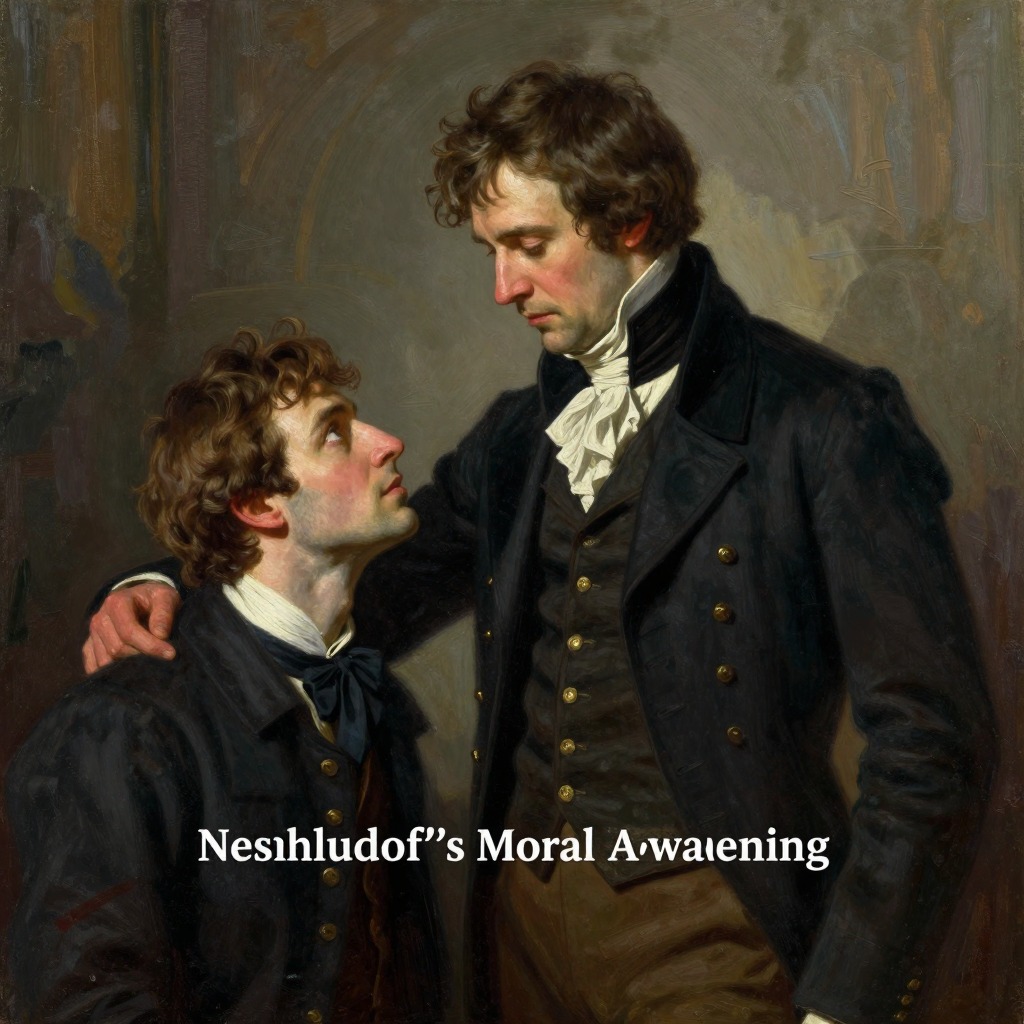
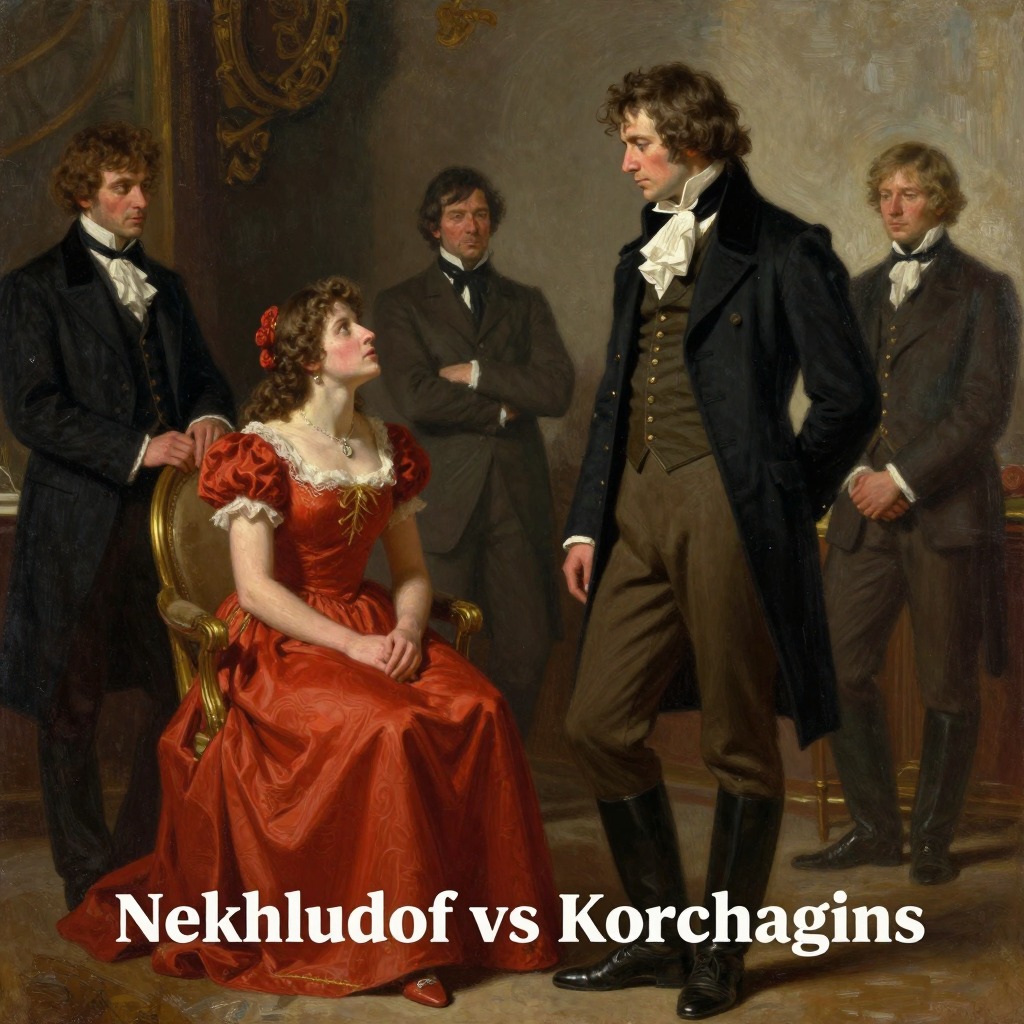
Missy appears in the novel primarily through Nekhludoff's eyes, and her presence is always tied to his internal struggle. On the morning of the trial, Nekhludoff receives her note and grimaces, recognizing it as a continuation of the skillful maneuvering the Princess has practiced for two months. He is torn: in favor of marrying Missy is that she comes of good family and thinks more of him than of anybody else, which he takes as proof of her good sense; against it is that she is already twenty-seven and that he is hardly her first love. He compares himself to the ass of the fable, unable to decide which haycock to turn to. After the trial, when he visits the Korchagin house for dinner, everything there repulses him: the self-assured, trivial liberalism of Kolosoff, the sensual, bull-like appearance of old Prince Korchagin, and Missy herself, who now seems unattractive and affected. He sees all her defects — the wrinkles of her face, which of her teeth are false, the way her hair is crimped, the sharpness of her elbows, and how large her thumb-nail is and how like her father's. When she uses the pronoun "him" to remind him of their intimacy, it strikes him as particularly unpleasant. He feels like a horse being caressed to make it submit to the bit, and he is less inclined than ever to draw. He leaves without promising to return, and later, in his moment of moral awakening, he resolves to tell Missy the truth: that he is a profligate and cannot marry her, and has only uselessly upset her.
Relationships and Conflict
Missy's relationship with Nekhludoff is built on a foundation of unspoken expectations and social pressure. She pursues him with the unconscious yet obstinate cunning of someone who is mentally diseased, as Nekhludoff observes. When she notices his preoccupied and dissatisfied look, she tries to find out what has caused it, and when he refuses to tell her, a muscle twitches in her face and she pushes back the chair she is holding. She is hurt, but she also knows that if he were to show the least weakness, it would mean disaster — it would bind him to her. Nekhludoff, for his part, is ashamed of having hurt her, but he fears this more than anything. After his awakening, he feels himself unworthy not only of marrying her but even of being intimate with her: "If she only knew what I am, nothing would induce her to receive me." The final break comes when he sees her at the railway station as he is about to leave for Siberia. She blushes when she sees him, and he notices that she is still trying to appear as if nothing has occurred. He tells her he is on the point of leaving, and she asks him to come and see her mother, knowing that what she says is not true and that he knows it also. He refuses gloomily, and she frowns angrily, shrugs her shoulders, and turns away.
Change and Ending
Missy does not undergo a moral transformation; she remains static, a representative of the world Nekhludoff leaves behind. In the final scenes, she is part of the Korchagin family's move to their country estate, and Nekhludoff sees her at the station, still beautiful, still smiling, still surrounded by the trappings of wealth — the footman, the folding chair, the doctor, the maid. Her father, Prince Korchagin, remarks to his sister-in-law, "Oh, il est du vrai grand monde, du vrai grand monde," and Nekhludoff, overhearing this, contrasts the idle, luxurious world of the Korchagins with the world of the convicts and the working people he has just left. Missy's fate is to remain in that world, while Nekhludoff moves irrevocably beyond it.
Thematic Significance
Missy functions as a narrative and moral counterweight to Maslova. Where Maslova is a victim of society's cruelty, Missy is its pampered beneficiary; where Maslova is capable of change and sacrifice, Missy is fixed in her pursuit of social advantage. Nekhludoff's rejection of Missy is not merely a personal decision but a symbolic renunciation of the entire aristocratic order. The ease and comfort she represents become, in his eyes, a form of moral corruption, and his inability to marry her is a necessary step in his spiritual awakening. Her presence in the novel thus sharpens the critique of the ruling class and clarifies the nature of Nekhludoff's conversion.