Château d'Albignac
SatanChâteau d'Albignac is an ancestral estate in the Lot whose layered history and private archives draw Loïc into the mystery of the lost Castelmont cameo. First encountered as the setting for his and Laurence’s wedding reception and honeymoon in 2003, it later becomes a place of sustained historical research and, in 2019, a prospective permanent home for Laurence’s parents. The building links domestic life to the novel’s longer histories: its rooms hold both the present-day family and traces of centuries of inheritance, upheaval, and concealed records.
Setting and architectural history
The château stands on a rocky height above the Lot River, between Calvignac and Larnagol. Its great medieval keep rises like an armored giant above a valley described through sharp contrasts: idyllic slopes give way to sheer walls, cliffs, and rocky spurs. The sudden appearance of the keep around a bend in the road makes the approach itself a kind of revelation, bringing the estate into view as an imposing structure set apart from its surroundings.
The building’s history is marked by destruction and rebuilding. Its foundations reach back to the eleventh century; fire destroyed the château in the fifteenth, and it was reconstructed in the sixteenth. In the 1920s, it was restored by the father of Hervé d’Albignac, a colonel who had been wounded and decorated in the First World War and inherited the property. The estate thus carries visible layers of medieval origins, later reconstruction, and modern restoration rather than belonging to a single historical moment.
The family associated with the château had nearly been decimated during the French Revolution, while its earliest traces in the region reach back more than a thousand years. The surrounding area had become an important stop on the road to Compostela, and a millennium of regional history had been celebrated at Rocamadour ten years before Loïc’s 2003 visit. The estate’s inherited title and its long family chronology make the house a repository of both local memory and aristocratic survival.
Wedding, rooms, and family life
At the end of May 2003, Loïc and Laurence married in a discreet ceremony attended by a small group of relatives and friends, marking the first anniversary of their meeting. They then travelled to France. Laurence’s parents had announced the marriage in the Figaro’s daily notices and arranged a reception in the family château, where the newlyweds were to stay for three weeks before continuing with summer sightseeing.
On their arrival, the count showed them around and offered a choice of three bedrooms. One was known as Henry IV’s room, named for the king who, according to the château’s tradition, had often stayed there because he was enamoured of the woman who owned the estate. The figures and monograms on its ceiling were still presented as evidence of the royal connection. Loïc and Laurence instead chose a larger room suited to a honeymoon: it contained a four-poster bed whose golden-yellow silk canopy gathered into folds like rays converging on a central knot. The choice establishes the château not only as a historic monument but as a private domestic setting for the couple’s new life.
The house is also inhabited by a sense of accumulated time. Loïc perceives a subtle ghostly presence in its creaks, sliding sounds, and unexplained breaths. Those impressions accompany, rather than replace, the building’s documented history: the château contains descendants of a family that survived revolutionary violence, and its long past is materially present in its architecture and rooms.
The library and the search into the past
Hervé d’Albignac tells Loïc that the lost cameo is an open secret among descendants of the former nobility in the region. His own career in the French museums administration, including international cultural work, has given him broad knowledge of the country’s historic buildings, artifacts, and collection jewelry. For Loïc, the meeting seems providential: the château has brought him into contact with someone whose family background and professional experience may supply a missing link in the cameo’s history.
Hervé directs Loïc to investigate the family’s past back through the Revolution and beyond. He points him toward the memoirs of the Marquise de Créquy, a distant relative whose account covers the eighteenth century and the first years of the nineteenth. He also explains that papers have accumulated for centuries in cupboards and concealed closets throughout the château’s roughly forty private rooms, spaces not opened to tourist visits. The records include land registers and correspondence, while a history student from the Lot has been hired to sort and catalogue the disordered archive. Hervé had long wanted to undertake the work himself but had never found the time. He hopes that diaries, family chronicles, letters, or travel notes might surface among account books, reports, and business papers.
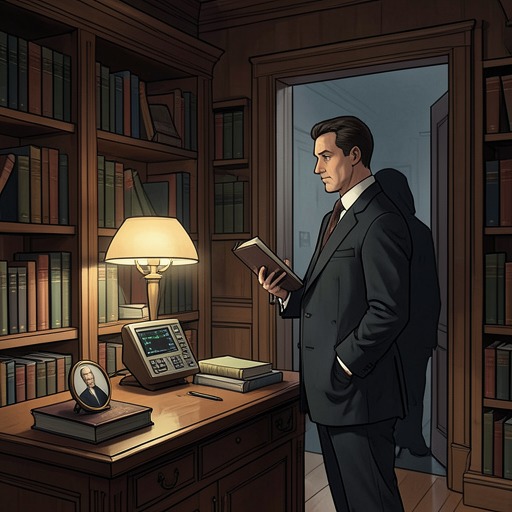
Loïc makes the old library his own daily research ground, spending at least a few hours there. Large windows look onto a row of beeches, while shelves along three walls hold old leather-bound books alongside recent glossy publications. He begins by browsing at random to understand the collection and how its volumes are arranged, then immerses himself in earlier periods through folios bound in morocco or vellum and smaller-format books. Ex-libris marks and elaborately flourished signatures give him a sense of the people who once handled the volumes; the library turns historical inquiry into a close encounter with the material traces of past lives.
Among his first sustained reading is the ten-volume memoir of the Marquise de Créquy, in an 1840 edition, which he reads rapidly and somewhat diagonally using a technique learned at university. He also finds an 1838 edition of Mémoires tirés des archives de la police de Paris, depuis Louis XIV jusqu’à nos jours. That book seems potentially relevant to the violent rivalry he suspects between Castelmont twins in the nineteenth century. In the memoirs, he discovers that the marquise met the Countess of Castelmont at the Palace of Luxembourg, then used as a prison during the Terror. The countess spoke quietly of her twin children, who had escaped the family’s decimation in 1793. The château’s library therefore becomes a point of entry into a history that is not confined to its own walls.
Return and continuing significance
In April 2019, the château reappears in Loïc and Laurence’s life as a possible permanent residence for Laurence’s parents. Loïc, who has arrived from Montreal the previous day, is in Paris for a day before he is due to join Laurence in the Lot. Her parents are spending Holy Week at the château while preparations are made for Hervé’s ninetieth birthday. They are considering moving there permanently with domestic help because Paris seems increasingly unsafe, and they have put their Quai Saint-Michel apartment up for sale.
The château also frames the couple’s response to a distant catastrophe. When Notre-Dame de Paris catches fire, Loïc watches the blaze from the apartment and calls Laurence to warn her. The following night, he and Laurence are already in the Southwest, not far from Château de Barzac, when that estate is consumed by a devastating fire. They have just arrived at Château d'Albignac to help Laurence’s parents rearrange rooms for their planned move. The count wakes them with news of the destruction; Loïc checks the reports on his tablet, and the family follows the coverage through the day. Within the novel’s pattern of endangered historic buildings, Château d'Albignac is at once an old inheritance under consideration as a refuge and the surviving household from which the destruction of another château is witnessed through news reports.