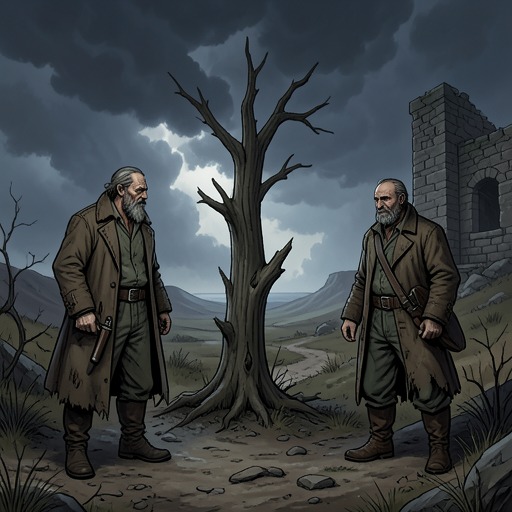
Carthage, Missouri, Site of the 1842 Castlemount Ranch Raid
SatanCarthage, Missouri, Site of the 1842 Castlemount Ranch Raid is presented as the starting point of a violent but poorly documented episode that may connect a frontier family to the later history of the D’Anjou and Castelmont lineages. The novel first stages the raid as a scene from the past, then complicates it through contradictory newspaper reports and Loïc’s archival research. The place matters not only as the alleged site of an attack, but as the origin point of an unresolved history of flight, uncertain identity, and possible concealment.
Setting and Historical Geography
The raid is dated November 2, 1842, and placed at a ranch roughly eight to ten miles south of Carthage, in an isolated part of Missouri near what is now Oklahoma. The account situates the settlement within the wider frontier region traversed by the Santa Fe Trail, connecting Missouri with the Southwest. It describes raids on travelers and white settlements as part of the period’s violence, giving the ranch’s location a broader context without establishing that this particular attack happened as first reported.
The novel’s geography becomes consequential when Loïc considers what followed. He reconstructs a route from the ranch northeast to Florissant, near St. Louis, where the Religious of the Sacred Heart of Jesus had established a school for girls and a novitiate. In his account, the distance was nearly five hundred kilometers. Carthage is thus both a named frontier settlement and the beginning of a journey across a large, hostile landscape.
The Reported Ranch Attack
The narrative’s initial reconstruction places about fifteen riders near a clearing at dawn. After the ranch’s dogs bark, gunshots announce the riders’ arrival; flaming arrows then set the buildings alight as Sioux warriors enter the ranch. The owner, described as a sixty-year-old Frenchman, orders his workers to gather available weapons, release the horses and livestock as a barrier, and shelter the women and children in the house. He tries to defend the ranch, but is overwhelmed. The scene presents the ranch as a working household with enslaved Black workers, women, and children, not simply as a building isolated on the prairie.
A few days later, a short report in a Bowling Green, Missouri, weekly gives the attack a public record. It says that a party of Indians attacked Mr. Castlemount’s ranch around six in the morning, burned the dwelling and barns, and was presumed to have killed the owner, his wife, their children, and at least six other people, mostly Black. The report also says that horses and cattle were taken and that thirty dragoons were sent in pursuit. It records no confirmed account of their return. The newspaper’s wording is important: the deaths are reported as presumed, rather than established by identified remains or witnesses.
Conflicting Records and Possible Identity
In the next issue, the same paper published a correction based on a county sheriff’s statement. It said an Indian attack had not been proved, that natural causes might have started the fire, and that nobody might have been at the ranch when it burned because no bodies had been found in the ruins. The correction turns the supposed massacre into a disputed event. The location remains identifiable, but the cause of the destruction, the fate of the household, and even the presence of its occupants are left uncertain.
Loïc finds no related judicial records in the Missouri archives he searches and no corroborating account among several other newspapers from the state that he consults online. He interprets the correction and the gaps in the record as possible signs that the affair was deliberately suppressed, and suspects that local authorities may have been corrupt. These are his conclusions, not facts independently confirmed by the novel’s archival evidence. The shifting account of Carthage therefore makes the limits of the surviving record part of the mystery.
The proposed owner’s identity is uncertain as well. Comparing censuses, land records, and public documents, Loïc finds Louis de Castelmont, a French aristocrat who had settled in the United States and become a western pioneer. He judges it likely that Louis de Castelmont is the rancher referred to in the paper as Mr. Castlemount, but the identification remains a hypothesis. Loïc’s online search also leads him to the present-day Charles de Castelmont, a Bordeaux-region vineyard owner. He wonders whether Charles possesses the other twin cameo, but the connection is not established by the evidence surrounding Carthage.
The Flight North and the Location’s Narrative Role
The ranch’s uncertain history intersects with Loïc’s effort to explain a young woman’s arrival at Florissant with a baby. He suspects she had reason to fear for both their lives and sought protection from the Religious of the Sacred Heart of Jesus rather than from local civil authorities. In his reconstruction, she travelled almost five hundred kilometers northeast from Carthage, avoiding settlements she might consider hostile and crossing the Ozark plateau before following the Missouri River for part of the way.
The journey, as Loïc calculates it, took twenty-six days: nearly twenty kilometers a day. He reasons that fear might have driven her to travel quickly, while allowing that she may have covered some stretches in a carriage or on a horse or mule, perhaps with help from strangers. He further connects her journey to a snowstorm and her death less than a kilometer from the convent. These details form Loïc’s reconstruction of a plausible route, rather than a fully documented itinerary.
Carthage consequently anchors several layers of the novel’s inquiry: the vivid first telling of the ranch’s destruction, the newspaper’s later retreat from its own account, and Loïc’s attempt to connect a suspected survivor and child to the Castelmont name. Its significance rests in that tension between a precise place and an incomplete history. The more Loïc uncovers, the less securely the event can be stated, even as the possibility of a connection to the family’s past grows.