World Trade Center complex
SatanThe World Trade Center complex is both a real setting of catastrophe and a narrative hinge: its destruction appears to swallow Roger Bolduc and a family cameo, yet neither disappearance proves final. The towers turn a private jewel conspiracy into a public tragedy, connect Loïc Bolduc’s unsettling dream to events in New York City, and establish a pattern of destruction from which the stone may—or may not—emerge intact.
The towers as a meeting place
The complex enters the plot through a planned meeting on September 11, 2001. Roger Bolduc had an appointment in New York City with a man named Patrice Desbois, whose telephone number carried a French country code. When Georges D’Anjou learned of the appointment by examining Roger’s computer with police assistance, no location was recorded—only the date and city. A call to Desbois’s number produced an automated message that service had ended, leaving the meeting’s purpose and its intended venue unclear.
Georges’s further inquiries supplied a more troubling connection. Desbois appeared to be a European contract employee or associate of Berkshire Funds and sometimes rented an office for New York business. The company’s offices were in the North Tower, on the 99th floor—the very tower struck by the first plane. The address did not establish that Roger had gone there, but it gave the family’s search a precise and ominous possibility.
The planned meeting was part of Charles de Castelmont’s effort to recover a cameo he considered invaluable to himself and his family. In a recollection of that day, Charles is at the Château de Barzac, waiting for the arrangement to reach its conclusion. His friend Pierre de Mirbeau had told him that their representative, Franck Aubry, and an assistant were waiting for Bolduc in an office at the World Trade Center. Charles had chosen the location to impress the Quebecer and had spent years arranging the scheme. The appointment therefore brings two lines of the story together: Roger’s unexplained New York journey and Charles’s covert attempt to obtain the jewel.
September 11 and the lost transaction
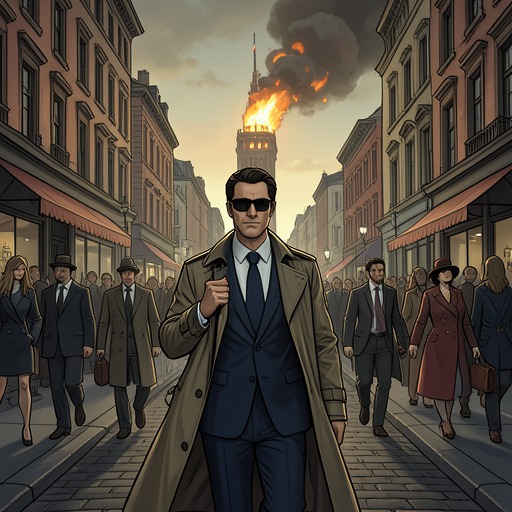
As the attack unfolded, the World Trade Center became a televised image of mass destruction. The narrative notes that the first plane struck at 8:46 a.m.; the towers’ burning and the repeated broadcast footage make the moment impossible for Loïc to regard as merely distant news. His nightmare had coincided with the time of the first impact. He wondered whether he had experienced a chance coincidence or a telepathic intrusion into another person’s mind, perhaps at the moment of death. The place thus bears not only the visible catastrophe but also Loïc’s unresolved sense of a connection across distance.
At Château de Barzac, the same events first register as a threat to Charles’s plans. He tries to determine which floor held the appointment and how high the plane struck the North Tower. News reports speak of thousands of possible deaths and of the many people who worked in the towers each day. Charles’s first and most urgent concern is the cameo, ahead of the lives of Aubry, the assistant, and Bolduc. As reports of further hijackings and an emergency evacuation of Congress widen the crisis, even his focus shifts; when the towers collapse one after the other, he understands that the jewel may be lost beneath the wreckage. His repeated calls to Pierre de Mirbeau cannot alter what has happened.
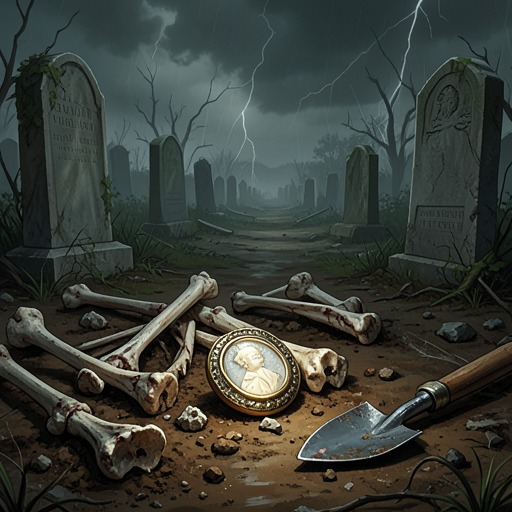
That reversal gives the complex a particular role in the plot. It is where an elaborate transaction was meant to succeed, but the catastrophe makes the outcome unknowable. The collapse seemingly erases the distinction between a failed deal, a missing man, and an object buried among human and material remains. Charles laments the cameo, while the novel leaves the fates of the people meant to handle it uncertain at this point.
A contested grave for the cameo
The jewel’s subsequent history makes the World Trade Center more than a presumed endpoint. Rodrigo Lerbier tells Loïc that a cameo passed into the hands of a Cuban émigré who had spent about twenty years dealing in antiques in Kansas City, returned clandestinely to Cuba, and died in an extraordinary combustion in Cárdenas. Rodrigo could recount what followed that death and the cameo’s later burning in Havana, but could not explain how the stone had travelled from Ground Zero into the antique dealer’s possession. Its extraction from the debris, and the route between New York and Cuba, remain gaps in the account.
Loïc is especially struck by how close he came to recovering it. The babalao, a distant cousin, had offered him the jewel; shortly before that offer could be accepted, it disappeared again. Loïc had believed the family object buried in the World Trade Center ruins, then learned that it had survived into a sequence of events that brought it within reach. He wonders whether the stone’s influence had drawn him toward it, or whether his own altered state had coincided with its burning. These are his questions, not settled explanations, and the place’s importance lies partly in the unanswered passage from rubble to Cuba.
The uncertainty deepens when Isabelle D’Anjou later tells Loïc that a cameo has been found in New York and delivered to Quebec intact, apparently having survived the explosions, fire, and collapse. Loïc cannot tell whether this is the original stolen jewel, a counterfeit, or another stone altogether. In Barzac in 2003, Charles de Castelmont identifies the New York cameo he has received as a fake, even though the Quebec family had revered its own object as a treasured link to an illustrious French ancestry. The two claims prevent the complex from serving as a simple place of recovery: it is associated with an apparently surviving cameo, but survival does not resolve authenticity or establish that the same object travelled to Cuba.
Repeated collapse and narrative significance
The World Trade Center’s destruction becomes a measure against which the novel imagines later disasters. Eighteen years afterward, the Château de Barzac is destroyed by an explosion and fire. Loïc compares its collapse to that of the towers and wonders whether the paired cameos, displayed together shortly before the château’s destruction, were destroyed as well. He speculates that the stones might have accumulated and released a force of their own, but the novel presents this as his conjecture rather than a demonstrated cause. The resemblance between the two sites intensifies the cameo’s supernatural associations without resolving them.
The later uncertainty returns to the debris itself. Loïc considers that the cameo may have remained beneath the World Trade Center ruins, despite the account that it was found intact in New York. He entertains the possibility that the stone could survive even a catastrophe vastly larger than the destruction at Barzac. The apparent contradiction is part of the location’s narrative function: the complex is at once a mass grave, a possible hiding place, and a point of origin for competing stories about the object.
The attacks also return through public memory. Years later, a journalist’s account of Roger Bolduc’s disappearance amid the World Trade Center attacks expands the scandal surrounding the D’Anjou family. The original question of Roger’s fate becomes entangled with speculation about other family events, and the multiplying reach of news and online media magnifies the accusations beyond what the known facts can establish. The World Trade Center therefore connects private uncertainty to public scrutiny: an unexplained appointment and an unaccounted-for man become part of a much larger story whose visibility does not guarantee clarity.