Havana
SatanHavana is where the novel’s search for the Founder’s cameo crosses paths with Santería, clandestine politics, and a chain of threatened lives. The city brings together Loïc, Laurence, Rodrigo Lerbier, and Isabelle, while its cemetery, cathedral, and Yoruba sanctuary turn separate lines of inquiry into a shared and increasingly dangerous history.
A city of overlapping routes
Havana is both Rodrigo’s home and a place to which characters arrive with different purposes. Loïc and Laurence have visited before, but return on an excursion organized by Manuel, whose planned tour of the historic districts gives them a reason to remain in the city. Their particular interest is a Santería ceremony: Manuel has discussed the Yoruba religion with Loïc and tells him that his cousin is a babalao, or Yoruba priest, who grew up with him in Cárdenas, near Varadero.
The city’s routes become a quiet pattern of convergence. At the entrance to Colón Cemetery, Manuel meets the couple and explains that Oya guards the cemetery gate. A long blue Mercury from the 1950s then takes them to a popular neighborhood for the ceremony. At the gathering, Loïc recognizes Isabelle, who wears a white head covering like those worn by other women present. They both pretend not to see one another, avoiding an awkward encounter between couples. Only later does Loïc understand the full improbability of their simultaneous presence: the Founder’s cameo is nearby, and three descendants of the Founder are in Havana together without realizing it.
Rodrigo’s sanctuary and the cameo
After the ceremony, Manuel introduces Loïc and Laurence to Rodrigo Lerbier. Walking toward the bus that will return them to Varadero, Loïc feels an immediate kinship with Rodrigo and asks him about Yoruba religion. Then he abruptly asks whether stones can contain malign forces. Rodrigo is unsettled, but answers that stones can concentrate powerful positive or negative energies. Loïc cautiously describes a family jewel, without naming it as a cameo, and says it belonged to his great-grandfather and had brought harmful effects upon the family. He withholds its disappearance in New York on September 11, 2001.
Rodrigo’s knowledge is not theoretical. He had encountered the jewel in Cárdenas after the sudden, unexplained death of Cardoso, who had bought it in Kansas City. Returning temporarily to his hometown to visit his sick mother, Rodrigo was carrying the jewel in a handkerchief and felt its negative energy. He considered whether Santería might harness its extraordinary ashé energy for its practitioners, provided the stone were kept in a sacred Yoruba place. Seeking guidance through Ifá divination, he received a terrifying vision: Chango appeared amid infernal flames and warned that the stone belonged to evil forces. It could transform reality for someone who knew how to use it, or destroy someone who did not. The vision also warned that a Yoruba shrine housing it would need offerings, preferably human and otherwise animal, to appease the spiritual appetite within the stone.
Rodrigo’s Havana premises combine everyday work and religious practice. His building serves as his residence and workshop, where he makes tourist jewelry from shells and small stones; a separate room is a Yoruba place of worship. Caged chickens and pigeons are kept there for sacrifices. The cameo is displayed high on the rear wall in a golden reliquary among images of the orishas and offerings, deliberately kept out of reach. Rodrigo knows its danger and tries to contain it. After Loïc and Laurence leave, however, he sees the stone glowing like an ember and giving off smoke. His instinctive sign of the cross joins his Catholic reflex to his Yoruba priesthood, showing that the threat exceeds the boundaries of either religious practice.
Covert politics and surveillance
Havana’s religious networks intersect with the novel’s political underworld. An American chargé d’affaires in the city has a CIA agent as an aide, and the agency uses a Spanish double agent with access to the Castro government. Through this network, the authorities trace Cardoso’s movements, learn of his strange death in Cárdenas, and discover that the jewel he bought in Kansas City came into Rodrigo’s possession. An operative then follows the babalao.
A separate, concealed opposition network also has roots in Havana. A covert dissident and his associate hold senior positions within the Castro regime while maintaining links to Cuban Freemasons in Florida and elsewhere in the United States, organized through the Grand Lodge of Cuba in Exile. Their purpose is to prepare for a political order after Castro. These intersecting operations make the city more than a setting for private religious encounters: its streets and institutions are also traversed by surveillance, opposition, and efforts to shape Cuba’s future.
That pressure is visible in Manuel’s unease. On the day of the ceremony, he has learned that the government has arrested dozens of dissidents, including journalists and friends, in one of the severest crackdowns since the regime began in 1959. The arrests have not yet become public news. Manuel keeps silent, especially around tourists. The ceremony unfolds amid a danger that its visitors can sense only incompletely, while Rodrigo’s suspicions about being watched acquire a political as well as supernatural context.
The cathedral and the returning past
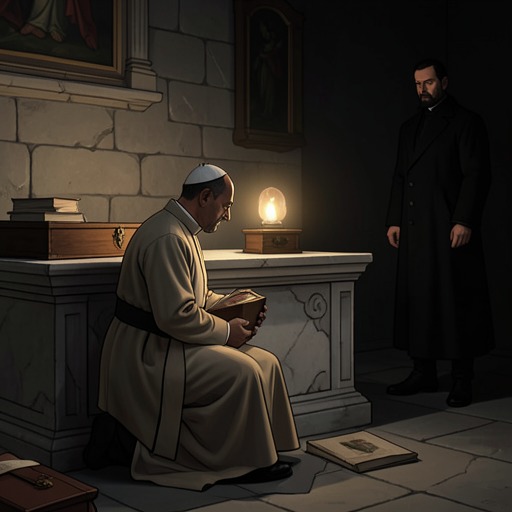
Years later, the streets around Havana’s cathedral become the site of another convergence. On February 10, 2016, Aurelio leaves the cathedral after imagining a renewed Christian faith practiced outside what he sees as a spiritually exhausted hierarchy. In the arcades, shadows move behind him. He turns toward the lit square, but an assailant grabs him from behind and cuts his throat; Aurelio dies on the paving stones as the killer escapes into the streets behind the church.
Rodrigo, waiting for Aurelio to return from Ash Wednesday services, grows alarmed. He and Aurelio have both felt watched, and distant police sirens intensify his foreboding. Near the cathedral, Rodrigo finds a crowd held back by security officers and learns that a young man has been killed. The old paving stones are wet with blood. Worried that the victim is his friend, Rodrigo is asked to identify the body at the hospital morgue.
The murder also reopens Rodrigo’s memory of the cameo’s disappearance. More than a decade earlier, in March 2003, he had wondered who could have stolen the jewel from his modest Yoruba temple in Cárdenas. He reconstructed the opportunity: he had brought it from the capital before dawn, left it at the temple, and gone to sleep at his mother’s home. A person following him could have entered in darkness, while the streets were empty. Rodrigo had even considered whether the theft might have freed him from a cursed object, though he could not dismiss the possibility that the thief knew his movements and the circumstances of Cardoso’s death. In the years that followed, his nearly completed apprentice Aurelio disappeared from the Havana temple’s training, and Rodrigo searched for him, eventually suspecting his former protégé might have taken the cameo.
Consequences and significance
When Aurelio returns to Rodrigo months later, destitute and badly altered, his appearance forces Rodrigo to connect the disappearance with the young man’s long absence. The later killing makes that connection more terrible: Rodrigo and Loïc suspect revenge by the sect, and Rodrigo fears for his own life. Loïc, who never knew Aurelio, sees him as another victim added to the growing toll associated with the cursed stone and worries that Rodrigo may suffer the same fate.
Havana’s significance lies in the way it gathers apparently distinct histories into the same urban space. The cemetery leads to a ceremony; the ceremony brings Loïc into contact with Rodrigo; Rodrigo’s sanctuary gives the cameo a religious setting; and the cathedral becomes a place of surveillance, murder, and news. The city’s public religious landmarks and hidden networks coexist with Rodrigo’s private attempt to confine the stone. That attempt does not end the danger: the cameo’s movement and the people drawn to it continue to bind Havana to the novel’s wider story of family inheritance, political secrecy, and supernatural harm.