Touladi
SatanTouladi is the rural village where Loïc grows up among the D’Anjou and Bolduc families, and where the novel’s private histories become public struggles over inheritance, memory, and belonging. Its exposed houses, surrounding forest, and close-knit streets are not merely a backdrop: storms, political rivalries, family deaths, and new technologies repeatedly alter what the village means to its inhabitants. The rise and disappearance of the Founder’s House trace a parallel arc, from ancestral center to ruin, as the old D’Anjou presence in Touladi dwindles.
Landscape and the Village in 1944
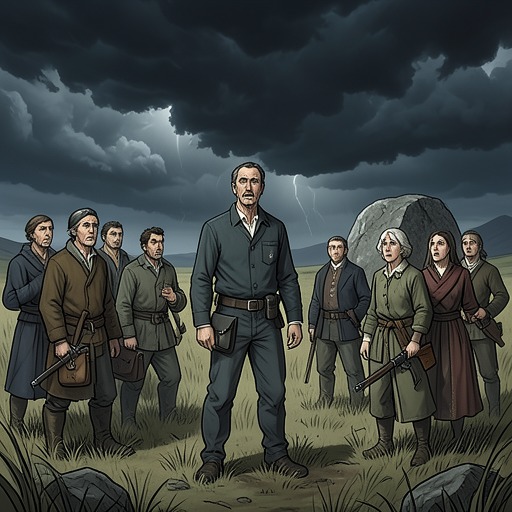
On November 13, 1944, Touladi is struck by a violent storm that begins with an uncanny stillness. Noé Bolduc, an early-rising bachelor, notices his cat acting nervously before a furious wind and hail sweep across the village. Roof timbers creak and beams groan; dogs bark, frightened cats race through houses, and branches and commercial signs are torn loose and hurled against buildings and cars. The houses begin to move as the ground shakes. The inhabitants, sheltering indoors, wonder whether the war in Europe and Asia has somehow reached them; Noé thinks of German submarines reportedly seen in the St. Lawrence near Rimouski. At dawn, the wind abruptly subsides and quiet snow falls, but a piercing cry carries across the village. The scene establishes Touladi as a community where natural violence is experienced collectively and interpreted through both contemporary fears and supernatural beliefs.
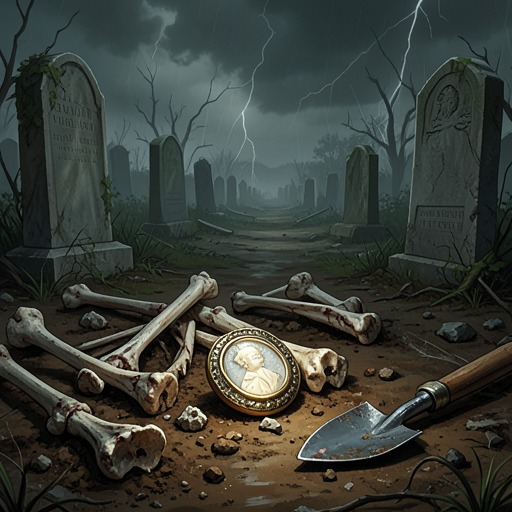
Five days later, on November 18, a family gathering in the Founder’s House gives the village’s upheaval an ancestral dimension. Around a long oak table, Guillaume carefully takes a mysterious cameo from a makeshift wooden case and displays it to about twenty D’Anjous summoned from town and the woods. The jewel raises questions about the Founder’s hidden origins: why he kept it secret until his death, and whether it supported long-standing rumors that the celebrated founder of Touladi had an unknown ancestry. The storm and the discovery are distinct shocks, but both make the village’s apparent solidity seem uncertain: the land itself has shaken, and the family’s account of its beginnings is now in doubt.
Childhood, Darkness, and a Bird’s-Eye View
During the winter of 1949–50, Touladi still has no electricity. Autumn and winter nights close in for long stretches, while violent winds batter house frames and make the village seem vulnerable to the surrounding forest. Loïc rides his tricycle from one dark room to another, orienting himself by Guillaume’s baritone singing in the living room. He dreads passing beneath the immense portrait of the Founder: flickering oil lamps animate the stern face and the cross on the Founder’s coat, making the portrait seem to watch him. In Loïc’s imagination, the forest around Touladi holds dangerous beasts, and night brings the village close to chaos and wilderness.
On October 13, 1951, a flight gives Loïc a sharply different view of the settlement. After a day that has included an earthquake, his father pilots a plane above the lake and forest, then turns back toward the village. From above, Loïc recognizes the Charron farm at the junction of the Biencourt road and the route toward the village. Touladi appears as rows of small houses following the bends of a lake and two rivers before gathering more tightly around the church. He identifies his own home among the elms and cherry orchard, at the cemetery road’s junction with the bend in the main street; his grandfather Bolduc’s house stands at the village’s eastern end, and his father’s house, where people say Loïc was born, is almost opposite it. The aerial perspective makes homes seem fragile and miniature, but Loïc also imagines the lives and memories contained within them. The houses hold whole inner worlds, and, if the earthquake had shaken them harder, they could have become coffins.
That same day, the family conflict between Guillaume and Alcide erupts in the main street. The two brothers-in-law exchange curses and insults while villagers watch from behind their windows. They stand in the roadway like opponents in a duel, with a dozen houses along the route and shadowed observers behind the glass. At moments Alcide advances and Guillaume turns back with a raised fist. Guillaume holds Loïc by the hand and leads him away from the cursed fire nearby; Loïc feels fear and shame, and sees his brother Maurice and his cousins following at a distance. His aunt Germaine, Alcide’s sister, has long urged her brother to reclaim his children, especially Loïc, whom she believes the D’Anjous are turning against his father. The public street makes a private dispute into a spectacle watched by the whole village, while Loïc’s divided family affiliations become physically visible in the distance between the two men.
Political Rivalry and the Supernatural Village
By the summer of 1952, Touladi’s family divisions are entangled with provincial politics. Guillaume’s near-fatal heart attack alarms the D’Anjous not only because he is the first heir of the senior branch, but because the mysterious cameo has become the family’s Holy Grail and a possible proof of aristocratic descent. Relatives discuss whether the jewel should be moved out of Touladi and whether the Québec branch would be better placed to guard it. Guillaume’s recovery early in the new year ends that debate, although he returns to Touladi at the end of winter markedly thinner, stooped, and frail. The coming provincial election threatens to intensify conflict between the Bolduc and D’Anjou families.
The Grébiche gives that political conflict a supernatural vocabulary. From the outset of the campaign, she declares around the village that the election has been prepared amid misfortune following the quarrel between Loïc’s fathers and will end badly. She claims that the dead are no longer resting in their graves and that their shadows pass through her cats’ night-seeing eyes. Some residents mock her, while others remember her earlier campaign against a proposed hydroelectric dam that would have flooded the village. Then, she had invoked the Founder, whom she said she had seen angered in a dream, and threatened to set spirits against those who supported the inundation. Her loyalty to the Founder’s legacy also makes her a fierce opponent of the Bolduc brothers’ efforts to secure control of Touladi. She pursues Romuald with public insults and calls him the Antichrist; he tries to ridicule or evade her, and his attempts to use force against her have backfired. The village’s political life thus carries older disputes over land and memory alongside the visible contest for power.
Television and a Changing Commons
On November 21, 1954, the Founder’s House becomes the first home in Touladi to receive television. Guillaume has a tall mast erected beside the house, with a many-branched antenna pointed due north to catch signals from Rimouski. He orders a large, varnished cube with a glass screen and places it in the living room beside the Founder’s portrait. On the autumn Sunday when the set is expected to work, Loïc waits with his cousins for its screen to flicker. About a hundred people arrive, many hours early; those who cannot get inside gather outside the windows. The occasion draws the village into one house, much as a public gathering might, but its new object of attention is a screen rather than a ceremony or a family heirloom. The Sunday, formerly reserved for the Lord, now accommodates the arrival of a new popular attraction.
The television’s presence also marks a wider change in how people experience distance. Later, Loïc thinks of Laurette, who was so susceptible to travel sickness that she rarely left Touladi; the farthest she had gone was Rivière-du-Loup, by ambulance. Yet television had allowed her to imagine that she had traveled widely. In this way, the village’s new connection to images offers an escape without requiring departure. It also contrasts with the intimate, face-to-face world of the older community, whose inhabitants had once assembled in a home to witness a single shared event.
Death, Dispersal, and the Founder’s House
In December 1964, Guillaume leaves alone for the Pain-de-Sucre forest and does not return. The next day, his jeep is found at the edge of the woods; he lies nearby with an old hunting rifle fallen from his hands, and a large male deer shot in the chest rests about twenty meters away. The likely cause is a heart failure: he had not taken his nitrate capsules in case of an attack, perhaps deliberately. His death in the woods recalls that of his father, Égide, almost forty-four years earlier. The news reaches Loïc in Montreal, where he is finishing his classical studies. At Guillaume’s funeral, the mourners include relatives and friends from far away, as well as Brunswick Company executives who travel from Campbellton, Bathurst, and Saint John to honor the hunting and fishing guide who had led their expeditions. The attendance shows the reach of Guillaume’s relationships beyond Touladi even as the local family succession approaches its end.
The family’s dispersal becomes visible in the funeral cortège, formed by the Brunswick executives’ limousines, the Bolduc brothers-in-law’s Cadillacs, and the D’Anjous’ fine sedans from Québec. Régis cannot attend because he is in California at a conference on cybernetics, serving as a delegate to a government commission on education reform. Loïc, who knows Régis mainly by reputation, distinguishes him from the Québec D’Anjous he instinctively dislikes. That aversion deepens after the funeral: Georges D’Anjou takes the cameo to Québec almost immediately after Guillaume is buried. Loïc objects not to the possibility of transferring the jewel, but to the haste and disrespect he sees in removing it while Guillaume’s body is scarcely buried. He is not consulted, and understands that the family regards him as negligible both because he is young and because he does not bear the D’Anjou name.
After Marie-Louise dies and Laurette moves away, the Founder’s House stands empty and deteriorates. Romuald Bolduc wants to buy it, but the D’Anjous refuse. An ensuing fire destroys the old ancestral house completely. The D’Anjous suspect arson and blame Romuald, who is systematically acquiring houses and properties across the village, but his local dominance makes proof difficult to obtain. Loïc is ultimately left to sell the ruins and land to his wealthy uncle, reluctantly and with revulsion, because no other buyer comes forward. The family keeps the land for a time; then municipal pressure forces a sale, since the D’Anjous do not intend to rebuild. They agree to sell on the condition that a memorial stele honor the village’s founder, but Romuald, as mayor, firmly opposes the proposal and has it rejected shortly before his death.
The burial of Laurette completes the withdrawal of Loïc’s adoptive family from Touladi. Her coffin is placed in the cemetery’s charnel house until the ground thaws, and only a small group of elderly friends attends the quiet ceremony beneath a veiled sun. The Québec relatives are absent, while Régis, away on a Senate mission in Australia, sends a large floral arrangement and an homage read from the pulpit. With Laurette’s death, the family that raised Loïc is, in the narrative’s terms, erased from Touladi: the house is gone, and the Founder’s portrait has been moved to Québec, to the judge’s home. Driving back to Montreal through heavy rain, Loïc feels the loss not only of people but of the witnesses and landmarks that had anchored his childhood. Touladi’s transformation therefore registers as both material and historical: homes, family presence, and inherited customs disappear, leaving the village unable to preserve even a public monument to its founder.