Guillaume’s Chronic Heart Disease and Physical Decline
SatanGuillaume D’Anjou’s chronic heart disease is a recurring physical vulnerability that reshapes family life and gives Loïc an early, frightening experience of separation. A heart attack in 1951 nearly kills Guillaume, then leaves him markedly weakened; years later, a probable cardiac failure in the forest ends his life. Across these episodes, illness is not merely a diagnosis: it interrupts the household, exposes the limits of care, and binds Guillaume’s decline to Loïc’s fear of being left without a father.
The 1951 attack
In October 1951, a confrontation between Alcide Bolduc and Guillaume sharpened into an attack on the D’Anjou family’s reputation. Alcide’s final insult referred to the family’s alleged debauchery and illegitimacy; Guillaume turned sharply to answer, but only a few words emerged before his breath caught in his throat. He clutched his chest and staggered toward his house. The quarrel had already wounded Loïc, who heard the hatred around him; Guillaume’s sudden collapse brought that conflict into the body of the father who had taken him in.
Inside, the women of the household saw Guillaume arrive with his head bowed and one hand gripping his chest. He struggled across the threshold, bracing himself against the doorframe, his face contorted with pain. His attempt to speak broke into a cry. The scene marks the attack as both an acute medical crisis and a family emergency: the argument outside gives way to a man who can barely cross the entrance to his own home.
The village priest recognized the signs as a heart crisis and administered extreme unction. Because Marie-Louise D’Anjou and her daughters understood the last rites as a sign that death was near, they wept. The priest tried to reassure them that many people who received the sacrament survived, framing it as a dividing line between those whom God would take and those who would recover. Yet his explanation could not dispel the uncertainty in the house. The doctor was away attending patients in a neighboring locality, leaving the priest, Clovis Lacroix, the women of the household, and two visiting cousins to do what they could while Guillaume remained between life and death for hours.
Loïc’s first experience of possible loss
During the administration of the sacrament, Loïc was kept apart from the salon. He sat on the kitchen floor in front of the stove, trying to read comic strips from the newspaper while crying at the thought that his father might die. A cat came to rub against him, as it habitually did when he was distressed. In the other room, adults gathered around Guillaume; for the child, the crisis registered as a sudden threat to the ordinary household and to the person who had become his father.
Loïc avoided looking at Guillaume’s pale, unconscious face on the sofa. Instead, he fixed his attention on an image of the wounded Sacred Heart above it, imagining Guillaume struck in the heart and perhaps suffering because of him. That association joins the child’s fear to a sense of personal blame, without establishing that Guillaume’s illness was caused by Loïc. The surrounding religious images and rites give the medical emergency a spiritual frame, but they do not make its outcome certain or relieve Loïc’s distress.
When the doctor finally arrived, he judged that Guillaume needed to be taken immediately to the nearest hospital, in Notre-Dame-du-Lac. The urgent transfer offered a chance of treatment but also meant that Loïc could not know whether his father would return. At the same time, Alcide took advantage of the moonlight to fly away in his airplane, with no clear destination and no known time of return. One father was being carried toward a hospital; the other had disappeared into a night flight. Loïc was left feeling without either father or a secure point of reference.
Survival and lasting weakness
Guillaume survived the crisis and left the hospital in the winter of 1952, having narrowly escaped death. Survival did not restore his former strength. He was physically much diminished and walked in short steps like an old man. The narrative presents this as a lasting change in his condition, rather than a temporary interruption that simply ends with his discharge. The attack had made his heart disease visible to the household; his frailty afterward carried that warning into daily life.
The difference between the immediate crisis and its aftermath matters. In 1951, the family waits to learn whether Guillaume will live, and the doctor’s arrival triggers an emergency journey to hospital. By the following winter, the danger has receded enough for him to return home, but his movement itself records the cost. For Loïc, this survival did not erase the earlier fear: the possibility of losing Guillaume had already become part of his childhood experience.
Death in the forest
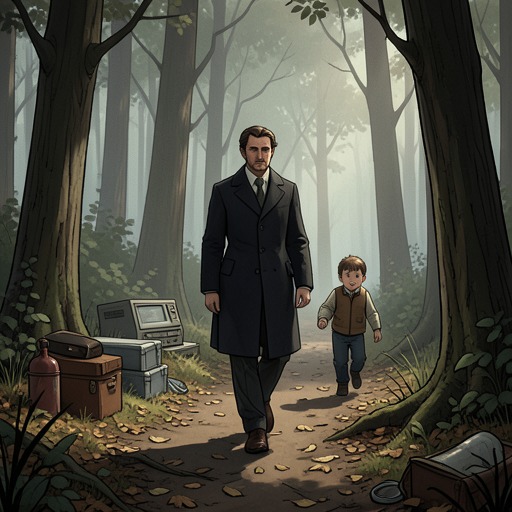
In the autumn of 1964, Guillaume went alone toward the Pain-de-Sucre and did not come back. The next day, his jeep was found at the edge of the woods, and Guillaume lay in the forest with an old hunting rifle fallen from his hands. Nearby, about twenty metres away, a male deer lay dead from a bullet to the chest. The account suggests that Guillaume suffered a cardiac failure; he had not brought the nitrate capsules he was meant to carry in case of an attack. Whether he left them behind deliberately remains uncertain, and the circumstances do not establish a definite intention to die.
The forest setting gives his death a stark contrast with the crowded, prayerful vigil of 1951. Then, relatives and neighbors surrounded Guillaume and tried to keep him alive while they waited for medical help. In 1964, he was alone, and the evidence of his final outing was discovered only afterward. The narration suggests an atavistic pull toward death in the woods, comparing him with his father, Égide D’Anjou, who had died there forty-four years earlier, almost to the day. It presents that resemblance as an impression, not a medical explanation for Guillaume’s death.
The loss reaches Loïc
The news reached Loïc in Montreal, where he was completing his classical studies. Returning to his room at the philosophy pavilion, he found a message asking him to call his family in Touladi urgently. He immediately feared that someone had died. Marie-Louise confirmed over the telephone that Guillaume had been found dead in the forest with his rifle, then quickly insisted that it was his long-ailing heart that had finally failed.
That explanation recalls the 1951 crisis and the years of diminished strength that followed it, while leaving the precise circumstances of the forest death unresolved. Guillaume’s heart disease thus links two moments in Loïc’s life: the childhood night when a doctor carried his adoptive father away, and the later call that confirmed he would not return. The illness’s narrative force lies in this recurrence, and in the contrast between a first survival that seemed to preserve the family and a final failure that made the earlier fear irreversible.