Loïc’s Ghostlike Role as a Hidden Ottawa Speechwriter
SatanLoïc’s ghostlike work in Ottawa makes invisibility both his professional condition and the central tension of his political life. He serves as a concealed writer in Pierre Elliott Trudeau’s government, close to the machinery of federal power but uncertain whether he belongs there. His one firm point of recognition is Régis, the older cousin who brings him into that world and gives his otherwise unacknowledged presence a sense of weight.
Position inside the government
The cabinet’s final year in Édifice de l’Est places Loïc in a setting thick with institutional memory. He reaches his first-floor office by a broad, two-flight staircase lined with portraits of successive viceroys; the building’s long corridors and Gothic arches lend it the air of an old palace. In these formal surroundings, Loïc comes to help Régis shoulder what Régis regards as the burden of Canada. Yet Loïc’s own place in the institution is deliberately obscure: he is a ghostwriter not only in the literal sense of writing for others, but also in the sense that his work and presence remain largely unseen.
That obscurity suits his ambiguous position. Régis is Trudeau’s principal writer, while Loïc occupies a subordinate, less visible role. His status as a kind of writer beneath the principal writer allows him to pass through the office with little notice. The few occasions on which he meets Trudeau, and the few words exchanged between them, do not make him feel more substantial or better recognized. Trudeau’s attention is too limited to draw him out of his anonymity, whether in Édifice de l’Est or later in Édifice Langevin.
A hidden observer and recorder
Although his official presence is slight, Loïc is not simply absent from the government’s life. He watches what takes place around him and keeps a daily journal of the people and events he observes. The journal is tangible evidence of his attention, but it also sharpens a question about the purpose of his work: he records, yet cannot be sure for whom or for what the record is meant. His writing therefore repeats the paradox of his employment. He produces words within the government while remaining outside the visible authorship and public recognition those words might otherwise bring.
Looking back, Loïc understands his time in Trudeau’s cabinet as an early image of a longer condition: the sense of being a literary presence without a visible body. The office seems to have fixed an identity he would later struggle to cast off. His retrospective account also turns the old government workplace into a place inhabited by political and personal absences. The people who once occupied it have died, disappeared from public life, or returned to anonymity. Loïc’s memory briefly restores them, but only through his own partial perspective. His record is not a neutral view from nowhere; it is the recollection of a participant who had himself been difficult to see.
Régis as mentor and point of recognition
Régis is more than Loïc’s senior colleague. Loïc experiences him as an intellectual and moral foster father, complementing the parental care Guillaume had given him in a more literal sense. Régis opens cultural and intellectual horizons for him and gives him an expansive, Christ-centred vision in which human suffering might find redemption. Loïc accepts this guidance, at least partly without fully understanding what his commitment will demand of his independence and integrity.
The two men are not equals in their government roles: Régis is Trudeau’s principal writer, and Loïc is his less visible junior. But the difference in rank is also part of their bond. Régis is the person who recognizes and elevates Loïc, making him feel seen when the larger institution barely notices him. Their closeness does not erase their different political positions or private strains. Both are caught in the demands of their service, but for opposing reasons, and the friendship that draws Loïc into government also makes it harder for him to leave or speak plainly.
Political conflict and the strain of concealment
Loïc’s position becomes increasingly difficult as the conflict between Quebec and Ottawa intensifies. The federal workplace gathers Anglophone and Francophone colleagues within an unequal political setting, while public arguments about Canada’s future can make the government’s ambitions seem larger than the people serving them. In retrospect, Loïc sees officials on both sides as caught in historical and ideological forces they do not fully understand. That view complicates any simple account of his service: he is not merely a hidden partisan within a federal office, but an observer who doubts how freely political actors choose their roles.
The victory of the sovereigntists in Quebec pushes Loïc’s divided position toward a breaking point. He has concealed a fundamental part of himself from Régis, and the resulting conflict leaves him feeling unable to function amid Ottawa’s political hostility toward Quebec. In the weeks and months that follow, he turns over possible ways to escape his imposture without destroying the relationship he values. He wants an honest explanation, but still hesitates to remove the mask completely. Later, he reproaches himself for his evasiveness and for using his close attention to Régis as a way of preventing Régis from attending just as closely to him.
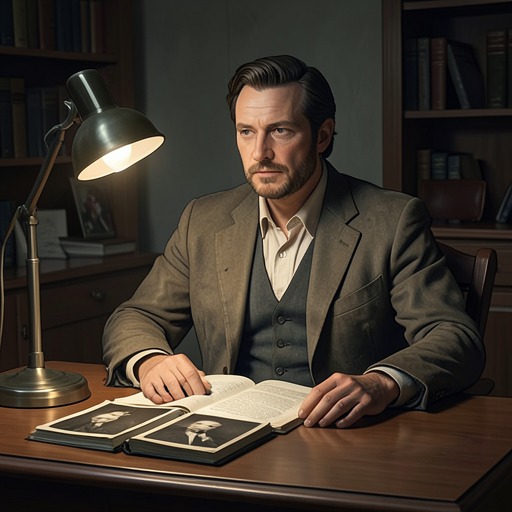
Eventually Loïc tells Régis that he has been sleeping badly since November 15 and fears he cannot endure the political tension much longer. Régis responds by pointing to two portraits of the diarist Samuel Pepys, one showing him at thirty and the other at fifty, and draws attention to the visible effects of strain. He recalls Pepys’s own trials, including anti-Catholic repression and imprisonment in the Tower of London, then asks whether something else lies behind Loïc’s sudden distress. The exchange marks an opening toward disclosure, but the evidence does not establish that Loïc then reveals the concealed truth. His ghostlike role thus ends, in this account, not with a clean departure from the government, but with the political and personal costs of remaining unseen finally becoming difficult to contain.