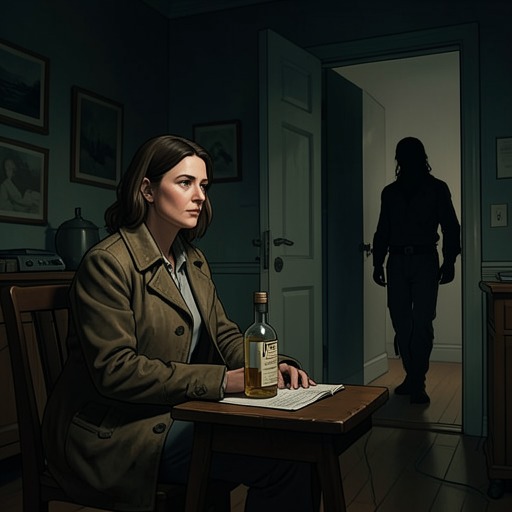
Isabelle’s Alcohol and Cocaine Addiction
SatanIsabelle D’Anjou’s slide from alcohol into cocaine is bound to the secret she cannot confess: she helped Roger Bolduc steal the family cameo, and afterward she is left with guilt, suspicion, and the fear that telling the truth will destroy her family ties. Her addiction gives that concealed complicity a physical cost, culminating in a near-fatal overdose and rehabilitation in early 2002.
Complicity and the Burden of Concealment
Roger had presented the cameo as a chance for the couple to make their fortune. Isabelle helped him by obtaining the combination to Georges D’Anjou’s safe from her mother, enabling Roger to take the object. She had extracted the combination while her mother was drunk, a detail that made confession especially perilous: her mother believed she had never revealed it. Isabelle feared that admitting what she had done would alienate both her mother and her father.
The theft was entangled with the couple’s hopes for a new life. On the terrace of the inn La Goéliche on Île d’Orléans, they had celebrated Roger’s forty-second birthday with champagne, two days before his trip to New York City. They imagined using the proceeds for lavish cruises and stays on tropical islands. Later, as Roger’s whereabouts remained uncertain, Isabelle wondered whether he had taken the money and gone to enjoy those destinations alone. The remembered excitement of their plans sharpened into bitterness rather than relief.
Suspicion, Guilt, and Addiction
The discovery that Roger had concealed most of his wealth abroad strengthened the suspicion that he had fled to start over elsewhere. The family could even imagine that his appointment at the World Trade Center had been fabricated as a false trail and that the September 11 attacks had provided cover for an escape. Whatever the truth about his disappearance, the cameo was missing, and Roger appeared the likeliest person to have taken it. Isabelle’s knowledge of the theft—and her part in it—kept her under suspicion rather than clearing her name.
Her predicament had no tolerable way out. To disclose everything meant confessing her complicity; to remain silent meant continuing to bear the lie and the family’s suspicion. She could not even turn to her mother, whom she considered her closest confidante, without exposing how she had taken advantage of her drunkenness to learn the safe combination. The account describes Isabelle as lacking the courage and moral strength to untangle the situation. In autumn 2001, an existing inclination toward alcohol intensified; soon, alcohol was no longer enough, and she began using cocaine.
Overdose and Rehabilitation
In early 2002, Isabelle nearly died from an overdose. She was sent to rehabilitation. The sequence makes the crisis more than a general response to Roger’s absence: her father, Georges, suspected that the disappearance alone could not explain her condition, while her own knowledge of the theft and her assistance in it remained concealed. The narrative does not state that rehabilitation resolved her guilt or established a lasting recovery; it records the overdose as the acute consequence of an addiction that had escalated under the pressure of secrecy.
Later Family Crisis and Withdrawal
In the later account, Isabelle appears to have recovered from a long depression, and the official confirmation of Roger’s death gives her the means to pursue a life of pleasure and travel. She goes to Cuba increasingly often and stays longer. At the same time, her mother Lucille’s Alzheimer’s disease worsens, and Lucille repeatedly begs Georges to help her die. Isabelle witnesses another desperate scene between her parents but recoils from her mother’s decline, considering a move away from the household. Her later conduct suggests renewed mobility, not proof that the earlier addiction has been cured: travel offers distance from the family’s suffering, while the narrative leaves the full course of her recovery unstated.