Loïc’s Twin Loss and Birth Trauma
SatanLoïc’s Twin Loss and Birth Trauma begins with a birth shadowed by two possible deaths: Marie-Ange D’Anjou is dying, and the doctor suspects that another child may have been present but recognizes it too late. The novel leaves the medical circumstances uncertain, while Loïc’s later account gives the loss an intimate certainty: he believes he had a twin sister, and that her disappearance divided his sense of self from the beginning.
Birth and Maternal Death
The birth takes place amid an emergency. The doctor focuses on Marie-Ange, whose pulse is fading and whose breathing has become ragged, while the possibility of a twin passes beyond recovery. Her aunt Berthe, acting as midwife, is running out of towels to staunch the blood and uses the last one to clean the baby before wrapping him in a small wool blanket. In the kitchen, Marie-Ange’s mother and Guillaume D’Anjou wait for news; a radio continues broadcasting in the background as the family listens for movement from the bedroom.
The priest does not arrive in time. Marie-Ange opens her turquoise-blue eyes briefly, her expression mixing astonishment and anxiety, but Berthe cannot make out what she murmurs. She dies at twenty-five. Beside her, the unnamed infant is blue and bloodless, caught between life and death. His survival is uncertain for days: brief signs of renewed alertness give way to deeper lethargy, and those around him fear he may not live.
The Twin as an Unspoken Loss
The doctor’s fleeting impression—that there may have been another baby—is not knowledge the family can pass on to Loïc. In his later reconstruction, he recognizes a silence at the center of the story: no one told him that his mother might have died with the other part of him, because no one knew that the lost child was his twin. He comes to identify that twin as a sister, not as a fact established by the birth scene, but as the truth he believes he has gradually recovered from scattered accounts and the imprint they left on him.
In Loïc’s understanding, the twin has vanished from the visible world but has not disappeared from his inner life. The absent child remains an invisible, inseparable companion and a bridge between him and his dead mother. The loss is therefore both familial and epistemic: it concerns a possible sibling, but also a past that was never fully witnessed or explained. Loïc describes the memory as something that cannot be said, even as he returns to it in writing.
A Divided Self and the Work of Reconstruction
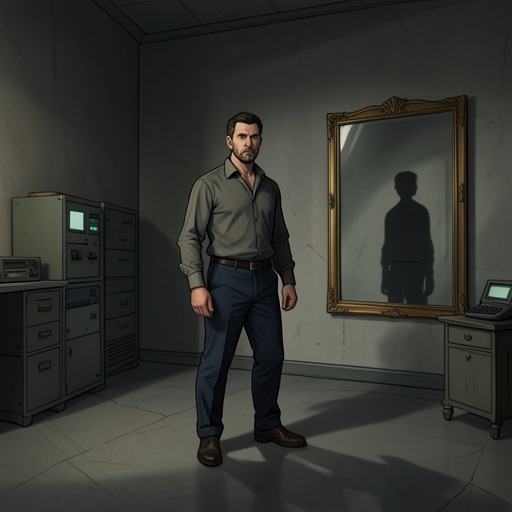
Looking back, Loïc treats birth as a kind of death. He understands himself as having been double and then reduced by half, his self fragmented before he could know what had happened. The image does not simply describe grief for a sister; it becomes his account of an enduring incompleteness, a self that feels unable to become whole on its own.
That sense of division directs his attention toward the moment of origin. He wants to return to it, explore what remains hidden there, and recover the part that escaped. His language turns the self into a worksite: he is continually trying to bring the lost part into the world again and to rebuild a unity that cannot be restored by explanation alone. The search offers a purpose, but its repeated and often despairing effort also shows that the original loss has no final resolution for him.
The Wound’s Later Echo
The novel later returns to the image of a woman lost in snow. After Lucille (the Alzheimer’s patient) wanders out of her home in a sheet during a December night, she is found dead on the Plains of Abraham. The narration says that her snow-covered body echoes that of a young woman found dead earlier in the Midwest with a baby wrapped in her arms. This recurrence does not establish the circumstances of Loïc’s twin’s fate; instead, it places the birth story’s conjunction of a dead woman and an infant within a wider pattern of loss and remembrance.
The twin’s absence consequently remains both an intimate wound and an unresolved mystery. Loïc’s account gives the silence a shape without making it disappear: he can name the division he feels and describe the life-long work of reconstruction, but the moment itself remains inaccessible, held between what the family could know and what he later came to believe.