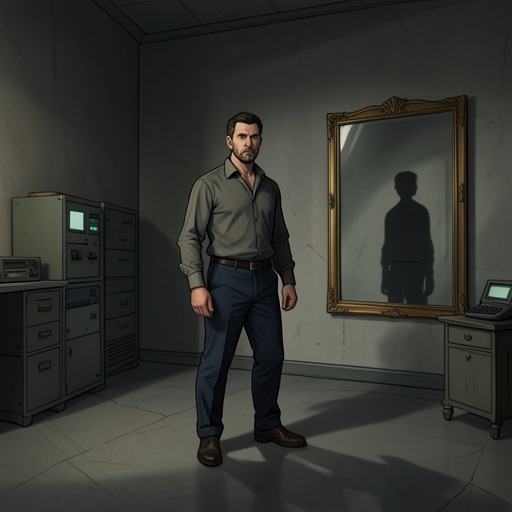
Loïc’s Divided Belonging between Two Families
SatanLoïc’s divided belonging between the D’Anjou and Bolduc families shapes both his childhood and his adult sense of self. Adopted by Guillaume D’Anjou and Marie-Louise D’Anjou after Marie-Ange D’Anjou died giving birth to him, he grows up surrounded by the D’Anjous but remains connected to Alcide Bolduc, his birth father. The division is not simply between two households: it is reinforced by a longstanding family feud, competing political allegiances, and a history in which adoption and concealed origins recur across generations.
Birth, Adoption, and Two Fathers
When the newborn Loïc seemed unlikely to survive, Laurette brought him to Guillaume D’Anjou’s home so that the family could care for him. Guillaume gathered his mother, his wife, and his three daughters and urged them to look after Marie-Ange D’Anjou’s child. The baby was baptized promptly, with Guillaume and Marie-Louise D’Anjou as his godparents. They then decided to adopt him with Alcide Bolduc’s agreement; the Bolduc family took responsibility for the other two children. His place in the D’Anjou home was therefore established through care and adoption, while his connection to the Bolducs remained acknowledged rather than erased.
At six, Loïc listens from upstairs as the adults discuss whether he can visit Alcide Bolduc and ride in his airplane. The child has no settled name for the relationship: Guillaume is the father who lives with him, while Alcide is the distant, intermittently returning father associated with the aircraft. Guillaume objects to Alcide’s unreliable way of life, describing him as an aviator and hunter whose drinking makes the flight seem unsafe. Loïc’s wish to go, and the adults’ disagreement over whether he should, make the divided arrangement concrete: affection and daily care belong to one household, while another father remains a real presence beyond it.
The household nevertheless offers Loïc an abundance of maternal care. His grandmother, aunt, and two female cousins watch over him alongside the adults already raising him; he is, in the novel’s formulation, surrounded by mothers. That shelter does not settle his paternal identity. The family quarrels he hears, the strained looks and guarded speech around him, and the conflict between his two fathers make the outside world feel threatening rather than separate from the home. His fear is presented as bound to the circumstances of his birth and the antagonisms into which he was born.
A Family Feud That Crosses Generations
The D’Anjou–Bolduc division predates Loïc. By the time he considers contacting his cousin Roger Bolduc, the two families have been locked in a political resentment lasting almost a century. Roger is the youngest child of Romuald Bolduc, remembered among the D’Anjous as a rapacious businessman and their bitterest enemy in Touladi. Roger’s marriage to Isabelle D’Anjou, herself related to Loïc on his mother’s side, reproduces an older pattern: the D’Anjous had also resented Loïc’s parents’ marriage across the family divide. Isabelle is consequently shunned for marrying a Bolduc.
Loïc hesitates before calling Roger after finding his number in Québec. The old feud is not what stops him; the immediate obstacle is the awkwardness of contacting a cousin after years of silence, and the fear of intruding without warning. He spends much of the day weighing whether to call while following the repercussions of an extraordinary event in the United States and around the world. This hesitation shows how inherited division persists in ordinary conduct, even when Loïc himself does not treat the feud as a sufficient reason to keep his distance.
The family’s fractures are not confined to the D’Anjou–Bolduc line. Marthe recalls that Élie D’Anjou’s daughter Mathilde broke with her father after her mother died in childbirth in 1889 and Élie refused a caesarean section, which the Church prohibited. Mathilde fled after Élie rejected and cursed her; Marthe remembers her sister seeking refuge with her before disappearing the following morning. The rupture helped prompt Marthe to become a missionary and leave. She alone later received secret news that Mathilde had long been living in the Republic of Cuba. Her story supplies another version of family belonging: a daughter expelled from her home, remembered privately but excluded from the family’s acknowledged life.
Adoption and the Unsettled Family Origin
The Founder’s history makes adoption and unknown origins part of the family’s deeper inheritance. Marthe says that before leaving on her mission to China, she learned that the Founder had been adopted, knew nothing of his birth family, and did not want his adoption discussed. He also confided that a valuable stone in his safe troubled him because it came from the United States. He feared the object, regarded it as evil, and concealed it in his scapular, sewn into his clothing, intending to be buried with it and to leave the matter unspoken. His secret connects uncertainty about ancestry to a deliberate act of concealment.
Later, Loïc reads an archival account of a rescued infant found with a finely made jewel in a torn silk purse attached to the baby’s swaddling. The record says that the infant was to be baptized and given adoptive parents; the child was taken in by a young French Canadian couple in St. Louis. The register gives the name Éloi, though the handwriting leaves room for the later reading Élie, the name of the Founder. Loïc wonders whether the unknown woman who saved the child could have been his great-great-grandmother and whether the Founder had carried the cameo from infancy to his grave. The document does not resolve every uncertainty, but it gives Loïc a possible line of descent in which adoption, a concealed object, and an obscure maternal history converge.
Loïc also learns that his own mother had carried another fetus. A doctor tells him that the second child was stillborn and that he had withheld the fact because Marie-Ange D’Anjou’s death was already such a grievous loss. The revelation adds a further absence to Loïc’s account of his birth: alongside the mother he never knew is a twin whose existence was kept from him. It intensifies the sense that his identity has been shaped by family decisions about what could be known, what should remain private, and which losses were spoken aloud.
Political Allegiance and the Cost of Division
The split between Loïc’s two families becomes part of a broader division in his adult life. He had shared an unusually close intellectual and spiritual communion with Régis D’Anjou, one of the people to whom he was most deeply attached. Yet Loïc’s public defense of an opposing political camp wounded Régis, who served as an adviser and close confidant to the Prime Minister of Canada and regarded that camp as an enemy to defeat. Their political disagreement turns allegiance into a personal rupture: a choice made in public reaches into one of Loïc’s most intimate relationships.
Loïc understands the injury as reciprocal. In standing with a political position opposed to Régis’s, he has hurt his friend and, at the same time, wounded himself. He describes his life as divided from birth among incompatible loyalties, two clans, two homes, and two fathers. The formulation gathers his adopted and birth families together with his later political conflict; neither division cancels the other, and no single affiliation offers a complete answer to who he is.
Narrative Significance
The novel presents Loïc’s divided belonging through repeated gaps between biological connection, lived care, social recognition, and family secrecy. Guillaume D’Anjou and Marie-Louise D’Anjou raise and adopt him; Alcide Bolduc remains his birth father; the Bolduc and D’Anjou families contest one another’s loyalties; and the Founder’s hidden adoption gives the question of origin an older, archival dimension. These are distinct relationships, not interchangeable definitions of kinship, and their coexistence keeps identity unsettled.
The division also accumulates across generations rather than ending with Loïc’s adoption. Mathilde’s estrangement, the Founder’s concealed origins, the undisclosed stillborn twin, and Loïc’s rupture with Régis each mark a different boundary between what a family contains and what it will admit. By the time Loïc recognizes the shadow of this history over his childhood and adult life, divided belonging has become more than a dispute over which family claims him: it is the recurring condition through which he experiences attachment, loyalty, and loss.