Lucille D’Anjou’s Alzheimer’s disease
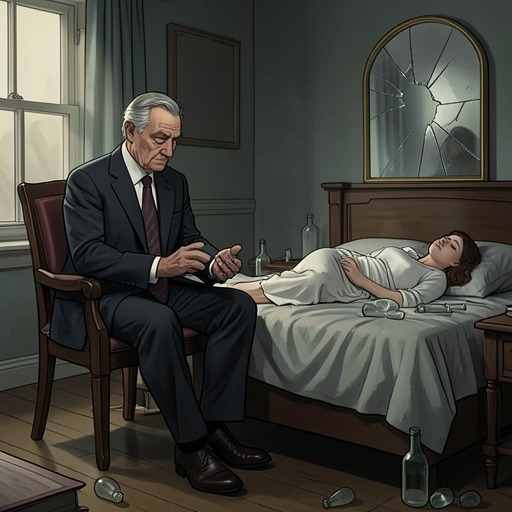
SatanLucille D’Anjou’s Alzheimer’s disease turns small lapses into a progressive loss of independence, memory, and recognizable selfhood. Its diagnosis becomes public after she fails the driving examination required of her once she is past seventy-five; as her confusion deepens, the illness reshapes her family’s life and brings Georges D’Anjou face to face with her repeated pleas to end her suffering.
Diagnosis and Early Signs
Before the diagnosis, Lucille’s forgetfulness appeared in ordinary forms: distractions, brief episodes of losing her way, and increasingly frequent difficulty finding her keys or wallet. Georges D’Anjou noticed that these lapses were not like the short absences that followed her drinking. They could happen in the middle of the day, and they became a persistent source of worry.
The decisive public revelation came when Lucille, already past seventy-five, was required to prove that she remained fit to drive. Anxiety and nervousness intensified her confusion; she failed the examination and lost her license. The loss restricted her movements, but it also made the illness visible to others. The medical diagnosis was Alzheimer’s disease.
Decline and Its Effects
Afterward, Lucille’s condition worsened. Prescribed anxiety medication, combined with the alcohol she continued to drink secretly, was described as intensifying her symptoms and accelerating her cognitive decline. Even a familiar outing to have a drink at the Château Frontenac became harder: taking a taxi was difficult, while walking risked leaving her lost and asking passersby for directions. People in the Haute-Ville began to whisper about her condition.
Her changes were increasingly abrupt. She could move from clear-mindedness to intense anxiety and paranoid anger, sometimes within hours. As she misplaced more belongings, she accused others—including the longtime maid, Clémentine—of searching her drawers and stealing from her. She came to suspect that her doctor’s medication was making her insane and that members of her family intended to poison her. When she spoke of suicide, Georges took steps to keep medication away from her and control how it was taken.
The disease also unfolded alongside a history of trauma that the family largely did not know. Lucille had been sexually abused by her older brother in childhood. She had buried the memory in denial and used alcohol to suppress its return; the narrative presents this as part of the history behind her drinking, not as the cause of Alzheimer’s disease. She had never told Georges or her children, including Isabelle D’Anjou, her closest confidante. Only her older sister, Lucienne, knew, and Lucienne herself was beginning to lose her memory with age.
Lucille, Georges, and the Pleas to Die
As her moments of lucidity became more painful, Lucille repeatedly told Georges that she wanted to die and begged him to find a way to end her life. At first he rebuked her. She persisted, and her pleas gradually wore down his resistance. Knowing that he kept a pistol in his office, she once tried to enter and find it. Georges caught her, refused to give her the gun, and told her that its ammunition was kept elsewhere.
Lucille collapsed onto the living-room rug, wept, and clung to Georges’s legs as she pleaded for mercy. In another appeal, she named her Alzheimer’s, acknowledged that it could not be cured, and said she did not want to become lost in madness or make her family live through that ordeal. The scene makes the conflict intimate and concrete: her expressed wish is set against Georges’s refusal, his responsibility for her safety, and the distress of witnessing her deterioration. Isabelle, confronted with her mother’s increasingly unfamiliar behavior and the scenes between her parents, avoided the decline and considered leaving the house.
In 2009–2010, Georges’s resistance gave way to sustained deliberation. He considered whether he could hasten a death he regarded as inevitable, initially imagining a natural-appearing method. His past interest in mycology led him to consider the poisonous death cap, but his research reminded him that poisoning could bring severe symptoms and prolonged suffering. The prospect of inflicting that agony on Lucille troubled him. He also considered an alcohol-and-sedative death, then worried about the traces it might leave and the suspicions or accusations it could bring. These plans remain deliberations in the account; the narrative does not say that he carried them out.
Disorientation and Death
Lucille’s experience of the illness is rendered as a progressively unstable boundary between memory, perception, and reality. She loses track of what is real and what is dreamed, wanders among fragments of memory, and speaks in phrases that no longer hold their meaning for her. Her fear and anger turn toward the people closest to her: in paranoid episodes she accuses Georges and her children of neglecting and mistreating her. Georges, in turn, sees occasional flashes of intelligence quickly submerged by vacant confusion.
One night in late December, after Isabelle had left again for Cuba, Lucille went through the front door of the family home. Because the alarm had been disabled since she became ill, the door offered no obstacle. Barely dressed and wrapped in a sheet over her nightgown, she walked out into the freezing wind. At dawn she was found dead from the cold on the Plains of Abraham. Loïc later noted that she had fallen at the place where Montcalm died in 1759, a historical echo the narrative links to a people’s fate and, more obliquely, to the tragedy of forgetting.
Narrative Significance
The account traces Alzheimer’s through specific losses—driving, finding familiar objects, trusting relatives, and holding onto coherent speech—rather than presenting diagnosis as an isolated label. At the same time, Lucille’s decline is entangled with secrecy, alcohol use, childhood trauma, and the demands placed on the family. Her pleas force Georges into a painful confrontation between her stated wishes and his efforts to keep her alive and safe; his private planning shows the pressure of that conflict without resolving it into a simple account of mercy or cruelty.
The illness’s final image joins intimate disorientation to public history. Lucille leaves home wrapped in a sheet that resembles a shroud and is found in snow on the Plains of Abraham, where the narrative recalls Montcalm’s death. The comparison gives her loss a national resonance, but the preceding scenes keep that metaphor grounded in her particular experience: a woman progressively deprived of memory, independence, and the ability to make herself understood.