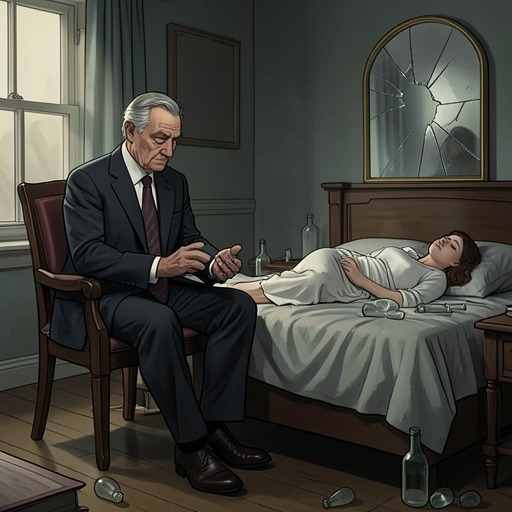
Lucille D’Anjou’s alcoholism
SatanLucille D’Anjou’s alcoholism shapes how her family and community understand her decline, but it also conceals a private history of trauma. Her drinking becomes entangled with Alzheimer’s disease: it contributes to episodes of absence, worsens the effects of prescribed medication, and persists as her memory and independence deteriorate.
Drinking and a concealed history
For Georges D’Anjou, the first signs of a problem were practical and recurrent: Lucille was searching for her keys or wallet almost every day. He knew that after drinking, she could have brief absences the following morning. Those episodes, however, were temporary and unlike the new confusions that began occurring in the middle of the day. The distinction mattered: her drinking was already familiar to the household, but it did not explain the growing pattern of disorientation.
The novel later gives her alcoholism a deeper context. Lucille had been sexually abused by her older brother in childhood and had buried the experience so completely that she denied it even to herself. Alcohol became a means of keeping the memory submerged, a repeated attempt to escape what she could not bring herself to face. Her dependence is thus presented not simply as a public habit or a failing, but as a response to a trauma she never disclosed to Georges or to her children, including Isabelle D’Anjou. Only her older sister knew; as that sister began to lose her memory too, the secret’s already narrow circle of witnesses grew more precarious.
Dependence amid cognitive decline
At seventy-five, Lucille had to demonstrate that she remained fit to drive. Anxiety and nervousness intensified her confusion during the examination; she failed and lost her licence. The loss restricted her mobility, but it also made her illness publicly legible. A medical diagnosis confirmed Alzheimer’s disease, distinguishing the progressive cognitive decline from the short-lived absences Georges had associated with drinking.
After the diagnosis, Lucille continued to drink secretly despite being prescribed anxiolytics. The combination was described as harmful and as contributing to the worsening of her symptoms and accelerating her cognitive decline. Even familiar outings became difficult. Going for a drink at the Château Frontenac, once part of her life, became increasingly hard to manage: taking a taxi posed problems, while walking risked her getting lost and needing to ask for directions. In the Haute-Ville, where she was well known, people began to notice, speculate, and quietly pass on word of her condition.
Her confusion grew increasingly unpredictable, shifting between lucidity, anxiety, and paranoid suspicions. She misplaced possessions and accused others of taking them, including Clémentine. Alcohol remained part of this worsening situation, but the narrative does not reduce her Alzheimer’s symptoms to drinking: it describes a progressive disease, compounded by continued alcohol use and medication, that increasingly unsettled her sense of self and her relationships.
Family strain and the wish to die
During lucid moments between periods of confusion and paranoia, Lucille fell into despair and repeatedly asked Georges to find a way for her to die. At first he rebuked her; as her pleas continued, his resistance began to weaken. Her alcoholism belongs to the circumstances of this crisis, but the stated reason for her request is her awareness of Alzheimer’s and fear of losing herself to an incurable disease.
Lucille knew Georges kept a pistol in his office and once tried to enter while he was unaware. He discovered her attempt, became furious, and refused to give her the weapon. She continued pleading, telling him she could not bear her decline and did not want her family to watch her disappear into illness. Isabelle D’Anjou, having witnessed another such scene, recoiled from the painful transformation of the mother she loved and began seriously considering leaving the house. Georges, meanwhile, was worn down by the daily confusion and distress in the home. His later deliberations about hastening Lucille’s death arose from this sustained crisis of care and her repeated requests; they are not presented as a consequence of alcoholism alone.
The secret and the ending
The account connects Lucille’s drinking to a history she could not speak about, while showing how its consequences became visible to others: lost independence, public whispers, and a household increasingly organized around her illness. Yet the family’s understanding remained incomplete. The trauma beneath her dependence was unknown to Georges and her children, even as they confronted the effects of her drinking alongside the advancing dementia.
Lucille eventually left the house alone during a winter night, while the alarm system was disabled because of her illness. She was found at daybreak, dead from the cold on the Plains of Abraham. The novel does not establish that alcohol caused her to leave or that it directly caused her death. Rather, the ending follows a long deterioration in which drinking, cognitive illness, isolation, and family distress converge without becoming interchangeable explanations. Her alcoholism is both a concealed history of survival and one part of the painful circumstances through which her final loss of safety unfolds.