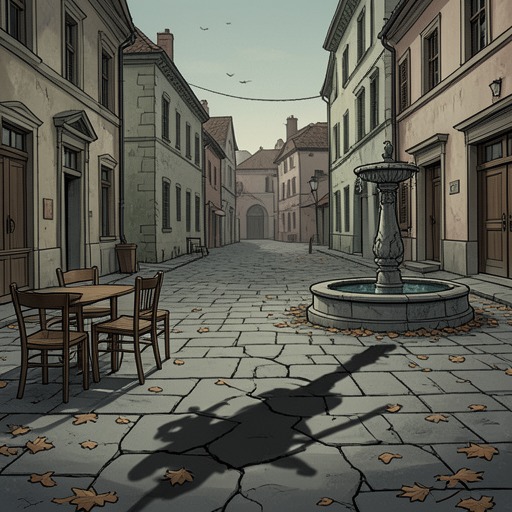
The Decline of the D’Anjou Family in Touladi
SatanThe Decline of the D’Anjou Family in Touladi is a sequence of losses rather than a single rupture: the family’s last local heir dies, its defining heirloom leaves the village, its remaining household disperses, and its ancestral home is destroyed and sold. Through Loïc’s experience, the decline becomes both a personal bereavement and a question of how a family’s presence can survive when its people, places, and objects disappear.
A legacy sustained by memory and rumor
Touladi’s understanding of its founder was never complete. Villagers wondered where Le Fondateur had come from, what he had done in the United States in his youth, and why he had employed Grébiche, a woman unknown in Touladi and said to come from a family of itinerants. Moïse Dubois suggested that Grébiche had learned secrets from Le Fondateur on his deathbed. His account, however, was part of a changing village tradition: stories grew or altered in the telling, and Moïse was known to enlarge what age had blurred. Noé Bolduc offered a less supernatural version of the tale of Grébiche’s supposed dance with the devil. She had danced a quadrille with an American hunter, he said, and accidentally struck an oil lamp, burning her face; after years away, she returned with a faint scar. The contrast between rumor and correction shows how the Founder’s legacy was carried not only by family property but also by competing oral histories.
That legacy had a political dimension. Grébiche opposed a plan to flood Touladi for a hydroelectric dam in New Brunswick, invoking Le Fondateur and threatening those who supported the project with the anger of the dead. She also opposed the Bolduc brothers’ growing control of the village. During a later election campaign, she warned that the election had been prepared in misfortune after the dispute over Loïc’s paternity, and predicted that it would end badly. Her warnings were mocked by some and remembered by others as part of a longer struggle over who could speak for Touladi and its past.
Guillaume’s death and the removal of the cameo
After Guillaume D’Anjou was buried, Georges D’Anjou took the family cameo to Québec City. Loïc objected less to the transfer itself than to its timing and manner: it happened while Guillaume’s body was still newly buried, and felt to him like an impudent, disrespectful act. He had no say in the decision. In the eyes of the family, he was young and did not bear the D’Anjou name; to Loïc, that exclusion made the removal a further sign that his place in the family was uncertain.
The move revived a plan first considered in 1951, when a heart attack had brought Guillaume close to death. With Guillaume’s assent in hospital, his father, Jean D’Anjou, had been preparing to retrieve the jewel, but Guillaume’s recovery ended the plan. In 1964, while taking the cameo from the safe, Georges found a folded birth-certificate extract from the United States hidden at the bottom. He kept the discovery to himself. The document would later help Régis D’Anjou investigate Le Fondateur’s origins, linking the departure of the heirloom to a secret that remained in the family even as its local presence weakened.
For Loïc, Guillaume had been both adoptive father and maternal uncle: the man who had gently separated him from his dead mother and guarded his childhood against the Bolducs’ claims. His death therefore closed off more than a household relationship. The death of his grandmother Élisabeth two years earlier had already thinned his ties to the past; now the loss of Guillaume and the removal of the cameo made Touladi seem to recede, while Loïc’s connection to the D’Anjous also diminished.
Laurette and the end of the household
Laurette’s death soon brought Loïc back to Touladi to empty her apartment in the village’s public housing. He sorted the furniture and small possessions she had left behind, giving most of them to neighbors. The ordinary objects had witnessed her life, but their distribution made the household’s disappearance tangible. Laurette had been the first to care for him after his mother died, and had devoted her life to her parents and family, including the child born late in her parents’ lives. Her death removed the last member of Guillaume’s immediate household still living in Touladi.
At Laurette’s discreet funeral, held under a veiled sun, only a small group of elderly friends attended. The D’Anjou relatives from Québec City did not come, a further absence that Loïc resented. Régis, away on a senatorial mission in Australia, sent a large arrangement of flowers and an address read by the priest. With Laurette gone, the adoptive family was, in the narrator’s phrase, erased from the village map: the house was gone, and the portrait of Le Fondateur had also been moved to Québec City, to the judge’s home.
The house destroyed and sold
The Founder’s House, where Loïc had spent his childhood, had stood empty and badly deteriorated after Marie-Louise D’Anjou’s death and Laurette’s move. Romuald Bolduc wanted to buy it, but the D’Anjous refused. A fire eventually ravaged the old ancestral home. The family suspected arson and believed Romuald responsible, since he was systematically acquiring houses and properties in the village, but his power locally made proof difficult to obtain.
The sale of the ruins and land then fell to Loïc. He acted reluctantly, with revulsion, because no other buyer appeared and the family did not intend to rebuild in the near term. The municipality pressed the D’Anjous to sell; Romuald, as mayor, had influence over that pressure. The family agreed to sell on condition that a commemorative marker be erected at the site in memory of Le Fondateur. Romuald opposed the memorial and succeeded in having the proposal rejected shortly before his death. The sequence left the family not only without its home but without the public monument that might have marked its founder’s place in Touladi.
A local decline made into a larger history
Looking back, Loïc understood the losses—from Guillaume’s death to the destruction of the ancestral house—as the completion of the family curse. The work of Le Fondateur, at least for his descendants, had lasted barely a century. The D’Anjous’ roots in Touladi seemed too shallow to withstand the successive deaths, departures, and transfers of property. Loïc widened that reflection into a meditation on the vulnerability of small nations and on the fragile foundations of peoples in the Americas: houses and objects vanish, few monuments remain, and the signs of a community’s existence can be scattered into oblivion.
The family’s vulnerability also persisted in stories told beyond the village. Grébiche’s death was officially described as a fatal fire, likely caused by an oil lamp, but rumors later alleged that she had been murdered and burned to conceal the crime; those accusations were never established. Much later, after Lucille D’Anjou’s death, public suspicion and media speculation spread to her husband, her daughter Isabelle D’Anjou, and other relatives, while the story of Roger Bolduc’s disappearance in New York during the 2001 attacks added another scandal to the family’s public history. These reports do not resolve the family’s past; rather, they show how a weakened legacy can be reshaped by hearsay, accusation, and the circulation of fragments. In Touladi, the most lasting evidence of the D’Anjous’ decline is concrete: the people are gone, the cameo is elsewhere, and the house and proposed memorial no longer anchor the family to the village.