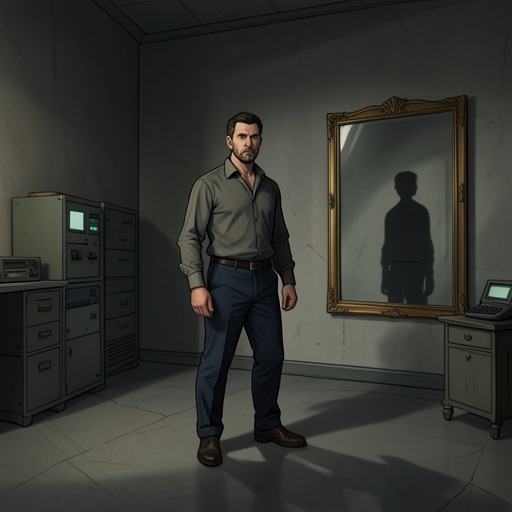
Loïc’s Twin Loss and Longing for Union
SatanLoïc’s Twin Loss and Longing for Union names the hidden birth trauma that reshapes Loïc’s understanding of himself: he was not born alone, but separated from a stillborn sister who remained inside their mother’s body until both were buried. The revelation gives physical form to a presence Loïc had sensed since childhood and helps explain why he repeatedly seeks a total union that ordinary love and friendship cannot provide. In his relationship with Laurence, that longing briefly seems answered, though the novel leaves its deepest object beyond earthly certainty.
Identity and Discovery
The truth emerges through two accounts separated by years of silence. Pierre Saindon, the doctor who attended Marie-Ange’s delivery, admits that another fetus was in her womb. He recognized that the baby was dead, but chose not to tell the family while they were already grieving. The concealment, intended to spare them another sorrow, becomes a burden he has carried ever since. His confession makes Loïc’s birth not a single tragic event but a divided one: he survived, while his twin sister was lost before she could be known.
The second account comes from the opening of Marie-Ange’s grave during the cemetery’s permanent rearrangement in 1947. The elderly witness remembers being there with Guillaume; Alcide could not stay long. They noticed a swelling low in the dead woman’s abdomen and found a withered infant between her legs, connected to her by a dried umbilical cord. They could tell only that the baby was a girl. Their discovery supplied the bodily fact that Pierre Saindon had withheld, but not an explanation for it. He later describes the rare process as postmortem fetal expulsion: gases accumulating in the mother’s body can push the fetus out of the uterus after death.
The accounts also reveal the cost of silence to those who knew. Pierre Saindon says he blamed himself both for failing to save Marie-Ange and for not disclosing the second baby later; he left the village six months afterward, fleeing his remorse and a descent into alcohol. Guillaume, meanwhile, had waited for Loïc to become an adult before telling him, and the witness believes Guillaume could not bring himself to speak. Loïc understands that delay, but the knowledge arrives after Guillaume can no longer be reproached or asked to explain it.
The Grave as an Inner Image
Loïc is struck less by the medical explanation than by the image of his sister left beside their mother in the grave. He turns toward his uncle with reproach, then asks how the fetus could have emerged from the womb after death. The shift from accusation to a concrete question registers the effort to grasp an unbearable discovery through physical fact. Yet the fact does not contain the experience: Loïc says he is not entirely astonished, because throughout childhood he often felt a presence around him, even within him. He had no conscious knowledge of his twin, but the revelation gives that old sensation a possible source.
After the final funeral vigil, Loïc goes to the room still kept for him upstairs. A short prayer with Marie-Louise and her two daughters has ended; downstairs, Guillaume remains in the wavering candlelight. Loïc cannot sleep. As consciousness fades into pre-dream visions, he imagines himself expelled from the womb like a passenger from a wrecked car, while his sister remains trapped inside, part of himself imprisoned in the fatal shell. The image brings back another haunting childhood picture: a child buried alive, turning over in its grave. The novel links these images without making them identical. The twin’s actual posthumous expulsion and the imagined child’s entombment converge as figures of separation, enclosure, and survival bought at the cost of an intimate other.
Separation and the Desire for Union
The later significance of the discovery lies in how Loïc interprets his relationships. He sees his hunger for fusion as reaching back to the twin bond from which he was violently separated at birth. The impression of his stillborn sister, though repressed from conscious memory, has worked more powerfully in the subconscious; earthly attachments become attempts to answer an absence whose origin he could not name. His desire is not simply for companionship. It is for a complete joining that reunites mother and sister as well as self, a trinitarian fullness that no human relationship can reliably supply.
That pattern extends beyond romance. Loïc judges that the fusions he sought in other liaisons, loves, and passions disappointed him, and that even friendship offered no exception: his closeness with Régis could not escape the same limits. In retrospect, the original rupture makes these failures appear related. Each bond can approach intimacy, but none can undo the first separation or reproduce an imagined wholeness. The twin’s absence thus becomes a structure through which Loïc reads both desire and disappointment, rather than merely a fact about his family history.
The novel also connects his longing to a succession of spectral calls from childhood onward. Loïc comes to understand these experiences as stages, sometimes painful and sometimes happy, on a path toward union in God. This spiritual interpretation changes the direction of the desire: what began as an unconscious search for reunion with a lost sister may point beyond earthly attachment. The text presents that movement as Loïc’s developing understanding, not as proof that the supernatural presence has been objectively explained.
Laurence and the Echo of the Twin
When Loïc meets Laurence, the longing briefly takes a startlingly intimate form. For the first time, he no longer feels alone. The idea of a soulmate unsettles him because he wonders whether Laurence could be the reincarnation of the twin who remained in their mother’s womb. Their communion seems to support the association: they often find themselves thinking the same thing at the same time, sometimes arriving at the same phrase or expression. Exchange, sharing, and correspondence make their closeness feel almost like the disappearance of the boundary between them.
Loïc also recognizes in Laurence an empathy for every form of life—people, animals, and even plants—that he has never encountered in anyone else. Their connection is therefore more than the fantasy of finding a substitute for his sister; it is grounded in the particular affinity and care he experiences with Laurence. Still, the resemblance cannot settle the question of the twin. The novel does not confirm reincarnation or claim that love repairs the loss. Laurence draws Loïc, for a time, away from his obsession with the family cameo, while the sudden intensity of their bond foreshadows his return to buried histories. Their relationship gives his longing a living and reciprocal expression, but leaves its deepest origin—and the possibility of complete union—open.