Loïc’s Childhood Nighttime Otherworldly Experiences
SatanLoïc’s childhood nighttime otherworldly experiences begin as a feverish terror of worms and open into a vision of Touladi as a second, concealed world. For several weeks in the winter of 1952, the child seems to leave his body and move through the village’s hidden emotional and spiritual life. The experience is at once bodily illness, frightening transformation, and apparent revelation: he encounters a malevolent force associated with the family cameo, then loses the memory so completely that its return decades later leaves him unsure whether he had seen another reality or dreamed one into being.
Illness and the Fear of the Worm
The episode takes shape amid illness and family tension. Loïc had eaten rich food at his grandfather Bolduc’s during the holidays, in the aftermath of the fathers’ quarrel, and came to fear that he had swallowed a tapeworm. One night he saw a multitude of points of light in the dark, became sick, and vomited; persistent stomach pain followed. The narrative lets this bodily distress gather meanings beyond its symptoms: the worm seems to embody what has been swallowed, including the poisonous words and resentments of the adults.
His adoptive mother’s attempts to reassure him do not dispel the fear. In the privacy of winter mornings, she examines her stool in a chamber pot, called a catrine in Touladi, and shows him tiny whitish worms as signs that he is getting better. Her satisfaction contrasts with his revulsion. He feels not comforted but invaded, imagining not a single parasite but a whole colony multiplying inside him. The domestic detail makes the supernatural turn inseparable from a child’s concrete, humiliating experience of illness.
The nights grow more terrifying. Loïc feels something twisting his gut and rising toward his throat; he hears gurgles, breaths, whistles, and what seem like the crackings of cartilage. Afraid, sweating, and overwhelmed, he hides under the covers and calls for light. Laurette comes to him, turns on the corridor lamp, and leaves his door open. Her practical act of care offers a small boundary against the darkness, though it cannot prevent the vision from developing.
Becoming the Worm
In fever and delirium, the distinction between child and parasite gives way. Loïc feels himself becoming the worm: it twists within him as he twists with it, then seems to emerge from his mouth ring by ring. His body doubles into a long, translucent, phosphorescent creature, its inner light visible as it uncoils into the night. Terror remains, but fascination overtakes it. The movement carries him beyond his ordinary bodily limits, as if he were being propelled through the air.
This transformation changes the worm from the object of disgust into a means of perception. Loïc travels through the hidden sides of things, along walls and ceilings and into enclosed rooms. The familiar village becomes legible from within: brains appear like transparent aquariums, their chains of neurons flashing and setting off further lights through the body. Thoughts, desires, and forbidden fantasies seem to drift in the air, while apparitions and the dead gather around the living. The image of the worm expresses both a child’s fear of being consumed from within and his imagined access to what ordinary sight cannot reach.
The Village Behind the Visible World
As Loïc adapts to this nocturnal state, he perceives more of the village, but the experience has an uneven relation to waking life. At night he remembers the day and seems to hover above its people and events; by day, returned to his schoolchild’s body, he cannot recall what he saw or did at night. The two modes of experience do not reconcile into a single continuous memory. Instead, the nocturnal view discloses a reverse image of daily life, in which outward appearances and inward states often contradict one another.
This hidden village is neither wholly benevolent nor wholly hostile. Loïc encounters secret kindness and beauty, but more often senses frustrations, grudges, and anger smoldering beneath public behavior. The village’s conscious voices may be overturned in sleep: the daytime braggart becomes timid in the night’s inward theater. Alongside the living, the dead seem to press close, their voices mingling with the desires and prayers of those still alive. Loïc understands himself as separated from this realm by a transparent, impassable wall: able to see, but unable to touch or intervene.
At times the visions become tender and almost paradisal. A presence envelops him with affection and music, accompanied by imagined fragrances of marjoram, lavender, and other aromatics; he feels absorbed into a joy from which he does not want to emerge. But hostile currents carry him elsewhere, into unbearable pain that returns him to the moment before birth, after which sleep and unconsciousness take over. The visions thus hold opposing possibilities together: consolation and torment, nearness to the dead and separation from the living, spiritual tenderness and forces that seem bent on destruction.
The Cameo and the Lost Memory
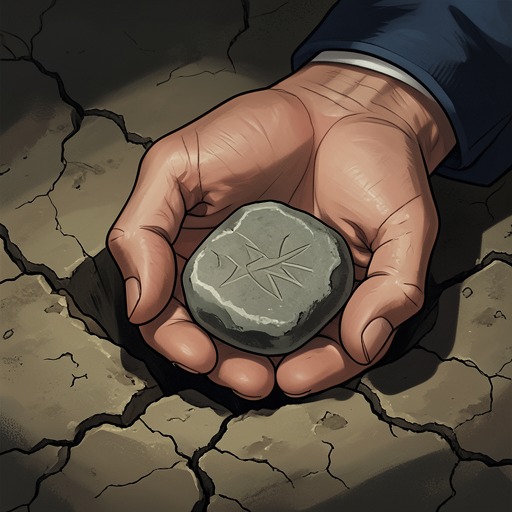
One night, Loïc perceives an ominous radiance enclosing the village and especially his home in enormous black tentacles. It seems to originate at the house of Le Fondateur. He understands it as the cameo’s diabolical magnetism, a force no safe can contain. The ray crosses Le Fondateur’s portrait and points toward the foundations and cellar, where stillborn children lie. Rats and vermin multiply there in the vision, while minute forces gnaw at the foundations of what appears solid. The childhood experience therefore reaches beyond private fear: it gives Loïc an image of the cameo’s malign influence and links that influence to buried family death.
The knowledge does not remain available to him. The power of nocturnal doubling disappears, and its memory becomes inaccessible. Loïc later wonders whether it ended with television’s arrival, his departure for college, his distance from Touladi, Guillaume D’Anjou’s death, or the cameo’s move to Québec; he cannot establish what closed the experience off. For decades he forgets the worm and retains only a sense of a black hole in his childhood, a gap into which much has vanished.
When the memory returns after roughly half a century, Loïc tells a psychoanalyst that the episodes may have been dreams or fever-induced hallucinations. The narrative preserves that uncertainty rather than confirming the visions as objective supernatural events. Loïc also considers whether the flying worm elaborated his airplane ride with his aviator father: an impossible aerial view of the village, shaped by his painful division between hostile fathers and a desire to escape confinement. Yet the cameo’s sinister radiance gives the memory a significance beyond that possible psychological explanation. The lost episode becomes a buried point of contact between bodily trauma, divided family history, and the novel’s supernatural world; later experiences can briefly revive its echo, even though the child who saw it could not carry its knowledge into waking life.