The Québec–Ottawa Political Conflict
SatanThe Québec–Ottawa Political Conflict is the novel’s recurring contest over Quebec’s political future, but it is never only a constitutional dispute: it reaches into private loyalties, political work, and the local power struggles of Touladi. Its sharpest personal expression comes through Loïc, caught between his desire for Quebec independence and his attachment to Régis D’Anjou, the cousin and political mentor whose federalist convictions place them on opposing sides. The conflict’s older local history shows how political division can also be sustained by patronage and coercion.
Federal Tension and the 1976 Election
On November 15, 1976, Loïc waits in his office in the Langevin Building in Ottawa as Quebec’s election results approach. The Westminster chimes mark six o’clock; polling stations are about to close, and the election may determine Canada’s future. A recent poll has put Quebec independence supporters near 50 percent, unsettling the political establishment and those whose livelihoods depend on Canadian federalism. The prospect of a Parti Québécois victory is therefore both a public political crisis and a private test for Loïc.
Régis has spent the weekend preparing possible statements for Prime Minister Pierre Elliott Trudeau. After an urgent meeting with Trudeau and senior advisers, he tells Loïc that he opposed what he regarded as a soft line toward the separatist program of René Lévesque’s Parti Québécois. Trudeau agrees with him and assigns Régis and Loïc to draft a telegram for the event of a Parti Québécois victory. They must acknowledge the legitimate election of a sovereigntist government without either congratulating it or taking rhetorical shots at it. The task makes Loïc’s position especially difficult: his professional work is to formulate the federal government’s response while his private hope is that the independence movement will succeed.
For Loïc, that hope is grounded in the vulnerability of French-speaking Quebec. He sees an independent government as a means of reversing the diminishing position of the only French nation in America and escaping a cycle of defensive nationalism and collective self-contempt. Around him, however, colleagues shut out the possibility of a Parti Québécois win even as the final polls predict it. As results begin to appear, the first reported lead belongs to a Parti Québécois candidate; by about 7:30 p.m., roughly ten of its candidates are ahead of Liberals. The atmosphere in the Langevin corridors changes with the count.
When the victory is confirmed, the federal staff watch on television as Lévesque addresses his jubilant supporters at the Paul-Sauvé Centre in Montreal. Loïc’s response diverges from the celebration he might once have shared with his generation. He feels remote from the young Quebecers celebrating across the province, and his sense of belonging to a collective “we” gives way to a more solitary self. The election does not resolve the conflict between Quebec and Ottawa; it makes Loïc’s own divided position harder to conceal.
Loïc and Régis: Political Loyalty as Personal Conflict
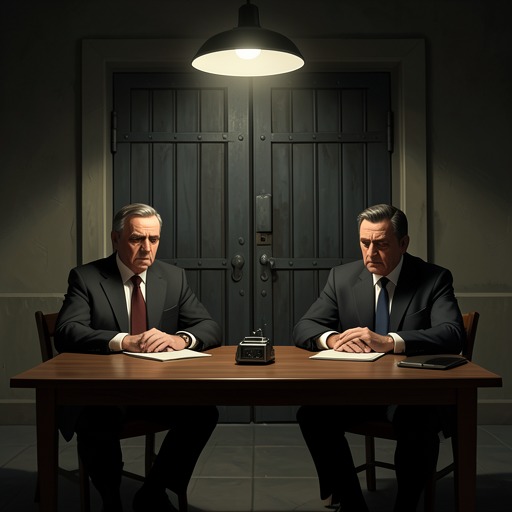
Loïc and Régis work for the same prime minister, yet their political commitments are increasingly at odds. Régis regards the separatist program as a rupture and, as the results approach, treats its possible success as a grave threat. Loïc sees the same prospect as a possible route to emancipation. Their silence about this disagreement has become a strain of its own: they serve the same government while withholding convictions that could divide them.
Régis’s place in Loïc’s life gives this political division an additional personal force. Loïc experiences him as a father figure, and the conflict recalls the older division between his biological father and adoptive father: the difficulty of being attached to one person while concealing that attachment from another. In Ottawa, as in the earlier family conflict, Loïc feels pressed between claims that he cannot reconcile by simply keeping quiet. The election brings those suppressed differences into sharper focus.
After the Parti Québécois victory, Loïc sees that Trudeau and his team are positioning themselves for a fight against Quebec. He concludes that he can no longer remain balanced between the two sides. In a difficult conversation with Régis, he explains that his generation cannot share Régis’s view of Canadian federalism. He says that he cannot continue to defend the rigid federalism embodied by Trudeau and, given the government’s preparations against Quebec’s new administration, does not have the heart to be enlisted in that effort. He would rather stand outside the political fray, perhaps by returning to journalism.
Loïc also argues that the sovereigntist party was chosen by a clear majority of French-speaking Quebecers and represents the will of a people that belongs to both men. Régis listens, visibly affected, but does not erase the disagreement. His earlier assurance that Loïc was entitled to his opinion and would not be tested for political orthodoxy had allowed their working relationship to continue; it could not remove the larger conflict their positions represented. For Loïc, the election turns an unspoken tension into a choice between loyalty to Régis and integrity toward himself.
The Conflict in Touladi
The novel places Ottawa’s federal crisis against an older, more local pattern of political division. In Touladi, party allegiance is bound up with family influence and control of local institutions. During the campaign launched by Maurice Duplessis at the Château Frontenac, Duplessis presents himself as Quebec’s protector against Ottawa’s encroachments, invoking the defense of the province, its language, and its faith. Roland Bolduc, his brother Romuald, and their allies campaign for the Blues. Clovis Lacroix, whose mother is a D’Anjou, organizes young Liberal supporters on the opposing side.
That opposition carries material risks. Clovis is warned that he may lose his teaching post if he continues to take part in politics. The school-board president, aligned with the Bolducs, delivers the threat after warnings from the priest and more forceful pressure from Roland. Rather than abandon his organizing, Clovis resigns from teaching so that he can act freely. The episode shows local political authority working through positions and pressure as well as party argument.
On election day, the dispute escalates around Roland’s garage. Young Liberals barricade themselves inside for the day to prevent the Blues from getting voters drunk and influencing their votes; they plan to cast their ballots only after that opportunity for interference has passed. The confrontation leads to violence and, the next day, Clovis’s arrest. The retired-bound sheriff Oscar Béland makes the arrest with Gilbert Rougeau, who serves as a constable in the locality. Clovis is accused of attempted murder, spends several months in the Rimouski penitentiary, and misses the start of the 1952 school year. Although his cousin Jean D’Anjou helps him avoid a criminal record, the teaching profession is effectively closed to him; he later works in Quebec City and, in the early 1960s, becomes involved in Montreal’s beatnik and revolutionary circles.
Recurrence and Significance
The Touladi episode and the 1976 crisis are distinct political conflicts, but the novel links them through their consequences for individuals. In Touladi, party rivalry is enforced through local relationships and the threat of losing work, then reaches the ballot box and the courts. In Ottawa, the sovereignist victory tests the limits of Loïc’s position inside the federal government and strains his bond with Régis. In both settings, public allegiance presses upon private relationships and choices.
The conflict is also presented as a recurring condition rather than a single election-night emergency. Loïc and Régis work amid repeated disputes between Quebec and Ottawa, including familiar accusations of executive overreach and conflict between branches of government. They find themselves caught in a political struggle neither claims to have sought, while their generational difference makes their opposing commitments harder to avoid. Loïc’s story gives that history an intimate measure: political division becomes the pressure of serving one side while believing that the other expresses the will of his people.