The Cameo’s Malevolent Curse and Supernatural Influence
SatanThe cameo’s malevolent influence is not confined to the hidden object itself: it seems to radiate through the Founder’s House, disturb Loïc’s childhood perception, and persist in the family’s understanding of misfortune. The novel presents that power through images of magnetic force, decay, and burial, while leaving open whether Loïc has encountered a supernatural reality or is interpreting trauma through the forms available to him. The result is a curse that acts both as a family belief and as a troubling presence in the material world.
A hidden object made consequential
The cameo occupies an unusual place in the D’Anjou family’s life. It is concealed from view, yet Loïc later remembers it as so present throughout his childhood that it seemed almost like a character in its own right. Its importance is intensified, not diminished, by its secrecy: hidden away, it gathers the family’s attention and imagination without becoming an ordinary possession that can be inspected or understood.
That investment has a social as well as a supernatural dimension. When Guillaume D’Anjou suffers a heart attack and comes close to death, the family is alarmed not only because he is the senior branch’s first heir, but because the mysterious cameo has become the family’s Holy Grail. The D’Anjous project dreams onto the jewel, treating it as possible proof of aristocratic descent. The object thus joins a threatened family succession to an imagined prestigious ancestry; its value is emotional and genealogical as well as material.
The crisis prompts discussion about whether the cameo should be moved, perhaps out of Touladi, and whether the bourgeois branch in Québec would be better placed to protect it. Guillaume’s recovery closes that debate for the moment. Yet the episode makes clear that the jewel’s safety is already a matter of family strategy and collective anxiety. Its hiddenness does not make it inert: it influences decisions even when no one is looking at it.
The childhood vision of its power
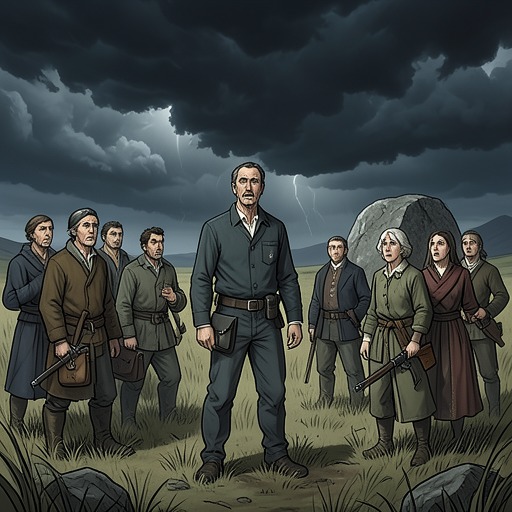
During a spell of extraordinary childhood episodes, Loïc sees a sinister radiance enveloping Touladi and especially his home in enormous black tentacles. The beam appears to originate at the Founder’s House. He understands it as the cameo’s diabolical magnetism, a force no safe could contain. In his vision, the ray cuts across the portrait of Le Fondateur and points down toward the cellar and the foundations, where stillborn children lie.
The scene makes the house’s architecture part of the threat. The cellar is not simply a place where the object is kept: it opens onto buried death, with hollow echoes rising from below and rats and other vermin multiplying in the dark. Loïc imagines innumerable minute forces working into matter, termites of the visible and invisible that gnaw away at foundations that seem solid. The image connects the cameo’s unseen influence to gradual erosion: the threat is not only a sudden apparition, but something that works beneath the surface and undermines what appears secure.
The radiance also gives the jewel a striking kind of agency. It seems to select and connect places, fixing on the family home, crossing the founder’s portrait, and directing attention toward the cellar. In this account, the cameo is more than a symbol of a family’s fears: Loïc perceives it as the source of a field that acts upon the surrounding space. But the vision remains his perception, not an independently verified event, preserving uncertainty about what the force is and how it operates.
Memory, doubt, and retrospective meaning
The knowledge Loïc acquires in the vision does not remain available to him. It sinks into his subconscious, and the episode disappears into what he later experiences as a locked region of memory. He forgets the wormlike form associated with his extraordinary projection, although he retains a disturbing sense of a void in his childhood, as if much of that period had fallen into an inaccessible darkness. For decades, he has unconsciously obscured what he recalls as a dangerous incursion into another world.
Looking back after half a century, Loïc entertains more than one explanation. The flying-worm episode might have been a fantasized extension of an airplane ride with his aviator father, carrying the aerial view of the village into a surreal realm. He also connects it to the painful division between enemy fathers and to a wish to escape gravity, confinement in time and space, and the weight of existence and destiny. These possibilities offer psychological and symbolic readings of the experience without erasing its uncanny detail: in the same episode, he had perceived the cameo’s fatal radiance, a discovery whose significance would become clear later.
Loïc also wonders whether an invisible double had drawn him through the mirror into the underside of reality, accounting for a lifelong capacity to perceive beyond the immediate. He had once told a psychoanalyst that he must have dreamed the events or experienced fever-induced hallucinations. The narrative does not settle the question in favor of either supernatural perception or illness. Instead, it emphasizes the persistence of the memory and the way later people, realities, or experiences can briefly revive its buried source.
Curse, family history, and continuing influence
When Loïc returns to school after one winter, another misfortune strikes the family, particularly him. The timing makes him wonder whether fear of the devil—or fear itself—has summoned the curse; he also suspects that the cameo’s radiance continues to exert its malefic influence in the Founder’s House. The sequence binds childhood dread to family calamity, but it does not establish a simple, provable cause. The curse is felt through the convergence of remembered visions and events that seem to answer them.
Decades later, the language of a family curse returns to Loïc. In autumn 2001, as Roger Bolduc disappears in the collapse of the World Trade Center towers, Loïc recalls the curse Grébiche pronounced against Romuald Bolduc and his descendants. He hears in the old woman’s fate a biblical echo of Elijah, whose name her father shared, and remembers her as an extraordinary woman for whom he felt affection. The recollection makes the curse seem prophetic to him, but the novel presents that force through memory and interpretation rather than as a demonstrated mechanism linking the cameo to each later disaster.
At Guillaume D’Anjou’s wake, the cameo again emerges as an object with an outsized presence. Standing before his adoptive father’s body, Loïc wonders why he was brought, newly born, into a house where he was loved and raised among D’Anjous haunted by a jewel kept there. He recognizes that the cameo had occupied much of his childhood precisely because it was hidden, concealed, and stolen from every gaze. He does not yet know how much time and attention the stone will claim in his life. Its influence therefore extends beyond the childhood vision: it persists as a secret organizing force in family memory, linking concealed origins, death, inheritance, and the unresolved possibility that the material world is not as securely bounded as it appears.