Event 1
奥塔瓦勒大撤离
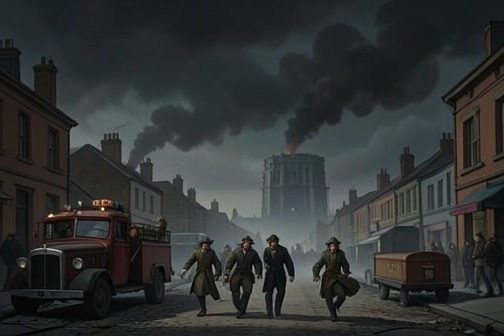
The [Grand Edict of the Exodus](entity:rule-recall-rule-1202f2407d86) was the mass departure that ended the ancient kingdom of [Otawalle](entity:location-recall-location-aa29b7c9f508)’s rule and gave rise to the [Kingdom of Aquafa](entity:organization-recall-organization-kingdom-of-aquaf-2fbf7a09fd3b). Its origin lies in a plague associated with black wolves; its defining act was [Takaluhalu](entity:character-recall-character-takaluhalu-474f86bc4612)’s decision to abandon the capital, isolate it, and save those not yet infected. The event survives not simply as a catastrophe but as a founding story whose terrible choices shape later arguments about disease, authority, and divine punishment.
## Background: The Plague and the Capital
About two and a half centuries before the events recounted in the novel, an epidemic swept through Otawalle, killing many capable statesmen before spreading through the kingdom. Its political structure weakened, and the decline of a realm that had flourished for thousands of years accelerated. Some later accounts attributed the disaster to divine anger at Otawalle’s exceptional knowledge, but the cause of the kingdom’s original collapse remained obscure.
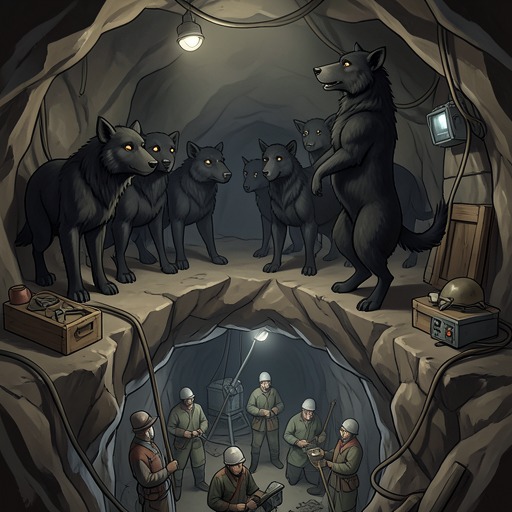
In the account [Hohsalle](entity:character-recall-character-hohsalle-658870c2400e) gives [Yotalu](entity:character-recall-character-yotalu-a3a5548dce4d), the plague’s story begins with black wolves brought back from the [Toga Mountains](entity:location-recall-location-5851ff07b2d5) by noblemen hunting for sport. Their unusual appearance made them fashionable acquisitions, and merchants and hunters captured and sold them. Historical records, as Hohsalle relates them, also say that some wolves were bred with dogs. The first animals may not have carried the disease; the trade nonetheless brought the wolves into the capital and multiplied human contact with them.
The first reported victims were black-wolf merchants who had been bitten. The illness appeared to disappear after the Divine King banned the trade, then returned as summer approached, now killing people who had not been bitten by wolves. [Academy of Deeper Learning](entity:organization-recall-organization-academy-of-deepe-d32e95260e66) physicians suspected transmission from wolves to blood-feeding fleas and ticks, then to rats. The disease began in the poorest, most crowded districts and spread across the capital; attempts to exterminate rodents and pests began only after thousands had died.
## The Exodus and Its Cost
Otawalle’s capital stood among three islands in a large inland sea. The location had offered strong defense against invasion, but its enclosed environment was also thought to have made the plague unusually lethal. That same geography offered a means of containment: the capital could be cut off from the mainland.
When Yotalu asks how the people stopped the disease, Hohsalle answers that they abandoned the capital. King Takaluhalu left the sick and those who refused to leave behind, then destroyed the long bridge connecting the capital to the mainland. The severed crossing isolated the infected city and helped protect those who had not contracted the illness, but it made the rescue inseparable from the abandonment of the people remaining there.
The ancient records describe the departing Otawalle walking naked and weeping in single file across the bridge. Hohsalle calls the scene a farce in its recorded presentation, while emphasizing that the fate of those left behind was no joke. The contrast exposes the human cost beneath the formal name of an edict: collective survival was achieved by drawing a boundary between those who could leave and those who could not or would not.
## From Otawalle to [Aquafa](entity:location-recall-location-aquafa-8f29c334cc79)
After leaving the capital, Takaluhalu moved the seat of government to [Kazan](entity:location-recall-location-4c001e8b4674), a trading city in Aquafa that had escaped the plague. He relinquished his crown to Kazan’s young ruler in exchange for a pledge to preserve local autonomy for the diverse peoples of the former realm. In this way, Aquafa’s kingdom began as a political settlement shaped by the flight from black wolf fever, not simply as the continuation of Otawalle under another name.
The transfer of authority followed the ancient kingdom’s longer retreat from centralized rule. Otawalle survivors established a Sacred Territory in a mountain-ringed valley and devoted themselves to preserving and developing medicine and other fields. They retained substantial influence through their learning and information networks, even after giving up their own country. Thus the Exodus ended one form of Otawalle sovereignty while its knowledge and institutions continued to affect the political life of Aquafa.
## Memory, Rumor, and Later Consequences
Hohsalle recounts the Exodus through the Ballad of the Fall of Otawalle, an epic whose opening refers to black shadows arriving from white mountain peaks. In his explanation, those shadows are the black wolves. The song gives the outbreak a memorable origin, while Hohsalle’s historical account distinguishes the stages of transmission and the uncertainty surrounding the plague’s earliest appearance.
The story also recurs as a practical warning in the present. Hohsalle tells Yotalu that the disease does not spread from person to person and that symptoms appear quickly after an infected animal bites its victim. This knowledge offers a basis for recognizing and responding to the illness, but the old catastrophe cannot be reduced to a simple lesson: the epidemic’s spread through other carriers and the abandoned capital show how quickly limited knowledge and delayed action can turn an outbreak into a civic disaster.
Later rumors recast the disease as the [Curse of Aquafa](entity:expression-recall-expression-curse-of-aquafa-57e92d22306c), claiming that it kills Zolians but spares Aquafaese. Hohsalle rejects the claim as unproved and warns that belief in immunity could make Aquafaese less cautious around disease-bearing animals. He further fears that wider exposure might allow the illness to change and spread through insects feeding on infected humans and animals. The Exodus therefore stands behind both scientific inquiry and political myth: a past plague is invoked to explain present deaths, even as Hohsalle insists that such explanations must not replace attention to how infection actually spreads.
The tale’s political meaning is similarly unsettled. Otawalle’s withdrawal from its capital preserved the uninfected, but Takaluhalu’s decision also meant leaving part of his people behind; Hohsalle suggests that the king may have concluded he was unfit to rule. Centuries later, stories of divine punishment can turn the memory of that loss into a weapon against outsiders. The Exodus remains foundational precisely because it joins a kingdom’s birth to an act of emergency rule whose human and political costs were never erased.
Event 2
阿夸法并入佐尔帝国
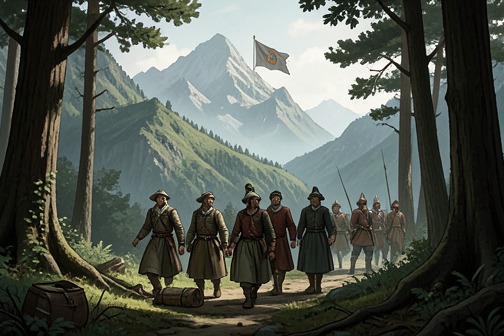
[Aquafa](entity:location-recall-location-aquafa-8f29c334cc79)’s annexation by the [Zolian Empire](entity:organization-recall-organization-zolian-empire-4da7f7d07f96) turned a kingdom into a province while leaving its inhabitants with a status denied to many communities on its borders. The conquest was not a single change of ruler: it brought a system of differentiated citizenship, frontier settlement, taxation, and land use that redistributed security and hardship across the region.
## Conquest and Political Settlement
The [Toga](entity:location-recall-location-toga-c18b33a0726c) region, in western Aquafa, was the last part of the kingdom to be swallowed by the advancing Zolian forces. Its mountain clans understood that they could not defeat the empire, but surrender without resistance seemed likely to leave them little better than slaves. Flight offered no safe alternative: the [Kingdom of Mukonia](entity:organization-recall-organization-97a52f696e5f) lay to the west and was described as even more oppressive than [Zol](entity:organization-recall-organization-zol-e274a7ee1291).
Aquafa’s rulers instead secured a political accommodation. The kingdom allied itself with the invaders and became a province, enabling the Aquafaese to remain ordinary citizens under the new regime. The former king could still send messengers to the Toga clans and seek terms for their safety, but he no longer had authority to determine their standing. With Aquafa reduced to a province, he could plead for their lives, not guarantee their rights.
The settlement in Aquafa had older roots. When an epidemic had weakened the [Ancient Kingdom of Otawalle](entity:organization-recall-organization-ancient-kingdom-398970d1b248), its last ruler, King [Takaluhalu](entity:character-recall-character-takaluhalu-474f86bc4612), moved the capital to [Kazan](entity:location-recall-location-4c001e8b4674), a trading center untouched by the disease. He transferred authority to the young Aquafaese ruler in return for a pledge of local autonomy for the realm’s diverse peoples. That arrangement founded the [Kingdom of Aquafa](entity:organization-recall-organization-kingdom-of-aquaf-2fbf7a09fd3b); its later accommodation with Zol preserved some autonomy, but did not preserve equal standing for every community within its borders.
## Unequal Citizenship and Frontier Rule
The Toga clans spoke the Aquafaese language and had defended Aquafa’s borders against Mukonian incursions. Under the Aquafaese king they had been treated as independent communities, with loose autonomy in return for allegiance. Zol, however, did not recognize them as Aquafaese citizens. Their history of service and cultural connection did not secure them the ordinary-citizen status enjoyed by the kingdom’s settled population.
This difference had a practical consequence: Zolian policy relocated lower castes to other conquered territory. Without recognition as ordinary citizens, the clans faced removal from their homelands and an uncertain livelihood in unfamiliar places. The Gansa leaders therefore devised a strategy of apparent resistance. They hoped a formidable show of fighting would persuade Zol that the clans were valuable allies, able to protect the empire’s western flank and serve as a buffer against [Mukonia](entity:location-recall-location-93059a62948b), and thus earn permission to remain.
The [Lone Antlers](entity:character-recall-character-lone-antlers-d3223a9e4b71) made that strategy possible. This ancient band of death warriors consisted of men who had been deprived of ordinary lives and vowed to serve as a shield for the Gansa. Its members could set aside the clan’s usual rules in exchange for the obligation to give their lives in its defense; outsiders escaping calamity could also join. Epidemics and warfare had left many men without families, swelling the band to unprecedented numbers. The clans’ proposed resistance was therefore not simply a bid to defeat Zol: it was an attempt to negotiate a survivable place within the empire’s frontier order.
## Settlement, Administration, and Taxation
Zolian expansion also relied on settlers. Poor farmers and herders from the edges of the empire were ordered to move into newly conquered frontiers and build Zolian-style communities. They raised crops and livestock familiar to Zol, constructed towns, and mingled with conquered populations, serving as an unarmed vanguard for making new territory part of the empire. Lower taxes and ownership of the land they cleared could benefit people who had previously been tenant farmers, but relocation also meant losing the possibility of returning home. The policy extended imperial influence through settlement as well as military conquest, while imposing its own cost on the settlers dispatched to carry it out.
Imperial administration made even remote peoples legible to the state. Tax officers collected information about nomadic groups in areas such as the [Oki](entity:location-recall-location-oki-94c6eb206638) Valley and [Toga Mountains](entity:location-recall-location-5851ff07b2d5), recording populations and ages. Some people hid in the woods when officers arrived, so the records were not complete; nevertheless, they were considered accurate enough to help locate communities. The same bureaucratic reach that supported taxation later offered a way to search for people difficult to find, showing how frontier governance could turn population records to more than one purpose.
Tax burdens also shaped household decisions. In the Oki region, every reindeer incurred a head tax, while rates were lower for people of Zolian descent. In one family, that reduction applied only to [Kiya](entity:character-recall-character-kiya-d7233ee1d06e) and her son [Tohma](entity:character-recall-character-tohma-aaf4112f4482), offering little relief overall. Their household tried replacing some reindeer with pyuika, which were taxed less heavily, but lacked the knowledge to breed them successfully. The effort left the family close to disaster: a difference in tax category mattered, but did not erase the hardship created by the system.
## Land Use and Displaced Livelihoods
In the south, the [Yukata Plains](entity:location-recall-location-017a18593c77) had been the homeland of the [Ahfal Oma](entity:organization-recall-organization-ahfal-oma-3e0ac15e9b87), the People of the Fire Horse. Their small, strong fire horses had once served in Aquafa’s cavalry. After subjugation, Zol requisitioned the breeding stallions and turned the grasslands into pasture for sheep brought by immigrants. The settlers also planted rye and beans suited to the cold region, but rye poisoned many horses. The resulting conflict ended with Zolian troops suppressing an uprising, the execution of its instigators, and the Ahfal Oma’s expulsion from the plains.
The ecological effects were also political. The plains might look like Zol’s fields, but their vegetation supported local animals and a distinct balance. Converting them to sheep pasture and rye cultivation disrupted that balance; for the Ahfal Oma, the loss was not just a change in farming but the loss of their homeland and the livelihoods bound to it. A later discussion weighs the possibility that hardier black rye might make the poor soil more productive against the danger of treating the plains as interchangeable with Zol’s own fields. The debate underscores the competing measures of prosperity: increased settlement and agricultural output on one side, the disrupted lives and ecological relations of the people already there on the other.
## Consequences and Significance
The effects of annexation varied by place and status. Aquafa’s inhabitants retained ordinary citizenship, while the Toga clans faced possible removal; settlers gained land and tax advantages even as they were cut off from their former homes; and the Ahfal Oma were driven from their territory after conflict linked to introduced crops and livestock. In the Oki region, reindeer herders and Zolian immigrants sometimes intermarried and assisted one another, while Ahfal Oma displaced from the plains remained hostile to Zol and shunned a region where immigrants had become part of local life.
Annexation thus joined political incorporation to selective exclusion. The empire could preserve a province, grant advantages to some groups, and still deny other inhabitants secure citizenship or continued access to their land. Its reach appeared in military conquest, but also in the less dramatic instruments that followed: official categories, tax records, migration orders, new settlements, and transformations of the fields and pastures on which people depended.
Event 3
多贡山区抵抗战
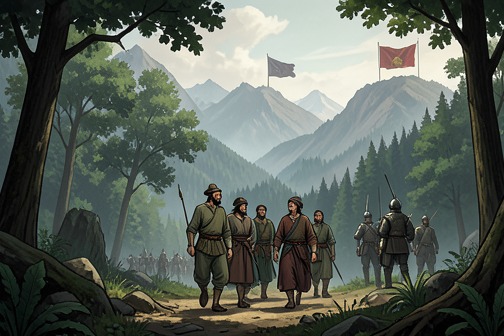
The [Toga](entity:location-recall-location-toga-c18b33a0726c) Mountain resistance was a nearly two-year campaign in which [Van](entity:character-recall-character-van-f4f93a307bf9) and the [Lone Antlers](entity:character-recall-character-lone-antlers-d3223a9e4b71) fought the advancing Zolian forces to influence the terms of the Gansa clans’ submission. Its central paradox was that the elders intended the fighting not as a path to independence but as a demonstration of military value: the clans hoped to secure a place within the empire without being driven from their homeland. The campaign’s tactics made that argument, and its fighters paid for it with their lives.
## Conquest and the Question of Status
[Aquafa](entity:location-recall-location-aquafa-8f29c334cc79) had become a province of the [Zol Empire](entity:location-recall-location-zol-e5e45a28a211), and its people were granted ordinary citizenship. The mountain clans of Toga, though they spoke Aquafa’s language and had defended its borders against incursions from the [Kingdom of Mukonia](entity:organization-recall-organization-97a52f696e5f), were not recognized as Aquafaese. Under the former [King of Aquafa](entity:character-recall-character-king-of-aquafa-d896b884e25a) they had retained loose autonomy in return for allegiance; under Zolian rule, that earlier arrangement offered no guarantee of their status.
The conquest put the clans in a perilous position. [Zol](entity:organization-recall-organization-zol-e274a7ee1291)’s forces had gradually absorbed Aquafa and, after securing its central government, turned to the remaining task of subjugating Toga. The King of Aquafa sent messengers to offer the clans negotiations over their safety, but as a ruler whose kingdom had become a province, he could plead for their lives without deciding how the empire would classify them. Imperial policy called for lower-status populations to be relocated elsewhere in conquered territory. For the clans, losing the chance of ordinary citizenship therefore threatened not only their political standing but also their ability to remain at home.
## A Strategy of Staged Resistance
After deliberating, the Gansa elders settled on a risky strategy: they would appear to resist Zol with a force prepared to fight to the death. The aim was to show that the clans could not be subdued cheaply and might instead make useful allies. Their knowledge of the mountains could help guard the empire’s new western frontier against [Mukonia](entity:location-recall-location-93059a62948b); if the Zolians valued that service, the Gansa hoped they might be allowed to stay.
The elders could contemplate this form of quasi-resistance because of the Lone Antlers, a band of warriors led by Van. Its members were men who had been deprived of ordinary lives, and its tradition traced its origins to the gods’ appearance as flying deer, or pyuika. Members were released from the usual rules binding the Gansa so long as they pledged to serve as the clan’s shield and give their lives when necessary. Outsiders fleeing calamity could also join as clansmen. The Toga frontier’s repeated epidemics, following incursions that brought both war and disease, had left many men bereaved; some of them joined the Lone Antlers, whose ranks grew to an unprecedented size.
When the elders offered Van and his men the mission, they accepted eagerly. Each carried sorrow and despair, and Van himself saw the assignment as a legitimate reason to make a final journey to his dead wife and son. His family had otherwise been lost to him, and he believed a rider who took his own life in despair would be denied the Land of Eternal Spring and condemned to walk the Road of Constant Day. The campaign thus carried a personal weight for Van, even as its political purpose belonged to the survival of the clans.
## Guerrilla Campaign and Its Result
Van’s fighters used Toga’s steep mountains and forests to offset the advantage of the Zolian troops. They drew the enemy into difficult terrain, attacked suddenly from the trees or descended from sheer cliffs, and relied on the speed and agility of their pyuika to outmaneuver mounted soldiers. Their methods turned the landscape into a military advantage and made the riders a source of fear for the occupying force.
For almost two years, the campaign continued. The pressure eventually led Zolian commanders to consider retreat and offer the tribal elders favorable terms for a truce. While negotiations proceeded, the Lone Antlers maintained the appearance of fanatical opposition to the elders, fighting on as though they rejected compromise. Once their mission had served its purpose, the band fell. Their defeat was therefore also the deliberate endpoint of a strategy whose desired result depended on making their resistance seem unyielding.
## Aftermath and Political Meaning
Van believed the elders and clansmen would not let the Lone Antlers’ deaths go to waste and would have secured whatever advantage they could from the campaign. But he did not know what had become of his homeland. His success had also earned him enemies among the Zolians, making a return dangerous: capture could bring further suffering to the people he wanted to protect. The campaign ended, then, without giving him either a secure homecoming or certainty about the settlement it had helped negotiate.
The conflict exposes the gap between being conquered and being incorporated on equal terms. Aquafa’s population received ordinary citizen status, while Toga’s clans—despite having fought for Aquafa’s borders—remained outside that category and faced the prospect of relocation. The Lone Antlers’ resistance answered this policy in the only currency the elders believed the empire might recognize: the military usefulness of the people it otherwise treated as expendable. Its bitter achievement was to turn a hopeless battle into leverage for the clans, while leaving the warriors themselves to bear the cost.
Event 4
卡舒纳河之战
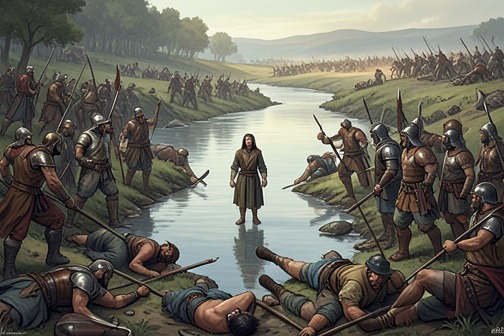
The [Battle of the Kashuna River](entity:action-recall-action-kashuna-river-9259394d6d5b) was the final catastrophe of the [Lone Antlers](entity:character-recall-character-lone-antlers-d3223a9e4b71)’ resistance to Zolian expansion: the Gansa warrior band was wiped out, while its commander, [Van](entity:character-recall-character-van-f4f93a307bf9), survived alone among the dead and was captured. The battle closes the account of a campaign designed to win better terms for the mountain clans through resistance, but its aftermath leaves Van with no clear knowledge of what that struggle achieved for his people.
## Background: Conquest and the Gansa Strategy
The battle belongs to the last stage of [Zol](entity:organization-recall-organization-zol-e274a7ee1291)’s conquest of [Aquafa](entity:location-recall-location-aquafa-8f29c334cc79). The mountain clans of the [Toga](entity:location-recall-location-toga-c18b33a0726c) region had fought to protect Aquafa’s borders from incursions by the [Kingdom of Mukonia](entity:organization-recall-organization-97a52f696e5f), but they were not treated as Aquafaese under the new imperial order. Although they spoke the same language and had once maintained a measure of autonomy under the [King of Aquafa](entity:character-recall-character-king-of-aquafa-d896b884e25a), Zol refused to recognize them as citizens. The clans therefore faced a forced move from their homelands and an uncertain life elsewhere in the empire.
The Gansa elders hoped to change that outcome by making resistance useful to the conquerors. They planned to present the clans as formidable fighters who might, after a show of defiance, negotiate a place in the imperial frontier system. Their aim was to persuade Zol that the Gansa’s knowledge of the mountains and their ability to act as a buffer against [Mukonia](entity:location-recall-location-93059a62948b) were worth more than relocating them. The Lone Antlers, a band of men who had given up ordinary lives to serve as the clan’s shield, made that strategy possible. Their ranks had grown as war and epidemics drove bereaved men to seek a place among them.
## The Campaign and Its Defeat
For almost two years, Van and the Lone Antlers fought in the steep, rugged terrain of Toga. They used their swift pyuika to outmaneuver Zolian horsemen, emerging from forest shadows or descending cliffs without warning. Their attacks made the riders a source of fear for Zolian troops. The pressure was sufficient to make enemy commanders consider retreat and offer favorable terms for a truce to the tribal elders.
The negotiations did not end the Lone Antlers’ part in the plan. While the elders negotiated, the warriors continued to act as if they defied the elders and would fight to the death. Once they had fulfilled their mission, they fell. The Battle of the Kashuna River was the destruction of the band: Van later recalled the battlefield as the place where Zolian forces crushed him and his men, and the account of his capture identifies the riverbank battle as the point at which he was taken.
## Van’s Survival and Capture
Van alone survived the battle. In the later recollection of the defeat, he is described as standing among a mound of bodies while the Lone Antlers were wiped out. Zolian commander [Yotalu](entity:character-recall-character-yotalu-a3a5548dce4d) confirms the scale of the loss when he identifies Van as the band’s leader and recalls that he had been told Van stood like a dead tree amid the fallen. Yotalu also had personal cause to remember him: Van had killed two of his best commanders.
The battle left Van in enemy hands. Records examined by Yotalu state that he was seized during fighting on the banks of the [Kashuna River](entity:location-recall-location-db97850a87dd); a damaged chain found later in the salt mine helps connect the prisoner once held there to the defeat. Yotalu recognizes him as Broken Antler Van, named for the missing left branch of the antlers on his helmet. The name that marks Van out as a leader thus also becomes a clue to his identity after the battle, long after his comrades have died.
## Aftermath and Meaning
The Lone Antlers’ defeat was not simply the loss of a fighting band. Their sacrifice had been the military part of the elders’ attempt to secure a more acceptable settlement for the Gansa, and Van believes the elders would not have allowed their lives to be spent without extracting whatever advantage they could. Yet he does not know what became of his homeland. He also fears that returning would expose his people to capture and further suffering, since his guerrilla campaign had won him powerful enemies among the Zolians.
The battle’s significance is sharpened by the contrast between its intended ending and its actual survivor. The Lone Antlers were meant to give their lives as the clan’s shield; Van did not choose survival, and his escape from the battlefield does not restore the comrades he loved or tell him whether the Gansa gained the protection they sought. During waking hours he vividly remembers his men being cut down, but he does not dream of the Kashuna River battle. Instead, dreams return him to the first man he killed, a young Zolian officer whose face unsettled his earlier image of the enemy. The battle therefore stands both as the end of the Lone Antlers and as a wound Van carries into the life that follows: he survives the destruction of his band, but cannot simply return to the world for which they fought.
Event 5
范携尤娜逃离盐矿
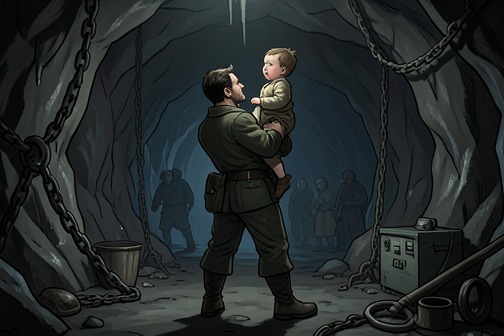
[Van](entity:character-recall-character-van-f4f93a307bf9)’s escape from the salt mine turns a flight from confinement into an act of rescue: after breaking free of his chain, he finds a living child hidden in an oven beside her dead mother and carries her beyond the mine’s perimeter. The escape joins physical release to a new responsibility, as Van leaves the compound with the child secured to his back rather than fleeing alone.
## Confinement and escape
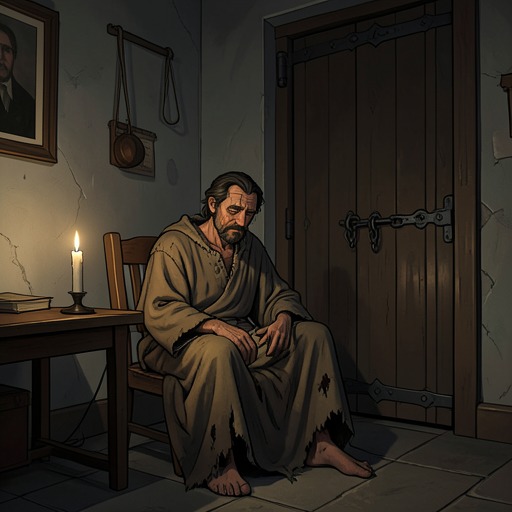
Van first staggers to his feet, unsettled by what he sees, and understands little of his situation. His immediate certainties are bodily and urgent: he must get out, and he is hungry. Anger at the chain holding him gives way to action. Though he knows he cannot pull the metal plate and bolts from the stakes set into the stone, he strains against the restraint until one thick ring twists open and breaks. He falls backward, then rises and runs with the severed length still attached to his ankle.
That break frees Van from the chain but not from the manacle. He searches the foreman’s house for the key and opens it, feeling the weight drop from his leg. The distinction matters: the first release comes through force and rage, while the second requires him to search the mine’s built environment for a means of removing what remains. He likens the relief to a dog shaking off its collar, an image that registers how completely confinement had marked his condition.
## The child in the oven
As Van searches the compound, muffled crying leads him to a room where the people lying on the floor appear dead. At the back, a young woman is propped against an oven, positioned as though she had tried to block its firebox. Her scarf has slipped out of place, and her hair clings to her cheeks. She appears to have died while struggling through fever and hallucinations to protect something inside the oven from the beasts.
Van gently moves the woman away from the opening. The crying becomes clear, and he sees a small child looking up at him, tear-streaked and clutching a crust of fahmu. The child’s survival is the decisive reversal in the escape: the room that first appears to hold only the dead also contains someone Van can still save. He speaks softly, offers his arm, and waits while she studies him before reaching out.
The girl can stand, though unsteadily, when Van sets her down. She reaches toward her mother’s body and says “Mauma.” Van holds her steady so she can press her face against her mother. His escape therefore does not erase the loss in the room; it carries the child away from it while allowing her a moment beside the woman who protected her.
## Leaving the mine
Van chooses not to open the south gate, although he thinks he could find its keys in the guardhouse. The mine is enclosed by a formidable iron fence, and the gate onto the road used for moving salt and supplies has remained shut because no one is there to open it. Van reasons that an open gate could reveal that someone has escaped. Instead, he places a discarded wooden tub by the fence near a garbage heap and lays a thick, frayed horse rug across the spikes at the top.
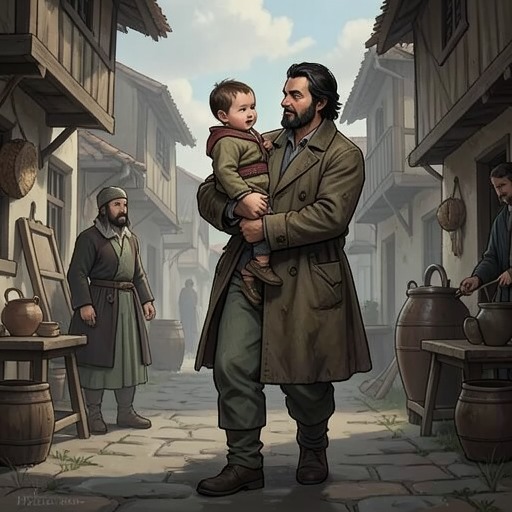
He throws his bag over first, then climbs across with the child on his back, and tips the blanket back toward the mine side. The route is deliberate: he uses what he finds at hand, crosses the barrier without opening the obvious exit, and avoids leaving the gate as a clear sign of flight. The baby sling he finds beside the child’s mother makes it possible to secure the girl to him and helps him climb.
On the far side, Van faces the forest. The child clings to his neck without making a sound; the sling may have reassured her, and it has certainly made the climb easier. The escape ends not with a return to safety or an explanation of what lies ahead, but with Van and the child outside the mine and facing the forest together.
## Significance
The event’s progression is defined by changing obligations. At first Van’s only stated aim is to flee, driven by fear and hunger; once he hears the child, leaving alone is no longer the action he takes. The chain’s sudden failure opens a path out, but the child’s discovery changes what escape means: freedom now depends on carrying another life across the same boundary.
The mine’s closed gate, spiked fence, discarded tub, and worn horse rug give the escape its practical shape. Rather than making the departure a simple dash for an exit, the narrative makes it a sequence of decisions: remove the ankle restraint, find the child, choose a less revealing route, and cross while carrying her. The final image of the child clinging to Van as they face the forest holds both the immediate achievement and its uncertainty: they have left the enclosure, but their destination is not given.
Event 6
范与托马相遇
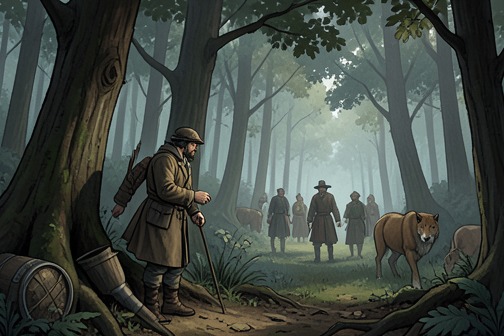
[Van](entity:character-recall-character-van-f4f93a307bf9) and [Tohma](entity:character-recall-character-tohma-aaf4112f4482)’s first meeting begins with a call for help that Van has every reason to distrust, but ends with a handshake and an invitation to share the [Oki clan](entity:organization-recall-organization-8d7b4969d8d1)’s uncertain hospitality. The encounter joins two immediate needs: Tohma needs his escaped pyuika, Tsupi, and Van needs work and a way forward. What starts as a wary rescue becomes the opening of Van and Tohma’s partnership, grounded not in grand declarations but in the return of an animal and an offer of shelter.
## The Call from the Forest
Van hears a faint voice beyond the trees and recognizes that the speaker is using Aquafaese, not Zolian, with the accent of the border clans. The northern lilt tells him the caller is not one of his former comrades. At first he continues on, even when the voice turns from a question into a desperate plea for help: the stranger says he has twisted his leg and cannot walk. Van knows that an apparent injury could be a trap; the woods are dangerous, and he has reason to expect thugs to exploit a passerby’s compassion.
He stops because a vivid impression unsettles his suspicion. Van becomes certain that the person is alone and is only a youth, although he cannot explain how he knows. The image that had come to him when he smelled smoke seems almost like something he had witnessed directly. Rather than treat the call as proof of danger or innocence, he decides to look for the hollow among the mossy rocks beyond the trees. The meeting therefore grows out of a tension between self-protection and an intuition that Van cannot dismiss.
## Tohma and the Missing Tsupi
In the hollow beneath a huge spruce, Van finds a pale, exhausted young man seated against one of three rocks, with one leg stretched out before him. A reindeer cart stands nearby, but the reindeer that should be harnessed to it is gone. The youth is roasting meat over a campfire and wears the hides of the northern nomads. His face combines features Van cannot readily place: narrow eyes and a flat nose that look Zolian alongside the marks of northern Aquafaese identity. The visible difference makes Van curious, but not hostile; he removes his hand from his weapon and asks how the youth hurt his leg.
The youth identifies the cause in a single word: ossam. He explains that he had been taking hides to sell in [Kazan](entity:location-recall-location-4c001e8b4674) when fallen trees blocked his usual route. After choosing another way, he found himself far from where he expected and had to camp for the night. A pack of ossam came out of the darkness like a black wave. He hid in his cart, and the animals flowed around it and vanished, but the frightened pyuika, Tsupi, had wound herself around a tree and nearly strangled herself on her tether. When Tohma freed her, she pulled the rope, knocked him down, and ran into the forest. His ankle was so badly twisted that he could not walk.
Tohma had waited at the campsite for three days, expecting somebody traveling to or from the salt mine to pass through. By the time Van arrives, the delay has left him frightened and convinced he may not survive there. His plight is specific and precarious: he is not merely separated from his mount but stranded, injured, and dependent on the chance that a traveler will choose to investigate an unfamiliar voice. Van’s decision to stop turns that long wait into the first step toward recovering both Tohma’s animal and his prospects.
## A Rescue Becomes an Exchange
The return of Tsupi changes the balance between the two strangers. Van finds her and leads her back to the campfire; Tohma’s mouth drops open, and he asks how Van managed it. Tsupi presses her nose against Van’s armpit while he strokes her and makes a clucking sound as he tethers her in the trees’ shade. She answers with a cluck and a shake of her head. Van asks whether Tohma knew that a pyuika would come to that sound. Tohma did not: the person who sold them Tsupi had said she would come when called by name, so that was what he had tried.
The rescue does not end with the animal’s return. Van asks whether, in return for bringing Tsupi back, Tohma will introduce him to a fur trader in Kazan. He explains that he can live by hunting, but circumstances prevent him from returning to his homeland, and he has come to Kazan looking for work. A trader could tell him about hunting rights and local regulations, information he needs before trying to earn a living in the area. Yet strangers have little chance of getting such help from traders protective of their own territory. Van’s request is thus a practical answer to his displacement, not a casual favor sought from a new acquaintance.
Tohma accepts the obligation created by Van’s help and first says he will introduce him to a trader. Then he goes further: he thinks he may be able to find Van a job himself. He cannot guarantee it, because the decision belongs to his father, but he wants Van to come with him and says his small, not wealthy clan will find a way to feed Van and the child traveling with him. Tohma’s offer makes the exchange reciprocal. Van has returned something essential to Tohma; Tohma offers a possible livelihood and a place to stay, though both depend on circumstances beyond his control.
## The Beginning of an Alliance
Tohma’s invitation is also tied to Tsupi’s future. He believes she may be carrying a young one, and worries that the birth could be difficult if she has mated with an elk. No one in the clan has seen a pyuika give birth, and Tohma recognizes that Van’s knowledge could help them keep the animal safe. The request to come live with the clan is therefore not only payment for the rescue or kindness to a stranger: it answers a concrete need within Tohma’s community.
Tohma urges Van to come, offers his hand, and gives his full introduction: he is Tohma yu [Oki](entity:location-recall-location-oki-94c6eb206638), Tohma of the Oki clan. Van accepts the handshake and gives his name in return. The gesture marks a change from guarded assessment to an agreement between people who have reason to help one another. Van arrived as a stranger looking for work; Tohma, stranded and afraid, had waited three days for assistance. Their exchange produces a possible place for Van and the child, while giving Tohma’s clan access to help with Tsupi.
The scene closes with late-afternoon sunlight cutting through rain-drenched trees. As Van looks at the light, he recalls a stream in his homeland and a leaf swept away by rushing water. The image links this new invitation to Van’s separation from home without resolving the circumstances that keep him from returning. The meeting does not erase his displacement; it opens a route through it, by way of a rescued pyuika, an offered hand, and a community willing to consider making room for him.
Event 7
Royal Falcon Hunt Attack
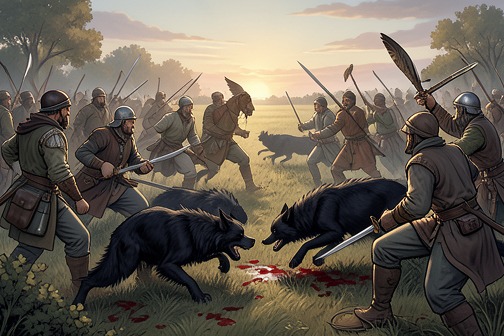
The [Royal Falcon Hunt Attack](entity:event-recall-event-royal-falcon-hunt-attac-bdeeaa95392c) is the sudden assault by black, wolflike beasts on falconers and guests at a royal hunt, transforming a field ceremony into a deadly melee. The attack leaves members of both Aquafaese and Zolian society bitten, including the royal family’s [Mazai](entity:character-recall-character-mazai-d7afc8cce0eb) and the governor’s family members [Utalu](entity:character-recall-character-utalu-cae02dc95bd7) and [Olimu](entity:character-recall-character-olimu-e8132407b9f7); the resulting cases become central to [Hohsalle](entity:character-recall-character-hohsalle-658870c2400e)’s investigation of the disease and its uncertain means of spread.
## Causes and Setting
The attack erupts at a falcon hunt attended by the [King of Aquafa](entity:character-recall-character-king-of-aquafa-d896b884e25a), the Zolian governor and their households. Its political contrasts are already visible in the gathering: [Yotalu](entity:character-recall-character-yotalu-a3a5548dce4d) stands with the Aquafaese royal family, while his older brother Utalu wears the blue headband of the Zolian team. Mazai’s son Olimu and Yotalu’s son are positioned together with their uncle, a falconer, to learn from him. The event thus brings members of the conquered country and the ruling power into a shared public space, with family ties crossing that political divide.
As the hounds bay, falconers turn toward the direction they expect the prey to emerge. Shrubs rustle behind them, and black shapes race out across the field. At first, [Makokan](entity:character-recall-character-makokan-0994878ab69f) and the watching guests mistake the beasts for hounds returning from the hunt. The spectators’ uncertainty delays recognition: alarm comes only when the animals charge directly at the falconers.
## The Assault
The black beasts leap upon the falconers as they turn to shield their hawks. Their bared fangs and streaming saliva mark them as more than ordinary hunting dogs. One falconer is knocked down while raising an arm to protect his throat, and the falcon on the nearest Zolian’s fist screeches and takes flight. The scene’s familiar order—the falconers facing the anticipated quarry—has become an attack from an unexpected direction.
A beast charges Utalu, but the veteran soldier responds without hesitation: he releases his falcon, draws his hunting knife, and faces the attacker. Mazai pushes the boys behind him; the pack surrounds them and briefly hides them from view. Across the meadow, shouting men and snarling animals replace the quiet of the autumn hunt. The King calls for his nephew, Yotalu for his son, and [Sulumina](entity:character-recall-character-sulumina-af9607e46c11) cries Olimu’s name.
The danger expands beyond the falconers and boys. The King and his guests rise, but guards hold them inside the pavilion. Aquafaese and Zolian soldiers run to help, then falter when still more beasts burst from the underbrush and rush toward the pavilion. Yotalu orders the soldiers to aid Olimu while the people at the pavilion hold their position; the King, in turn, urges them toward Mazai. The attackers have turned the hunt’s competing calls and commands into an urgent struggle to reach the endangered men and boys.
## Victims and Immediate Aftermath
When the immediate disturbance ends, the King and [Governor Ohan](entity:character-recall-character-governor-ohan-3827d1321a5c) recover their composure and direct their soldiers to assess the damage. The King asks Hohsalle to leave the washing of minor wounds to others and check those outside, and Hohsalle hurries from the pavilion. The attack’s victims include Mazai, his son [Izam](entity:character-recall-character-izam-75dec9e6511d), Utalu and Olimu. These named injuries connect the violence directly to both the Aquafaese royal family and the Zolian governing household, making the consequences more than a threat to unidentified hunters.
The morning after the attack, Hohsalle visits the governor’s palace to examine Utalu, one of the wounded. He has to visit all the victims and has managed only a quick breakfast before setting out from the clinic. Governor Ohan is expecting him; servants lead the physician deep into the palace, where [Lona](entity:character-recall-character-lona-b75615818481) is already taking Utalu’s pulse. The visit begins the transition from an assault in the open field to the close observation of individual patients.
## From Attack to Epidemic Investigation
The falcon hunt becomes a crucial reference point in Hohsalle’s effort to understand the illness affecting the bitten. He later gives a detailed account of how the disease appeared and progressed among those attacked at the hunt. His observations sit alongside the earlier salt-mine disaster, where victims developed symptoms rapidly and died in overwhelming numbers. Because no workers at the mine had shown signs of illness since that incident, Hohsalle argues that ordinary person-to-person spread, fleas or ticks, and transmission through the air do not adequately explain the pattern; bites from an infected beast appear more plausible. Yet he cautions against indiscriminately hunting wild dogs or wolves: shepherds were not reported to have fallen ill after attacks on sheep, suggesting that only particular animals might carry the infection.
The cases at the hunt also reveal unequal susceptibility. The Zolian falconer bitten near the chin develops the most severe symptoms most quickly, while Sulumina shows the greatest resistance, followed by Mazai and Olimu. Hohsalle regards the difference as a question for investigation, not proof of the politically charged [Curse of Aquafa](entity:expression-recall-expression-curse-of-aquafa-57e92d22306c). Identifying why some people resist the disease could help establish prevention, but he recognizes that surveying all of [Aquafa](entity:location-recall-location-aquafa-8f29c334cc79)—including remote regions and nomadic clans—would be a formidable task.
Later, a map assembled from reports shows that mittsual-like illnesses had appeared across the former [Kingdom of Aquafa](entity:organization-recall-organization-kingdom-of-aquaf-2fbf7a09fd3b) before either the salt-mine disaster or the hunt. Cases extend from the [Yukata Plains](entity:location-recall-location-017a18593c77) in the south to the [Oki](entity:location-recall-location-oki-94c6eb206638) forests in the north, and the oldest reported case dates back eight years. The accounts describe isolated wolf or ossam attacks, usually with only one or two people contracting the illness and no reported spread. Hohsalle finds this distribution difficult to reconcile with a disease carried by animals that live in packs: if one wolf’s bite infected people, further cases might be expected within the same pack’s territory, while years of tick and mosquito breeding should have widened the outbreak if those insects were transmitting it. The scattered records turn the hunt from an isolated catastrophe into one visible point in a longer, still-unexplained history of disease.
## Significance
The attack’s force lies in the reversal of an organized hunt. The participants wait for prey to emerge in a predictable direction; instead, the black beasts rush from behind the falconers and then multiply into a threat that also reaches the pavilion. The initial mistake—taking the attackers for returning hounds—shows how quickly a familiar animal spectacle can become deadly when its signs are misread.
The assault also gives the disease investigation a concentrated group of victims whose symptoms can be compared, while the later map complicates any assumption that the crisis began with the hunt. The event is both a public rupture and a medical puzzle: its victims make the danger immediate, but the widely separated earlier reports leave the underlying pattern unresolved.
Event 8
Black Wolf Fever Outbreak in Aquafa
The [Black Wolf Fever Outbreak in Aquafa](entity:event-recall-event-07342e5fd3c5) is a medical emergency and a contest over how its deaths should be understood. After patients bitten by animals develop a rapidly fatal illness, [Hohsalle](entity:character-recall-character-hohsalle-658870c2400e) investigates its possible transmission and urges precautions; meanwhile, the survival of some Aquafaese and the deaths of Zolians fuel the rumor that the disease is the [Curse of Aquafa](entity:expression-recall-expression-curse-of-aquafa-57e92d22306c). The outbreak’s significance lies not only in its lethality, but in the collision between incomplete evidence, religious doctrine, and an explanation that can turn infection into a weapon of ethnic blame.
## Causes and Early Investigation
The first established outbreak among the enslaved people at the salt mine had already made black wolf fever a concern. When the governor asks whether the new illness could be the same disease, Hohsalle confirms that the mine has experienced an outbreak and warns that, if the attacking animals were ossam, precautions are warranted. He proposes addressing both animals that may carry the disease and people who may have been infected. Simply killing suspected beasts would not be enough: Hohsalle also fears that fleas or ticks on infected animals could move to human hosts, so he argues for a thorough, cautious plan.
The available observations initially point toward animal bites rather than ordinary person-to-person spread. At the salt mine, victims appear to have been exposed around the same time, developed symptoms, and died nearly together; a gradual chain of human infections, Hohsalle reasons, would probably have allowed someone to report the outbreak earlier. The disease appears highly virulent and quick to manifest, with almost all the weakened enslaved people and even slave keepers dying. Yet people who continued working at the mine after the incident did not show symptoms. Hohsalle therefore doubts that fleas, ticks, or transmission through the air explain that episode, and considers infection through bites from a beast more plausible. He accepts that killing rats and mice would be prudent, but cautions against treating all wild dogs or wolves as equivalent: if animals had attacked sheep, shepherds bitten by them should also have fallen ill, yet no such reports had reached [Yotalu](entity:character-recall-character-yotalu-a3a5548dce4d). The task, Hohsalle concludes, is to identify and eliminate carriers, not to hunt indiscriminately.
## The Royal Hunt Cases
The outbreak’s course changes after the royal hunt. Patients with infected dog bites initially complain of fever and lethargy, symptoms that could be mistaken for ordinary consequences of bites. On the sixth day after the hunt, the Zolian falconer develops a rash. Hohsalle and [Milalle](entity:character-recall-character-milalle-01ffb4b71cd8) had prepared for this possibility; they move to respond, carrying medical supplies that must be transported specially. The rash marks the beginning of many sleepless days and nights.
The falconer’s illness then advances with alarming speed. What begins with cold-like symptoms, including a sore throat and fatigue, becomes characteristic of black wolf fever once the rash appears. The rash emerges early in the morning; by evening he has a high fever, feels profoundly heavy, and sinks into a stupor. Despite attempts to treat him, he dies during the night. His wife and daughter witness his death but cannot approach or touch him because of the risk of contagion. Milalle covers his face and leads them away to rest, while [Mana](entity:character-recall-character-mana-f7efa0f26440), the apprentice priest-doctor sent by [Lona](entity:character-recall-character-lona-b75615818481), introduces himself to the bereaved family and offers the presence of a healer.
At dawn the next day, the other Zolian patients break out in a rash. Medicine injected before the rash appears seems to delay their decline: they remain conscious until the following day. They then fall into comas in succession and die despite efforts to save them. By this stage, [Utalu](entity:character-recall-character-utalu-cae02dc95bd7) and [Olimu](entity:character-recall-character-olimu-e8132407b9f7) are the only surviving Zolians among the patients, while none of the Aquafaese patients develops a rash. The apparent difference in outcomes becomes a source of fear and speculation, but it does not by itself establish that Aquafaese are immune.
## Competing Explanations and Political Risk
The contrast between deaths and survival reaches the governor as a question about whether Aquafaese can die of the disease. Hohsalle responds cautiously: the illness has not been conclusively identified as black wolf fever, and it would be false to say that Aquafaese cannot die from it. The last recorded outbreak of black wolf fever was nearly 250 years earlier; although the present symptoms resemble the historical descriptions, resemblance is not proof of identity. Nor does the survival of the Aquafaese patients establish an ethnic rule. [Izam](entity:character-recall-character-izam-75dec9e6511d)’s symptoms, Hohsalle points out, were much more severe than those of Olimu, who is half Zolian; without [Limuelle](entity:character-recall-character-limuelle-d951360334bf)’s drastic intervention, Izam would probably have died.
Nevertheless, a religious and political interpretation is already spreading in [Kazan](entity:location-recall-location-4c001e8b4674). The claim that the returning disease is the Curse of Aquafa—divine retribution against those who violated the land—turns the patients’ uneven outcomes into supposed evidence of divine judgment. [Tohma](entity:character-recall-character-tohma-aaf4112f4482) repeats the popular account that only Zolians and immigrants die, while people of [Aquafa](entity:location-recall-location-aquafa-8f29c334cc79) and [Oki](entity:location-recall-location-oki-94c6eb206638) survive bites. He connects it to other stories: Olimu’s survival is attributed to his Aquafaese blood, whereas Utalu’s death is treated as meaningful because he had looked down on the local people. The salt mine deaths are folded into the same narrative: a place regarded as sacred to Aquafa was turned into a hellhole worked by enslaved people, and the attacking beasts are imagined as the [Hounds of the Gods](entity:expression-recall-expression-hounds-of-the-gods-5dad6c4b213a). These claims give separate events a powerful common explanation, but Hohsalle rejects the inference as unsupported.
Hohsalle also warns that the rumor can make the outbreak worse. If Aquafaese believe themselves immune, they may lower their guard around animals carrying the disease. Greater exposure, he fears, could allow the disease’s behavior to change. If it has the characteristics of black wolf fever, warmer weather and rising flea and tick populations could create a route for wider transmission through insects that have fed on infected people or animals. The immediate danger, in his view, is not that a curse has selected its victims, but that a false assurance of safety will encourage exposure while the means of spread remain uncertain.
## Outbreak Evidence and Unresolved Transmission
Hohsalle’s concern about prevention sits alongside a practical obstacle: treatment is still experimental. He has taken blood from patients to improve medicines made with weakened disease agents, but because every patient received the new medicine, the doctors cannot tell whether any would have survived without it. The falconer bitten near the chin showed the most dramatic and fastest severe symptoms. [Sulumina](entity:character-recall-character-sulumina-af9607e46c11) showed the greatest resistance, followed by [Mazai](entity:character-recall-character-mazai-d7afc8cce0eb) and Olimu. Hohsalle wants to know what accounts for that difference, and whether it could guide prevention more reliably than rumors about ancestry.
A broader investigation complicates the idea of a single new outbreak beginning at the salt mine. A map assembled by [Tomasolle](entity:character-recall-character-tomasolle-ca97d6d0a986) and Cheehana shows scattered cases of mittsual-like symptoms across the former [Kingdom of Aquafa](entity:organization-recall-organization-kingdom-of-aquaf-2fbf7a09fd3b), from the [Yukata Plains](entity:location-recall-location-017a18593c77) in the south to the Oki forests in the north. The oldest report dates back eight years, and the accounts describe separate attacks by wolves or ossam, usually with only one or two people falling ill and no reported onward spread. The salt mine incident is therefore not the beginning of every recorded case, even though it had become the popular marker of the crisis.
That scattered pattern raises a further epidemiological puzzle. If the disease is not passed from person to person but infected wolves live in packs, Hohsalle reasons, more cases should have appeared near a pack after its first infected bite. Several years have also passed, enough for ticks and mosquitoes to multiply through multiple summers. Yet the recorded cases remain isolated across a broad territory. Cheehana suggests that host animals may move on before transmitting the disease to ticks, but that possibility does not explain how dogs and wolves across such a wide area became infected in the first place. Tomasolle notes that northern and southern wolves could not simply have mingled; spread from one neighboring pack to another is a possible natural route, but it leaves another mystery unresolved. The evidence thus supports neither a settled account of transmission nor the claim that the disease follows ethnic or divine lines.
## Medical Doctrine and the Meaning of Cure
The outbreak unfolds against a longstanding conflict over medical authority. In the Pure Heart Creed, Zolian physicians are revered as the fingers of the god, and medicine is expected to follow divine teaching. When priest-doctors judge an illness incurable, the accepted practice is to leave the patient in the god’s hands and offer only medicines that ease a peaceful death. That principle has already been challenged by [Otawalle medicine](entity:concept-recall-concept-otawalle-medicine-99b510e0d0a8): Emperor [Natalu](entity:character-recall-character-natalu-59163cbc00c0) summoned Limuelle and Hohsalle to treat his gravely ill wife despite opposition from advisers who considered their remedies heretical. The two cured her, but their success provoked a confrontation between the emperor and the [association of priest-doctors](entity:organization-recall-organization-424ee15c3e69).
During the Aquafa outbreak, the possibility of an effective weakened-agent medicine makes that older clash immediate. Hohsalle argues that Aquafaese patients who lack resistance can die too, but that improved medicine could save them. If Zolians refuse inoculation and cannot be treated, however, the disease could in practice become a plague that only Zolians fear. The implication unsettles the room: people might interpret those deaths as divine will, and the Zolians’ presence in the disease’s homeland as the cause of their own suffering, leaving the Aquafaese free of blame. The governor does not decide lightly, but ultimately permits Hohsalle to continue developing and improving the remedies.
The outbreak therefore leaves two questions open at once: how the disease travels, and how communities will act while they do not know. Hohsalle’s case rests on comparison—symptom timing, the distribution of cases, differences in severity, and the absence of expected clusters—not on certainty. Against that careful but incomplete inquiry, the Curse of Aquafa offers a simple story that can redirect fear toward Zolians and persuade Aquafaese to take fewer precautions. The epidemic’s danger is consequently biological and interpretive: an uncertain infection threatens lives, while a confident but unproven explanation threatens to determine whose lives are protected.
Event 9
Jikalu Wood Treatment Breakthrough
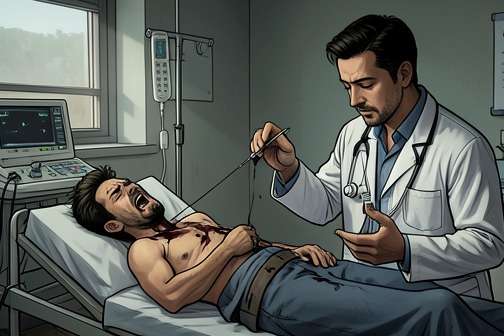
The [Jikalu Wood Treatment Breakthrough](entity:event-recall-event-bd92215d807f) is the experimental use of sedation and anti-mittsual medicine to treat [Black Wolf Fever](entity:state-recall-state-black-wolf-fever-8f2a7c72aa54), a turning point in the clinic’s effort to keep patients alive through the disease’s dangerous convulsions. Its promise lies not in a guaranteed cure but in a change of course: instead of allowing fatal symptoms to overtake patients, [Limuelle](entity:character-recall-character-limuelle-d951360334bf), [Hohsalle](entity:character-recall-character-hohsalle-658870c2400e), and [Milalle](entity:character-recall-character-milalle-01ffb4b71cd8) try to suppress those symptoms while the body fights the infection.
## Background and Medical Reasoning
In the Zolian Pure Heart Creed, physicians served as priests, and medicine was expected to follow divine teaching. If priest-doctors judged an illness incurable, the accepted practice was to leave the patient in the hands of the god and offer only medicines that would allow a peaceful death. The treatment developed at [Jikalu Wood](entity:location-recall-location-1c4ae2b1a1e1) represents a different account of disease and a different obligation to the sick: illness can be investigated, its agents resisted, and treatment attempted even when its outcome is uncertain.
That investigation begins with the bodies of the mine workers. Hohsalle identifies dog-bite marks and rashes across the corpses, evidence that the deaths were not caused by poisoned food. He explains that Black Wolf Fever can be transmitted by wolves and wild mountain dogs called ossam, and can spread even more dangerously through fleas or ticks that have bitten infected animals or people. In frost, fleas are mostly dormant, though they can survive through winter in warm places, including a dog’s body or near a hearth. These observations connect the visible evidence on the dead to a possible route of transmission.
The treatment strategy also rests on an emerging account of immunity. Milalle describes infected bodies as possible sources of disease agents that might be weakened to create resistance, substances that suppress or eliminate the illness, or antibodies that could be used to make a [serum](entity:object-recall-object-ddb239fd9804). Hohsalle explains the idea through the body’s internal defenders: like soldiers who must learn to recognize an enemy and acquire weapons to fight it, the body needs to be prepared to identify a specific disease. Limuelle, Hohsalle’s grandfather, had discovered that weakened disease agents could teach that recognition. The new remedy therefore belongs to a larger program of learning how illness works, rather than a single attempt to mask its symptoms.
## Sedation and the Trial in [Izam](entity:character-recall-character-izam-75dec9e6511d)
Milalle’s immediate reasoning draws on a prior case. A few years earlier, Limuelle had treated a young girl with rabies—the only successful case known—by using bossa, which had the same effect as [Kokalu](entity:object-recall-object-kokalu-75f8055b458e). By rendering the patient unconscious, he suppressed convulsions and stopped the brain’s commands from driving the body into them. At Jikalu Wood, Milalle believes a similar method might restrain Black Wolf Fever’s tremors, which had stopped patients from breathing, and give their bodies time to combat the disease agents.
Kokalu is useful precisely because it acts quickly without interfering with respiration, but it is powerful enough that a patient might never wake. Its use is therefore a risk, not a routine intervention. Once Limuelle administers it to Izam, the boy falls into a coma; his breathing is shallow, but it continues. That continued breathing establishes the immediate condition the treatment is trying to preserve.
Hohsalle reports that the new drugs had so far suppressed symptoms for only about a day and had not saved any of the patients treated previously. When Limuelle asks about supplies, Hohsalle says Milalle has prepared plenty of the anti-mittsual drug. Limuelle tells him to keep giving it to Izam. The plan, as [Makokan](entity:character-recall-character-makokan-0994878ab69f) understands it, is to inject the anti-mittsual drug while the boy is sedated, giving him strength to fight the illness without being overcome by the convulsions.
The treatment remains a gamble: Izam’s slight body may not withstand the battle. But he does not succumb to convulsions during the night. With Limuelle taking responsibility for his care, Hohsalle and Milalle can finally return to their beds and rest. The immediate result is modest but decisive: the boy survives the night without the symptom that had proved fatal to the other patients.
## Testing the Medicine and Its Risks
The experimental remedy is tested beyond Izam. After [Yotalu](entity:character-recall-character-yotalu-a3a5548dce4d) approves the next step, Limuelle gathers supplies in case [Sulumina](entity:character-recall-character-sulumina-af9607e46c11) has an allergic reaction and returns to the room where she and [Olimu](entity:character-recall-character-olimu-e8132407b9f7) are staying. Although Sulumina has asked to be injected first, the sight of the syringe makes her tense; Olimu also looks close to tears. Limuelle reassures the boy by appealing to his descent from a Zolian commander and the [King of Aquafa](entity:character-recall-character-king-of-aquafa-d896b884e25a), framing his brief endurance as a small test of courage. He injects the carefully measured serum into Olimu’s arm.
Olimu shows no signs of an allergic reaction. The injection site swells more than [Mazai](entity:character-recall-character-mazai-d7afc8cce0eb)’s, but the swelling does not develop into pronounced symptoms. Sulumina, by contrast, changes color soon after receiving the new medicine. The different responses make clear that the same treatment does not produce the same reaction in every patient, and that the team must remain alert to possible complications.
Mazai develops a rash that Hohsalle identifies as probably a drug rash and a likely allergic reaction. His loss of consciousness is the greater concern. That night he has convulsions, but they are less severe than those suffered by the other patients, end quickly, and never become life-threatening. The treatment has not made the reactions disappear; it has changed their course and severity.
The next morning, Olimu and Sulumina also lapse into a stupor and then convulse. Again, the episodes are not critical. After they subside, both fall into a long, deep sleep and wake about half a day later, disoriented, as if returning from a distant journey. Milalle tells them they will be fine and pats Olimu’s shoulder, unable to contain her joy. He looks embarrassed and cannot put what he wants to say into words. When she asks whether he had strange dreams, he nods. Their recovery gives the trial a human measure: not merely a change in symptoms, but patients waking after an alarming interval and being told they are safe.
## Significance and Limits
The breakthrough depends on several kinds of evidence being brought together: bite marks and rashes on the dead, knowledge of animals and parasites that transmit the disease, a prior successful use of sedation against rabies, and an explanation of how the body might be trained to resist infection. The approach does not erase the dangers. Kokalu may prevent breathing-threatening convulsions but can leave a patient unable to wake; the new medicine can provoke allergic reactions, and patients still experience stupor and convulsions. What changes is that those reactions prove noncritical in the cases described, while Izam survives a night without convulsions.
The clinic’s work also brings competing ideas of healing into focus. [Mana](entity:character-recall-character-mana-f7efa0f26440), a priest-doctor of the Pure Heart Creed, declines Hohsalle’s offer to show him the tiny organisms that cause disease. He considers direct observation of the patients sufficient: what matters, in his view, is recognizing defilement through the body and removing the obstacles it creates, not identifying the particular organism. He intends to devote himself to studying the human form and helping the sick live good lives. The contrast is not simply between concern and indifference: Mana remains committed to care, but understands its object and method differently from Hohsalle and Limuelle. Against the older practice of accepting an incurable diagnosis, the treatment at Jikalu Wood makes experimentation itself part of care—while leaving its uncertainty visible in every patient’s reaction.
Event 10
盐矿黑狼热事件
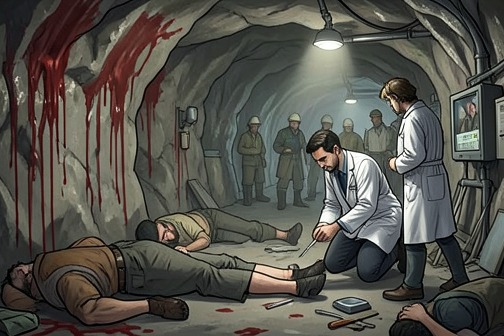
The [Salt Mine](entity:location-recall-location-6c800396ec7d) [Black Wolf Fever](entity:state-recall-state-black-wolf-fever-8f2a7c72aa54) event is the outbreak that killed the salt mine’s enslaved workers and turned an apparent local catastrophe into a wider medical and political crisis. The evidence of bites and rash led [Hohsalle](entity:character-recall-character-hohsalle-658870c2400e) to identify a disease associated with wolves and ossam, while the survival of [Van](entity:character-recall-character-van-f4f93a307bf9) and later cases sharpened questions about susceptibility, prevention, and the meaning of the outbreak. The mine’s victims also became central to efforts to understand and treat the disease.
## Causes and First Evidence
The disaster was recognized through the condition of the dead. Examining a body, Hohsalle pointed out that every corpse bore dog-bite marks and traces of a rash across the body. [Makokan](entity:character-recall-character-makokan-0994878ab69f) had initially suspected poisoned food, but the marks forced him to reconsider: the workers had died after being bitten, not from something mixed into a meal. The bodies thus supplied the first concrete evidence that this was an infectious disease associated with animal bites.
Hohsalle explained that black wolf fever could be transmitted by wolves and ossam, and that fleas or ticks which had bitten infected animals or people posed a further danger. He noted that cold weather reduced insect activity but did not eliminate the risk: parasites could survive in warm places, including on a dog or near a hearth. The outbreak was therefore not only a matter of identifying and killing infected beasts; the possibility that parasites could move to human hosts made precautions for people essential.
The mine’s security measures had failed to prevent the disaster. Later, [Tohma](entity:character-recall-character-tohma-aaf4112f4482) framed the outbreak in religious and political terms, recalling that the mine had been sacred to the people of [Aquafa](entity:location-recall-location-aquafa-8f29c334cc79) before the Zolians turned it into a place worked by slaves. He interpreted the deaths as divine punishment for the mine’s desecration, and wondered whether the dogs he had seen in the forest had been [Hounds of the Gods](entity:expression-recall-expression-hounds-of-the-gods-5dad6c4b213a) rather than ordinary ossam. This explanation belongs to the characters’ interpretation of the catastrophe, not to Hohsalle’s medical account.
## Investigation and Medical Response
The dead were also a possible source of medical knowledge. [Milalle](entity:character-recall-character-milalle-01ffb4b71cd8) explained that their bodies might contain disease agents that could be identified and weakened to produce a less potent infection capable of building resistance. Studying the agents could also help researchers seek substances to suppress or eliminate the illness. A further possibility was that infected victims had produced antibodies that might be used to develop a [serum](entity:object-recall-object-ddb239fd9804). The fact that the victims had died did not make their bodies medically useless: their remains might still disclose mechanisms for resisting the disease.
Hohsalle described the body’s defenses to [Yotalu](entity:character-recall-character-yotalu-a3a5548dce4d) through the image of soldiers. Different defenses performed different tasks, he explained, but the body could not necessarily recognize a dangerous agent on first encounter. Introducing a weakened version could teach those defenses to identify a particular disease and prepare to fight it. He credited his grandfather, [Limuelle](entity:character-recall-character-limuelle-d951360334bf), with discovering why some diseases are contracted only once and devising a way to introduce weakened disease agents. In the account of the mine outbreak, this explanation turns the question of why people died into a practical search for protection.
The medical approach stood in opposition to the Pure Heart Creed’s prevailing doctrine. Zolian priest-doctors were understood as “the fingers of the god,” and, when they judged an illness incurable, custom called for leaving the patient to divine will and offering only medicines that eased dying. Hohsalle and Limuelle had already challenged that authority by curing Emperor [Natalu](entity:character-recall-character-natalu-59163cbc00c0)’s wife with [Otawalle medicine](entity:concept-recall-concept-otawalle-medicine-99b510e0d0a8), despite opposition from the palace doctors. Their success had provoked conflict between the emperor and the priest-doctors; the mine outbreak gave the dispute over medical knowledge immediate human stakes.
## Survival and Competing Explanations
The sole survivor among the mine workers was Van, a member of the [Toga](entity:location-recall-location-toga-c18b33a0726c) [Ofal Oma](entity:organization-recall-organization-ofal-oma-8a35a8aef6d2). When Hohsalle considered the possibility of a further outbreak after an attack by ossam, Yotalu pointed to Van’s survival as evidence that people from Toga might resist black wolf fever. Hohsalle’s response was cautious: people exposed to the same disease might die or live, and accounts held that people from remote parts of Aquafa, [Oki](entity:location-recall-location-oki-94c6eb206638), and Toga could survive infection without showing symptoms. Because symptoms could appear very soon after infection, he proposed an injection containing a weakened disease agent as a precaution for those who might have been exposed.
That uncertainty left room for competing interpretations. Tohma later recalled that the mine outbreak was said to be where the wider crisis began, and connected the deaths to the Zolian use of a place he considered sacred. He also speculated that Van’s survival might reflect his Aquafaese heritage, while Yotalu had previously noted Van’s Toga background. These explanations differ from one another and from Hohsalle’s medical reasoning: the outbreak could be understood as divine judgment, as evidence of inherited or regional resistance, or as a disease whose spread and prevention required investigation.
## Aftermath and Significance
The outbreak’s consequences extended beyond the mine. Hohsalle warned that a suspected attack by ossam required action both against animals carrying the disease and on behalf of people who might have been infected. He stressed that exterminating the beasts alone would not suffice if ticks or fleas could transfer infection to humans. His proposed approach joined observation, preventive planning, and the search for treatments, rather than treating the dead as proof that no intervention was possible.
The event consequently became a point of intersection between medical practice, religious authority, imperial rule, and the political treatment of Aquafa’s people. The enslaved workers’ deaths revealed the scale of the danger, while Van’s survival and the proposed study of the victims’ bodies suggested that the disease might be resisted. Yet explanations of the catastrophe remained contested: clinical evidence pointed toward infection and transmission, while characters also read the same disaster through sacred history and the power relations surrounding the mine.
Event 11
古奥塔瓦勒王国覆灭
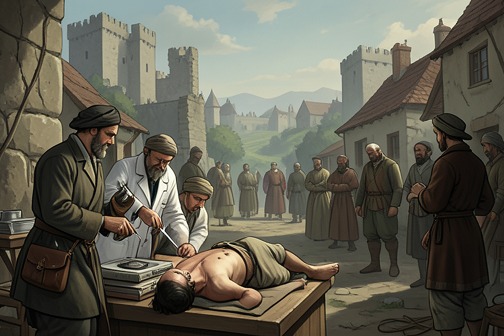
The fall of the [Ancient Kingdom of Otawalle](entity:organization-recall-organization-ancient-kingdom-398970d1b248) was a protracted collapse triggered by a devastating epidemic and followed by a deliberate transfer of political authority. The kingdom disappeared, but its people and expertise endured: survivors preserved their learning in the Sacred Territory, and their history became a model for understanding both imperial incorporation and the long reach of disease.
## The Kingdom Before the Epidemic
The Ancient Kingdom of Otawalle had flourished for thousands of years across a broad territory that included the salt mine, the [Yukata Plains](entity:location-recall-location-017a18593c77) to the south, the [Oki](entity:location-recall-location-oki-94c6eb206638) District in the north, and the [Toga Mountains](entity:location-recall-location-5851ff07b2d5) in the west. Its people were accomplished in medicine, engineering, and the arts, and their surviving cultural memory included odes to the prosperous lives they had led. Its later collapse thus marked not merely a change of rulers, but the end of a substantial and long-established political order.
About two and a half centuries before the events of the main story, a strange disease killed most of the kingdom’s capable statesmen before spreading into a full epidemic. The loss of so much political leadership shook the foundations of the realm and was followed by its rapid decline. Some people attributed the disaster to [Otawalle](entity:location-recall-location-aa29b7c9f508) knowledge exceeding human limits and provoking divine anger, but the actual cause remained obscured; the historical account presents that explanation as a claim, not a confirmed truth.
## The Transfer of Power and Survival
As the kingdom failed, its ruling class prepared for the transition rather than allowing the political crisis to become an account of sudden, total destruction. The last ruler, King [Takaluhalu](entity:character-recall-character-takaluhalu-474f86bc4612), moved the capital to [Kazan](entity:location-recall-location-4c001e8b4674), a trading center in [Aquafa](entity:location-recall-location-aquafa-8f29c334cc79) that had escaped the epidemic. He transferred authority to the young Aquafaese ruler in return for a pledge to preserve local autonomy for the realm’s diverse peoples. This settlement initiated the [Kingdom of Aquafa](entity:organization-recall-organization-kingdom-of-aquaf-2fbf7a09fd3b): the old kingdom’s sovereignty ended, while a political arrangement intended to protect its inhabitants continued under a new name and ruler.
The surviving Otawalle established the Sacred Territory in a valley surrounded by rugged mountains. There they devoted themselves to refining their knowledge and skills, including medicine. Their survival made the fall a history of displacement and institutional change as well as loss: the kingdom’s political body was gone, but its people retained a place in which their learning could continue.
## The Fall’s Later Meaning
Centuries later, the Otawalle’s defeat could be understood through the language of incorporation rather than simple victory or extinction. [Milalle](entity:character-recall-character-milalle-01ffb4b71cd8) described a people consumed by a stronger power as becoming part of the body that consumed them. For [Makokan](entity:character-recall-character-makokan-0994878ab69f), that image captured how the kingdom had been destroyed while its people survived by entering another political order; he recognized that this kind of endurance required both skill and resolve. The Otawalle saying “Live by helping other nations live” expressed the same principle, making survival through contribution a lasting cultural ideal rather than a claim that the old kingdom had won.
The epidemic also remained consequential as inherited knowledge. [Hohsalle](entity:character-recall-character-hohsalle-658870c2400e) recalled reports that people bitten by infected black wolves had developed and died from the disease, while inhabitants of remote Aquafa, Oki, and [Toga](entity:location-recall-location-toga-c18b33a0726c) were said to have survived without symptoms. He used that reported contrast to consider immediate injection of a weakened disease agent as a possible way to prevent illness in those exposed. [Van](entity:character-recall-character-van-f4f93a307bf9), meanwhile, said the Toga elders had taught that no one from the mountains had died of such an illness, even though the black wolves from his homeland had carried the disease that wiped out the Ancient Kingdom of Otawalle. The fall therefore persisted in the present not only as a political memory, but as evidence in an urgent inquiry into why some populations succumbed and others endured.
## Historical Echoes in Imperial Rule
The kingdom’s disappearance also frames the political pressures faced by the mountain clans of Toga under Zolian rule. Aquafa had joined the empire and its people were recognized as ordinary citizens, but the clans were not treated as Aquafaese, despite speaking its language and having defended its borders. Their earlier autonomy under the [King of Aquafa](entity:character-recall-character-king-of-aquafa-d896b884e25a) did not secure them citizenship after the change of sovereignty. [Zol](entity:organization-recall-organization-zol-e274a7ee1291)’s frontier policy threatened to relocate lower-status populations, making political classification a direct threat to local belonging and livelihood.
The Gansa elders consequently considered feigning resistance: a show of military usefulness might persuade the empire to let the clans remain in their homeland as a buffer against [Mukonia](entity:location-recall-location-93059a62948b). This strategy depended on the [Lone Antlers](entity:character-recall-character-lone-antlers-d3223a9e4b71), a band of warriors whose existence made a show of resistance possible. The echo of the older collapse is not that the two political crises were identical, but that both expose the vulnerability of communities when sovereignty changes hands—and the difficult calculations by which people seek to preserve their lives, knowledge, and place under a stronger power.
Event 12
火马族起义与逐出雪原
The [Ahfal Oma](entity:organization-recall-organization-ahfal-oma-3e0ac15e9b87) uprising and expulsion from the [Yukata Plains](entity:location-recall-location-017a18593c77) mark how Zolian conquest changed the land as well as its population. After immigrant farming introduced rye that killed fire horses, the Ahfal Oma attacked a village; the empire put down the revolt, executed its instigators, and forced the People of the Fire Horse from their homeland. The episode’s causes and consequences are inseparable: ecological change became a struggle over livelihood, and retaliation ended in dispossession.
## Causes and Background
Before the conquest, the southern Yukata Plains were home to the Ahfal Oma and their red-coated fire horses, once the mounts of [Aquafa](entity:location-recall-location-aquafa-8f29c334cc79)’s cavalry. Following subjugation, the Zolians requisitioned the stud horses and used the grasslands as sheep pasture for immigrant herders. The empire’s settlers also brought crops such as rye and beans, altering what was grown on the plains and who could make a living there.
The consequences were not limited to competition over grazing land. Fire horses died after eating rye, a crop that could become toxic to them. The Ahfal Oma, whose lives and identity were closely bound to the horses, blamed the new cultivation and the settlers who brought it. In contrast, [Kiya](entity:character-recall-character-kiya-d7233ee1d06e), a Zolian immigrant, described rye as one of the crops that could grow in the cold north and provide food for her family. The same plant could sustain one community and devastate another.
## Revolt and Expulsion
The deaths of the horses provoked the Ahfal Oma to set fire to an immigrant farming village. Zolian soldiers intervened to suppress the uprising, and the instigators were executed. The empire then drove the Ahfal Oma from the Yukata Plains. Their rebellion did not restore access to their homeland or reverse the changes to its land use; instead, it ended with their removal.
The expulsion scattered the Ahfal Oma. Some went to the highlands to live among the [Ofal Oma](entity:organization-recall-organization-ofal-oma-8a35a8aef6d2), while others raised horses for caravans or moved northwest to make a living in unfamiliar country. Few settled in [Oki](entity:location-recall-location-oki-94c6eb206638). There, forest-dwelling communities had increasingly intermarried with Zolian immigrants, a development that the Ahfal Oma’s continuing hostility toward the Zolians made difficult to accept.
## Unequal Belonging Under Zolian Rule
The revolt took place within a broader system that sorted conquered peoples by status and utility. Aquafa had allied with the invaders and became an imperial province, allowing its people to retain ordinary-citizen status. The mountain clans, despite speaking Aquafa’s language and having defended its borders, were not recognized as Aquafaese citizens by [Zol](entity:organization-recall-organization-zol-e274a7ee1291). Imperial policy could relocate people classified as lower castes to other conquered territories, making lack of recognition a threat to remaining in one’s homeland.
Zolian expansion also depended on settlers sent to the frontier. Poor farmers and herders from the edges of the empire were ordered to establish communities, raise familiar crops and livestock, and mingle with conquered populations. Their taxes could be lower than at home, and the cleared farmland could belong to them, but they were separated from their native lands and placed in the midst of peoples whose livelihoods the settlement process disrupted. The Ahfal Oma revolt unfolded within this imposed frontier order, where settlers and displaced inhabitants bore different costs of imperial policy.
## Memory and Consequences
The episode remained present in later encounters between the affected communities. In Oki, [Ohma](entity:character-recall-character-ohma-0e2984dc5913) recalled that the plains people had attacked immigrants over crops that made their horses sick. [Van](entity:character-recall-character-van-f4f93a307bf9) remembered the uprising more fully: the Ahfal Oma had burned a village, Zolian soldiers had put down the revolt, and its instigators had been executed before the people were expelled. Kiya suggested that the Ahfal Oma might not have known rye could turn toxic, while Van considered whether local wheat differed from the imported grain. The competing explanations do not undo the loss; they show how the same agricultural change entered one community’s memory as a source of food and another’s as the beginning of exile.
Later discussion of the plains likewise placed ecological transformation beside imperial ambition. [Tomasolle](entity:character-recall-character-tomasolle-ca97d6d0a986) argued that the region’s particular plants supported its own animal life, so replacing them with sheep pasture and rye disturbed an existing balance. The director, by contrast, observed that hardy black rye might thrive in poor soil and eventually make the plains more prosperous. That prospective prosperity does not erase the earlier price: the land’s new productivity was being imagined after the Ahfal Oma had been driven away. The uprising thus reveals the human consequences hidden inside apparently practical changes to crops, livestock, and settlement.
Event 13
索拉疯犬事件
The [Mad Dog of Soola](entity:time-recall-time-mad-dog-of-soola-e30110cb677f) was an earlier rabies outbreak remembered in the midst of the later mittsual crisis. Its defining medical precedent was [Limuelle](entity:character-recall-character-limuelle-d951360334bf)’s survival of a young patient: by using a potent sedative to suppress convulsions, he gave her body time to fight the disease. The episode informs a new treatment discussion, but it also stands against a Zolian religious tradition that could regard incurable illness as beyond medical intervention.
## Religious Medicine and [Otawalle](entity:location-recall-location-aa29b7c9f508) Practice
In the Zolian Pure Heart Creed, physicians were revered as “the fingers of the god.” Because medicine governed life and death, priest-doctors were expected to follow divine teachings. When they declared a condition incurable, accepted practice was to leave the patient in the god’s hands and provide only medicines that would ease dying. Limuelle’s approach, and the effort to learn from it, therefore challenged more than a particular treatment: it contested who could define the limits of care.
The clash had already become political when Emperor [Natalu](entity:character-recall-character-natalu-59163cbc00c0) summoned Limuelle and [Hohsalle](entity:character-recall-character-hohsalle-658870c2400e) to treat his gravely ill wife. They cured her despite strong opposition from advisers who considered Otawalle remedies heretical. Natalu asked the two physicians to remain at court and teach their methods, but the priest-doctors resisted furiously. Limuelle and Hohsalle ultimately declined the offer; nevertheless, their success and the dispute surrounding it alerted Zolian aristocrats to the possibilities of [Otawalle medicine](entity:concept-recall-concept-otawalle-medicine-99b510e0d0a8).
## The Earlier [Rabies](entity:state-recall-state-869e5e1dc47d) Case
As the later patients’ convulsions raised the question of whether to use kokalu, [Milalle](entity:character-recall-character-milalle-01ffb4b71cd8) recognized a possible precedent in the treatment associated with the Mad Dog of Soola. Hohsalle recalled that the earlier case had used bossa, not kokalu, while Milalle noted that kokalu was more potent. The comparison offered a basis for action, but not a simple assurance: the drugs had similar effects, and the stronger medicine carried a risk of leaving a patient unable to wake.
Milalle explained that Limuelle had saved a young girl with rabies a few years earlier, in what she described as the only successful case. He used bossa to render the girl unconscious and suppress her convulsions. In the current illness, patients had died when convulsions stopped their breathing; the proposed reasoning was that suppressing the tremors could give the body time to resist the disease agents. The previous rescue thus supplied a treatment model precisely where the present crisis offered little certainty.
## From Experience to Prevention
The later investigation makes clear how the physicians’ reasoning extended beyond treating a single patient. They considered isolating the agents responsible for mittsual, weakening them to produce a less potent infection that could build resistance, and seeking substances that might suppress or eliminate the disease. They also proposed that survivors or victims might have developed antibodies useful in a [serum](entity:object-recall-object-ddb239fd9804). These were distinct possibilities, not guaranteed remedies; the earlier rabies case, by contrast, was a concrete example of managing dangerous symptoms while the body fought illness.
Hohsalle described the body’s defenses through the image of soldiers: different defenders performed different tasks, and they had to learn to recognize a specific disease and acquire the means to fight it. A weakened agent could serve as a lesson for those defenses. This account, attributed to the discovery of Limuelle, placed prevention alongside treatment: the lesson of the Mad Dog of Soola was not only that a crisis might be survived, but that close observation and intervention could alter what happened to a patient.
## Competing Explanations of the Later Outbreak
As illness spread, a rumor took hold that the returning disease was the [Curse of Aquafa](entity:expression-recall-expression-curse-of-aquafa-57e92d22306c), divine punishment for violating the land, and that only Zolians died. Hohsalle cautioned that the illness had not yet been confirmed as black wolf fever and that there was no proof Aquafaese were immune. The cases cited in the debate complicated the claim: [Izam](entity:character-recall-character-izam-75dec9e6511d)’s symptoms had been more severe than those of [Olimu](entity:character-recall-character-olimu-e8132407b9f7), who was half Zolian, while Olimu’s survival was interpreted by rumor as evidence of Aquafaese ancestry protecting him.
The Mad Dog of Soola mattered within this larger struggle over how illness should be understood. Zolian religious doctrine treated incurability as a reason to yield to divine will; Limuelle’s rabies treatment instead represented an attempt to intervene in the course of disease. Hohsalle also warned that belief in Aquafaese immunity could make people less cautious around disease-carrying animals. He feared that wider exposure could allow the disease to change and spread through fleas or ticks as their numbers increased in warmer weather. Against explanations framed as divine retribution, the physicians urged attention to observed illness, transmission, and prevention.
Event 14
猎鹰狩猎袭击
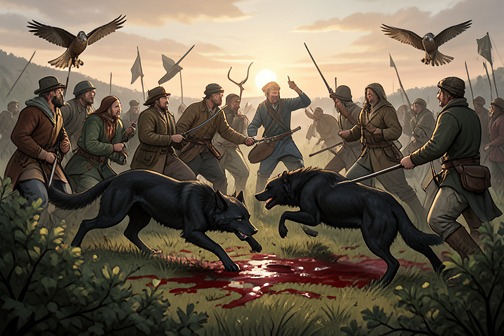
The [Falcon Hunt Attack](entity:action-recall-action-falcon-hunt-attack-403fdf9b9a58) becomes a turning point in the investigation of [Black Wolf Fever](entity:state-recall-state-black-wolf-fever-8f2a7c72aa54): evidence gathered after the hunt makes a seemingly animal-borne epidemic look potentially engineered, while the scattered cases and gaps in the transmission chain prevent the investigators from treating that suspicion as proven. [Hohsalle](entity:character-recall-character-hohsalle-658870c2400e)’s account of the people bitten at the hunt sets the inquiry in motion; the later map and epidemiological questions deepen it without resolving who, if anyone, directed the attacks.
## The Attack as a Medical Case
At a meeting with the director, Hohsalle gives a concise but detailed account of how the disease appeared and progressed among those bitten at the falcon hunt. The director finds both the conditions of infection and the speed and mortality of the illness highly unusual. Some bitten people survived, however, so the event cannot be described simply as an invariably fatal exposure. Hohsalle identifies [Sulumina](entity:character-recall-character-sulumina-af9607e46c11), an Aquafaese patient, as someone who might have survived even without medicine, though treatment of all the patients means that this possibility was not tested.
The contrast between patients becomes important to Hohsalle’s reasoning. Among those he treated, a Zolian falconer bitten near the chin developed severe symptoms most quickly and was affected most dramatically; Sulumina showed the greatest resistance, followed by [Mazai](entity:character-recall-character-mazai-d7afc8cce0eb) and [Olimu](entity:character-recall-character-olimu-e8132407b9f7). Hohsalle seeks an explanation for that variation that does not rely on politically charged rumors about the [Curse of Aquafa](entity:expression-recall-expression-curse-of-aquafa-57e92d22306c). He also asks why the illness has not apparently appeared in remote mountain regions where black wolves once lived in abundance. Finding and comparing survivors across [Aquafa](entity:location-recall-location-aquafa-8f29c334cc79) would help answer those questions, but Hohsalle says that a territory-wide survey and reliable information about nomadic clans would take too much time.
## From Animal Bites to Suspected Design
The earlier investigation had already suggested that the disease did not spread readily from person to person. At the salt mine, victims appeared to have been exposed, become ill, and died at nearly the same time; the absence of subsequent cases among people working at the mine also counted against a continuing human chain of infection. Hohsalle reasoned that the speed and severity of the illness, together with the lack of signs among mine workers, made fleas, ticks, and airborne spread unlikely. The working hypothesis was that infected beasts transmitted it by biting.
That hypothesis did not make indiscriminate hunting a convincing remedy. Hohsalle observes that if wolves or ossam involved in attacks on sheep had carried the disease, shepherds would have been bitten, yet no such reports had reached [Yotalu](entity:character-recall-character-yotalu-a3a5548dce4d). The distinction mattered: the investigators needed to identify particular carriers rather than assume that every wild dog or wolf posed the same danger. The Falcon Hunt Attack thus sits within an inquiry in which animal behavior and human illness must be connected carefully, not collapsed into a general fear of predators.
The circumstances of the attack then raise a more troubling possibility. After [Makokan](entity:character-recall-character-makokan-0994878ab69f) recounts what happened to [Sae](entity:character-recall-character-sae-496433fa64f4), the director focuses on the beasts’ attack from a cliff, judging the approach unnatural. Hohsalle agrees that it seems suspicious. The director reasons that, if the attack was intentional, someone may have been trying to stop the authorities from capturing the escaped Gansa slave—the one man who survived the disease. This would connect the assault at the hunt with the massacre at the salt mine as parts of a premeditated scheme, perhaps involving the [Gansa clan](entity:organization-recall-organization-gansa-clan-99b10a7ecd13).
Hohsalle goes further in his own assessment: after seeing the conditions at the salt mine and the attack on the falcon hunt, he believes a human hand is guiding the attacks and that someone planned them in service of a goal. But he does not claim that the organizer is known. The director cautions against dismissing coincidence, and Hohsalle acknowledges that committing to one hypothesis too early could conceal the truth. He notes, too, that few cases with mittsual-like symptoms have been reported and that no major outbreak followed the hunt. If the [King of Aquafa](entity:character-recall-character-king-of-aquafa-d896b884e25a) had been directing events, Hohsalle suggests, the governor’s explicit threat and the discovery that Aquafaese people could also die of the disease might have led him to abandon the scheme. This remains a conditional explanation, not an established finding.
## The Map and the Unfinished Pattern
The investigation expands when [Tomasolle](entity:character-recall-character-tomasolle-ca97d6d0a986) presents a map made from cases gathered with Cheehana’s help. Red dots mark reports of mittsual-like symptoms across the former [Kingdom of Aquafa](entity:organization-recall-organization-kingdom-of-aquaf-2fbf7a09fd3b), from the [Yukata Plains](entity:location-recall-location-017a18593c77) in the south to the [Oki](entity:location-recall-location-oki-94c6eb206638) forests in the north, where Makokan pursued the fugitive. Cheehana adds that the oldest reported case dates back eight years. The hunt therefore cannot be considered in isolation: similar illnesses had been reported over a wide area and long before the salt mine incident, though the evidence had not previously been assembled into a pattern.
The accounts on the map are not a record of one continuous epidemic. They describe separate wolf or ossam attacks, with only one or two people contracting the illness in each instance and no reported onward spread. Hohsalle finds this distribution difficult to reconcile with a simple model of infection carried by wolves. Wolves live in packs; if one animal transmitted the disease, later cases might be expected around other members of that pack. And if ticks or mosquitoes could acquire and relay the infection, several years and multiple summers should have allowed wider transmission. Instead, cases remain isolated across a broad territory. Hohsalle identifies the failure to spread as a problem requiring explanation, not proof of any single cause.
The natural-transmission question remains open. Cheehana proposes that carrier animals might not stay in one place long enough for ticks to transmit the disease. Tomasolle then points to the geographic distance between attacks: northern and southern wolf populations could not simply have mingled. Hohsalle asks whether the disease might have moved from one neighboring pack to another, and Tomasolle recognizes that as the only natural route under consideration before raising a further difficulty. The available account leaves that problem unresolved. The hunt’s significance lies in this tension: its manner suggests deliberate direction, yet the distribution and transmission evidence still resist a settled explanation.
## Significance
The attack changes the investigation from a question of how to control dangerous animals into a question of how the attacks themselves are occurring. Medical observations distinguish exposure by bites from person-to-person spread; comparisons among patients expose differences in resistance; and the map reveals a history of scattered, largely unconnected cases. Each finding narrows some explanations while leaving others open.
At the same time, the possibility of political violence enters through the suspected link between the falcon hunt, the salt mine, and the surviving escaped slave. That link is alarming precisely because it is not yet conclusive. The narrative makes investigation an exercise in resisting both credulity and premature certainty: a strange attack may be planned, but the evidence must still account for where the disease appeared, who survived, and why it did not spread as expected.
Event 15
pyuika corral attack
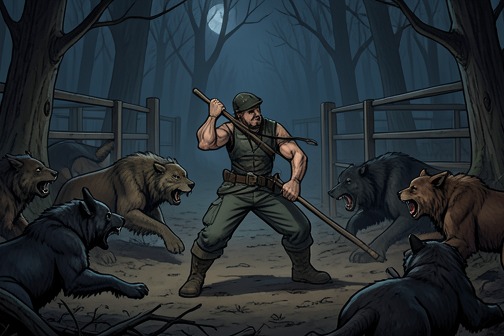
The [pyuika corral attack](entity:event-recall-event-5890c9781e23) is a nighttime assault by black beasts that draws [Van](entity:character-recall-character-van-f4f93a307bf9) into a violent defense of the animals and the people around them. Its decisive turn is not simply that Van drives off the attackers: through the pyuika’s panic and the beasts’ movements, he enters a state of bodily connection that makes him fight like a herd animal. When the pack finally runs, the same pull threatens to carry him and [Yuna](entity:character-recall-character-yuna-11ca56c16047) after it, and his grip on the child becomes the last barrier between protection and surrender to that call.
## The Herd and Its Vulnerability
The attack’s stakes grow out of the intimacy between pyuika and their herders. [Pyuika](entity:creature-recall-creature-pyuika-01714090ec97) can bond deeply with a person: once attached, they remember that friend and become lonely when separated. Tsupi’s habit of nudging Van in the back was a sign of such attachment. She had been far from home, with no other pyuika in the woods; during most seasons, she would have returned once the scent of an ossam faded. But the attack comes amid a wider precariousness in keeping pyuika. They resist restraint, and their care depends on understanding their habits rather than treating them as ordinary livestock.
[Mohoki](entity:object-recall-object-mohoki-8ad3958dabd0), a lichen growing on old trees, can help guide or confine pyuika because they loathe its scent and will not approach it. Herders can braid dried mohoki into ropes around a fence, and planting it along familiar routes can influence the animals’ seasonal movements. That knowledge gives the enclosure a protective edge during the assault: the black beasts approach it in a roundabout way, apparently confused by mohoki. The same barrier that helps human herders manage pyuika also interrupts the attackers’ approach, but it does not make the enclosure safe.
## The Attack and Van’s Defense
Van senses the danger before the pack reaches the tent. The beasts are headed for the pyuika enclosure, where the animals’ panicked stomping sends tremors through the earth; tied hunting dogs yelp at the stakes. Van runs toward the enclosure and sees the attackers work around its defenses. Some drive the frightened pyuika toward the far side, while another black beast creeps into position as the hunter, crouching to spring. Van anticipates the pyuika’s jump over the fence and charges the hunter from the side, as a buck would confront wolves with its herd behind him.
The moment he meets the animal’s eyes, Van’s perception fractures. The connection that had let him feel the herd’s fear is severed, and the attackers’ eyes kindle with a fiendish radiance. When one male leaps, Van strikes its muzzle with the back of his hatchet, in a blow likened to a stag’s antlers. As the animal falls and rebounds to its feet, the pack attacks from all sides. Van throws away the hatchet and fights with his fists, knocking the beasts away even as each impact seems to pull at his arm.
[Tohma](entity:character-recall-character-tohma-aaf4112f4482) sees the defense from close by. Van appears to glow, his eyes flashing as though flames rise from his body; he moves so quickly that the attacking beasts seem slow, and their fangs cannot reach him. When a beast climbs onto [Kiya](entity:character-recall-character-kiya-d7233ee1d06e), Van tears it away by the neck and sends it tumbling. He kicks, punches, and flings the attackers, his stance and movement again compared to a stag protecting its herd. The scene makes the defense both physical and relational: Van is not only striking at predators, but responding to the animals’ fear as if it were his own.
## The Flight and the Cost of Connection
The pack eventually turns toward the forest and bolts. Yuna wriggles free from her mother and races after it with impossible speed, while Van follows her into the darkness. He can see her faintly glowing figure linked to the beasts, and senses that his own light is linked to theirs as well. The attack’s danger has changed: the immediate assault is ending, but the bond that helped Van meet it now draws both him and the child after the fleeing animals.
When the beasts start running again and Yuna tries to follow, Van reaches her just in time, sweeps her into his arms, and holds her despite her squirming, growling, and flailing. Watching the pack disappear leaves him with a loneliness like that of a child abandoned by its mother; he wants to go with the beasts to the ends of the world. Yuna, pressed against his chest, is seized by the same urge and cries like a baby. The scent of ashimi gradually stills the tiny creatures within Van, and his familiar senses return. He does not release Yuna, turning the act of holding her into a deliberate refusal to let the animal pull take either of them away.
## Aftermath and Significance
The attack’s aftermath remains present in Van’s winter work with the herd. Tsupi butts and nuzzles him, and he feeds her ashimi, a lichen that pyuika eat in quantity during mating season and seem to crave when carrying young. Gathering it beneath the snow is difficult, but feeding the does is part of helping them bear strong calves. Van can now find the lichen by smell; its scent attracts and repels him, and it brings back memories of the night the rochai came. The animals’ needs, the human labor of tending them, and the memory of the attack therefore remain bound together after the fighting ends.
The event also sharpens the contrast between animal knowledge and indiscriminate control. Pyuika are not simply penned stock: they bond with people, follow familiar routes, and react strongly to restraint and scent. Van’s people learn their ways through close observation, while the attack exposes how much survival depends on reading those behaviors precisely. At the same time, the fight does not resolve the larger mystery of the black beasts or the disease associated with animal bites. [Hohsalle](entity:character-recall-character-hohsalle-658870c2400e) later argues that the mine victims’ rapid, near-simultaneous deaths and the absence of illness among people working at the mine afterward point away from person-to-person spread; he also doubts that fleas, ticks, or wind explain the infection. The apparent link to bites does not yield a simple solution: sheep attacked by wolves or ossam had not led to reported shepherd deaths, suggesting that identifying carriers would matter more than indiscriminately hunting wild animals. The corral attack is thus a local struggle for survival within an unresolved wider threat.
Event 16
范与尤娜会见回声大师
[Van](entity:character-recall-character-van-f4f93a307bf9) and [Yuna](entity:character-recall-character-yuna-11ca56c16047)’s meeting with [Suohl](entity:character-recall-character-suohl-471c400448f6), the [Echo Master](entity:concept-recall-concept-echo-master-2c6a7dc152d0) of [Yomida Forest](entity:location-recall-location-yomida-forest-79d5f78f75f0), turns Van’s uncanny experience running with the [Rochai](entity:creature-recall-creature-rochai-04a76c0ce6e0) into a lesson about how illness may work. Suohl calls Van’s condition otsufah, or being “inside out,” and offers a forest as his model of the human body: a community of small lives whose interactions can sustain or harm it. The idea becomes urgent when Van connects it to the scar left by a Rochai bite—and another bitten man is carried into the cavern before their conversation can resolve what that injury means.
## The Summons and the Meeting
[Assenomi](entity:character-recall-character-assenomi-0ba3d71f3c05), messenger of the Echo Master, approaches Van with two glossy raven feathers, one large and one small, and a request that he bring Yuna to meet her master. The Echo Master lives deep in Yomida Forest, where fire-flows seep from the earth and boiling water gushes forth. Assenomi urges them to travel during the brief break between blizzards. Yuna takes the feathers before Van can answer, delighted by them; the small gesture brings her unguarded curiosity into a summons whose purpose remains unknown to Van.
The meeting itself comes only the following evening. The Echo Master has spent until dawn following a child’s spirit and sleeps until the afternoon, delaying Van’s audience for a day. The wait also gives Van time to rest in the mountain caves, eat familiar, simple food, and study the tunnels while Yuna sleeps. Accustomed to judging a new place for defense and escape routes, he learns the layout even as he listens to patients describe their host’s difficult-to-define character and unquestioned powers.
Suohl receives Van in a great cavern, welcomes him as though he were an old friend, and invites him toward the hearth. Van bows but goes straight to the reason for his visit. Before Suohl properly introduces himself, a huge raven descends from the cavern roof and perches on his shoulder and arm. Suohl explains that the bird sometimes possesses him when no one is around, and that she had wanted to see Van through human eyes. He then identifies himself as Suohl and explains that he summoned Van after seeing him while riding with the raven: she carries his spirit, rather than bearing him physically on her back.
## [Otsufah](entity:concept-recall-concept-otsufah-01af3e2f85c0) and the Rochai
Suohl tells Van that, when he saw him on the earlier night, Van was completely otsufah. He had seen Van and Yuna running with the Rochai, black wolves crossed with [Ossam](entity:creature-recall-creature-ossam-e3423127facd). Assenomi’s report that the raven’s feathers had not looked black to Van and the child supports Suohl’s conclusion: even in ordinary circumstances they are already, to some degree, “inside out.” When body and soul switch places, Suohl says, sight and smell are affected. His explanation recasts the strange perception of that run not as an isolated oddity but as evidence of a condition involving the relation between body, soul, and the senses.
The meeting does not end with that revelation. Suohl says there is also something important he must tell Van about the Rochai, but postpones it to explain otsufah first. That promised information remains pending as the conversation shifts from Van’s unusual perception to the more immediate question of what may be happening inside his body.
## [The Body as a Forest](entity:expression-recall-expression-the-body-as-a-fore-908a0d56ac2e)
Suohl begins from a problem familiar to anyone who becomes sick: people cannot directly see or hear what is happening inside their own bodies, and in that sense know them less well than they know other people. His long experience treating the sick has led him to think of the human body as resembling a forest. Van feels close to understanding, then loses hold of the idea as Suohl develops it through the image of the lights Van saw while running with the Rochai.
In Suohl’s account, a forest is not a single, simple thing but a gathering of lives. Beasts and insects inhabit it; grasses and moss grow there; birds roost among the trees. These lives can have opposing effects: insects that chew leaves may make trees wither, while birds eat the insects and enrich the soil with their droppings. The forest persists through their interactions, not through the action of one life alone.
Suohl applies that interdependence to the body. It, too, is inhabited by tiny lives, some possibly present from birth and others entering later. He does not claim to know precisely when they arrive; he offers this as an emerging theory from his practice. Illness, he suggests, may arise when some of these creatures cause harm, as bugs eating a tree can damage the forest. The comparison makes the invisible interior of the body imaginable without making its inhabitants simply enemies: the forest’s birds and insects can injure, feed, or sustain one another, and the body’s health likewise depends on relations among lives too small to see in ordinary conditions.
## The Bite and the Interrupted Lesson
Suohl grounds the analogy in everyday responses to injury. A person pricked by a muddy thorn would pull it out and suck the wound; a cut from a dirty blade might be allowed to bleed a little, washing away what was harmful. Van then rubs the scar from his encounter with the Rochai and asks whether something harmful entered his body through its bite, as sickness can spread through the saliva of an infected dog. The gesture ties Suohl’s broad account of illness to a specific mark on Van’s skin and to a danger he has reason to consider personally.
Suohl’s narrowed eyes and recognition that one of the Rochai did bite Van confirm that the wound matters to his explanation, though the conversation supplies no diagnosis or outcome. Urgent voices and hurried footsteps interrupt them. Assenomi rushes in with men carrying another person on a wooden door; the injured man, she reports, has also been bitten by a Rochai. The encounter thus moves from an invitation about Van and Yuna, through a difficult account of perception and bodily life, into an immediate case that makes the Echo Master’s unfinished teaching consequential.
Event 17
Yomida cave attack
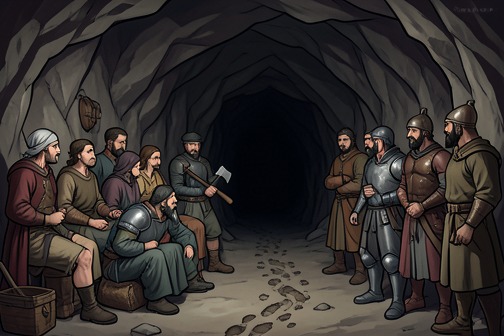
The [Yomida cave attack](entity:event-recall-event-dbb5cbf9529e) is the crisis in which [Van](entity:character-recall-character-van-f4f93a307bf9) must defend a cavern full of people from rochai while struggling to hold on to his human awareness. The beasts’ assault becomes a pursuit when [Yuna](entity:character-recall-character-yuna-11ca56c16047) disappears from the survivors’ shelter and Van finds fresh tracks leading away from the cave. He follows them with [Sae](entity:character-recall-character-sae-496433fa64f4), but his injury and failing strength overtake him before he can reach Yuna.
## The Alarm and the Defense
The attack begins amid the cave’s efforts to help an injured young man: [Assenomi](entity:character-recall-character-assenomi-0ba3d71f3c05) rushes in with men carrying him on a wooden door and alerts the [Echo Master](entity:concept-recall-concept-echo-master-2c6a7dc152d0) that a rochai has bitten him. Later, as the raven launches out of the cavern, [Suohl](entity:character-recall-character-suohl-471c400448f6) realizes that rochai have entered the cave. Van takes up a hatchet and gives Assenomi immediate instructions: gather everyone into the inner chamber while he confronts the beasts. He judges that the creatures are approaching from the opposite end of the cavern, far from where Yuna sleeps, and hopes a narrow passage will hold them long enough for her to be brought to safety.
Even giving directions costs Van effort. As the sensations he calls being “inside out” threaten to erase speech and human thought, he forces himself to ask that Yuna be brought in. He directs the men carrying the injured youth to make a barricade in a hollow protected on three sides by rock walls and a low ceiling. He warns them not to use arrows: the rochai move too quickly for a missed shot to be followed by another before they attack. The men initially struggle to understand, but an elder recognizes the sheltered corner Van indicates, and Van runs toward the danger.
## The Ambush and Van’s Loss of Control
The rochai do not charge at once. One after another, they line up before Van with lowered heads and bared fangs, snarling but holding their ground. Their restraint feels less like hesitation than coordination: Van recognizes the pattern of hunting dogs keeping prey in place until a master arrives. The danger is not only the beasts in front of him. A bowstring twangs from the darkness behind, and an arrow cuts through the cavern. Van twists aside, but it grazes his left shoulder; his thick clothing keeps the wound shallow, though the blow is enough to stagger him.
The rochai seize that instant. They rush him together, and the smell of their bodies and breath overwhelms the fragile restraint Van has been fighting to maintain. His body acts as his mind disappears. He strikes the leader’s nose with his hatchet, rolls with the force of the blow, then rises and crushes another beast against the wall with his body while kicking a third away. The attack exposes the peril of Van’s changing state: the same physical force that helps him survive can arrive with his human thought stripped away, leaving him unable to govern what his body does.
When the immediate clash is over, Van remains wary. He cannot sense beasts or enemies nearby, but he refuses to treat their absence as proof of safety. His first concern is the inner chamber and whether Yuna has reached it. Many people have crowded into the hollow he designated, and Suohl approaches to ask if Van is hurt. Van says he was only grazed and asks whether everyone is present. Suohl answers that several people are still missing and that Assenomi has taken men to search for them. Van turns and runs before Suohl can finish.
## The Search for Yuna
Yuna is not in the crowded shelter. Van runs out just as Assenomi and the others return; she says Yuna is safe and was with [Nakka](entity:character-recall-character-nakka-a05658838cde), but Nakka is missing. Van pushes past the group and calls down the stone passages. Hearing no answer, he runs through the empty tunnels and into the night, calling again for the child’s familiar response. Snow blows across the darkness, and the pain in his head, dry throat, and blurred vision make the search harder. He wonders whether something had been smeared on the arrow that grazed him.
At the cave entrance, the snow preserves a clue even as fresh snowfall begins to bury it. Most footprints lead from the forest toward the cavern, matching the route taken by the men who carried the injured youth. One set runs the other way. Its prints are fresher and deeper than the rest, and Van concludes that Nakka must have carried Yuna away. He follows the trail into the forest, but darkness and his dulled senses soon make the tracks difficult to see; without a lantern, he can pick up only vague scents and sounds.
A burning arrow illuminates the footprints. Looking toward the sound of the bowstring, Van sees a figure on the cliff above the cave entrance, silhouetted by its flame. The figure appears to be a woman and waves her bow as if to reassure him. Van bows and resumes following the trail southwest. When a bow-bearing figure later emerges from the darkness and calls his name, he recognizes Sae, whom he had met in the bath, by the faint scent of pine resin. She confirms that she loosed the burning arrow and says they must pursue Yuna before she can explain further.
## Collapse and Unresolved Pursuit
Van tries to continue, but his body will not move. Everything darkens, and he comes to with his forehead against the cold snow. Sae checks his pulse beneath his hood while he insists that she leave him and find Yuna; he is not sure whether he manages to say the words aloud. The anxious cawing of a crow is the last thing he remembers before losing consciousness. The cave’s immediate danger has passed, but Yuna remains away with Nakka, and Van’s pursuit ends in collapse rather than rescue.
Event 18
毒粮危机与阿赫法尔奥玛被逐
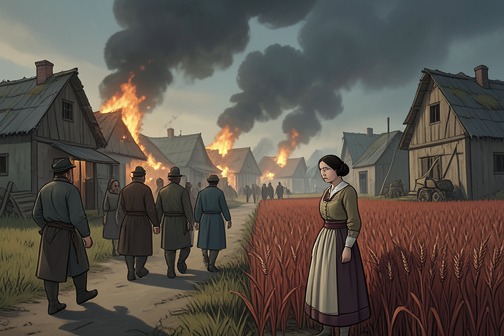
The toxic-grain crisis and the expulsion of the [Ahfal Oma](entity:organization-recall-organization-ahfal-oma-3e0ac15e9b87) are recalled as a disaster whose causes remain contested but whose human consequences endure. A hybrid crop killed horses and sheep; the resulting conflict led to the burning of a village and the Ahfal Oma’s exile. Later testimony complicates the accusation that immigrant rye alone caused the deaths, while [Hohsalle](entity:character-recall-character-hohsalle-658870c2400e)’s effort to investigate the first cases of mittsual shows how the old catastrophe remains entangled with new questions of disease and blame.
## Causes and Contested Accounts
The crisis enters the story through Hohsalle’s questions about past livestock losses. An old woman, [Nohmeh](entity:character-recall-character-nohmeh-dd873a912748), remembers sheep dying after bites, tick exposure, and toxic grain, and recalls the widespread belief that her people had made a mistake in coming to the region. [Tomeh](entity:character-recall-character-tomeh-b446d4234012) adds that the Ahfal Oma’s horses died in a major uproar and that one village was burned. Hohsalle identifies the conflict as the Ahfal Oma’s revenge and reports the familiar account: the horses had eaten rye brought by the settlers.
Nohmeh angrily rejects that explanation. She insists that the horses ate red wheat grown by the Ahfal Oma themselves, not grain supplied by her people. [Taya](entity:character-recall-character-taya-fdec942398ff), her companion, explains a more complicated agricultural cause: the Ahfal Oma cultivated native [Aquafa](entity:location-recall-location-aquafa-8f29c334cc79) wheat, but it had apparently crossbred with rye pollen carried on the wind. The hybrid grain was more likely to be toxic, and its poison was powerful. The crop’s origins thus crossed the boundaries around which blame had been organized: the dangerous grain grew in Ahfal Oma fields, but its hybridization was linked to rye introduced by settlers.
## Livestock Loss and Retaliation
The hybrid grain harmed both communities’ livelihoods. Taya says that the Ahfal Oma’s fire horses died after eating it, while many settlers’ sheep also perished. The sheep developed what the settlers called sheep-dancing sickness: they leapt and convulsed before dying. The evidence does not settle every detail of the horses’ exposure, but it establishes that grain toxicity affected animals on both sides of the conflict.
A separate recollection from [Tomasolle](entity:character-recall-character-tomasolle-ca97d6d0a986) connects poisoned rye, animal illness, and an older practice involving dogs. [Shikan](entity:character-recall-character-shikan-ab41c8796ba2) recounts a song in which a dog eats the flesh of a horse buried in [Kinma](entity:character-recall-character-kinma-a45aade9fb12)’s mound, bears pups, and dies; those pups grow into strong village hounds. He explains that people had buried horses that died of illness and later fed their carcasses to pregnant dogs, whose pups were believed to become loyal and resistant to sickness. Tomasolle says the Ahfal Oma also buried horses after they died from eating poisoned rye and fed them to pregnant dogs. But he rejects this practice as the explanation for mittsual’s spread: the dogs did not bear pups, and he personally confirmed that they suffered and died. Since the first known mittsual case occurred nearby, he asks permission to investigate whether the poisoning could nevertheless be related. Cheehana agrees that the question needs further study but objects to Tomasolle leading it because of his closeness to the Ahfal Oma.
## Exile and Its Costs
After the Ahfal Oma were exiled, the settlers spent a long time burning off the Aquafa wheat before they could grow rye safely. That remedy marks a lasting change to local agriculture, but it does not undo the earlier losses or the political violence. The account establishes that a village was burned and that the Ahfal Oma were driven out; it does not present a settled, neutral verdict on responsibility. Instead, the conflicting memories preserve how agricultural harm became a grievance between communities.
The wider settlement policy gives that grievance an imperial context. Hohsalle explains that frontier settlers were poor farmers and herders from the edges of the Zolian realm, ordered to move whenever conquest expanded the borders. They were expected to establish Zolian-style communities, grow the crops and raise the livestock preferred by Zolians, and mingle with conquered peoples until the territory became Zolian. In return, their taxes were lower than at home and cleared farmland belonged to them. Yet the privileges did not cancel the loss of home: settlers could be unable to return to their native land, while local people faced the conversion of their territory and ways of life. The account places the conflict within a policy that used settlers to transform conquered regions, rather than treating it as an isolated quarrel over grain.
## Recollection, Disease, and Blame
The crisis resurfaces during an investigation of mittsual, so the historical dispute is not merely background. Tomasolle distinguishes what he knows from what he suspects: the dogs did not produce surviving pups, the first case occurred near the poisoned-grain episode, and a connection cannot be ruled out. His request is for further inquiry, not a declaration that grain caused the disease. Cheehana’s concern about his personal ties shows that investigating the past also raises questions about trust and impartiality.
Nohmeh’s fierce denial is made more intelligible when Hohsalle explains her circumstances. She was among immigrants forced to leave her homeland and spend her life in a place she did not choose, where local people hated her community and hardship repeatedly followed. Her testimony does not resolve the grain dispute; it reveals what accusation means to someone who has already borne displacement. Across the competing accounts, toxic crops, livestock losses, retaliation, and exile remain linked, while the exact route from that earlier disaster to mittsual remains open to investigation.
Event 19
execution of Makokan’s brother
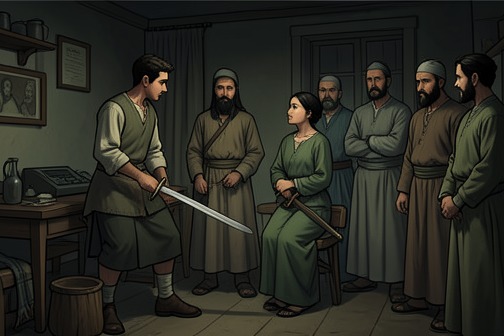
The [execution of Makokan’s brother](entity:event-recall-event-e135245e3c7f) was the family crisis that turned [Makokan](entity:character-recall-character-makokan-0994878ab69f) from a destined servant of the [Inner Circle](entity:organization-recall-organization-inner-circle-e298d7988d5d) into its lifelong skeptic. His brother’s forbidden love was treated as betrayal of [Otawalle](entity:location-recall-location-aa29b7c9f508)’s sacred houses, and the Inner Circle’s demand that his sister carry out the execution made loyalty appear to Makokan inseparable from violence and loss.
## Causes and Family Circumstances
The [Shinock family](entity:organization-recall-organization-shinock-family-caaa0921f511) had served the Inner Circle for centuries. Makokan’s father had accepted that inherited duty, while his elder brother and sister were trained from childhood as secret agents and traveled widely in the Inner Circle’s service. Makokan, ten years younger than his brother and eight years younger than his sister, saw them only once or twice a year, but their visits were affectionate; he admired their worldly sophistication and adored them.
That closeness made the news in Makokan’s thirteenth winter a rupture in the family’s familiar order. His brother had fallen in love with someone he should not have and was judged to have betrayed Otawalle’s sacred houses. To prove the Shinock family and clan remained loyal, his sister killed him with her own hands. The account presents the execution not as a private family decision but as an act demanded in the name of institutional allegiance.
## Makokan’s Response
When the news reached the family, Makokan’s mother wept uncontrollably, while his father and grandfather showed no sorrow. His father later explained the circumstances to the thirteen-year-old Makokan. Even if the decision could be defended as justified, the fact that the Inner Circle had forced his sister to execute her brother filled Makokan with rage and deep distrust.
The execution overturned the principles Makokan had grown up believing. From then on, everything he learned about the Inner Circle’s structure and workings seemed tainted. The contrast between his siblings’ earlier kindness and the role his sister was made to play in her brother’s death made the institution’s demand for loyalty personal: its rules had entered the family and transformed affection into an instrument of obedience.
## Consequences and Significance
The event changed the course expected for Makokan. Trained by his grandfather and uncle, both retired from Inner Circle service, he was meant to travel to the [Sacred Territory of Otawalle](entity:organization-recall-organization-sacred-territory-789d567a309a) at fifteen, declare allegiance to the sacred houses, and enter service. Instead, in the spring of his fifteenth year, he refused to take his vows and turned away from the life prescribed for him. The family disowned him, and his clan expelled him.
As an adult, Makokan could understand why the Sacred Territory’s rules had been established in a world where countries sought to consume one another. That later understanding did not erase the anger of his youth or restore his trust. The execution remained the point at which an inherited duty became, to him, a dark and heavy chain—and the decisive break between Makokan and the family and institution that had shaped his childhood.
Event 20
马可坎与霍萨尔在族城附近遭伏击
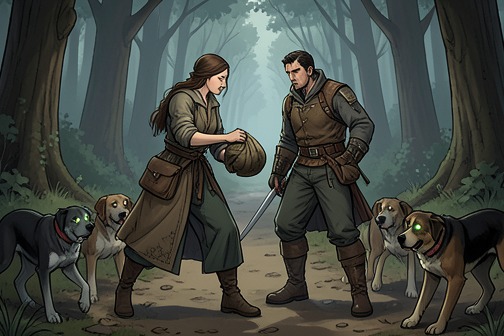
The ambush near the Shinock clan city turns a journey with [Hohsalle](entity:character-recall-character-hohsalle-658870c2400e) into sudden captivity, then ends on a revelation [Makokan](entity:character-recall-character-makokan-0994878ab69f) can scarcely believe: the woman who enters his makeshift prison is his sister [Ilia](entity:character-recall-character-ilia-df6a4a70f050). The scene moves from watchful danger to helplessness and, finally, to a recognition that makes the identity of the captors more troubling than their method.
## The Surrounding Dogs
Makokan and Hohsalle are on a path near Makokan’s birthplace when he feels the hair prickling at the back of his scalp. Dogs watch from the underbrush on both sides. Their eyes glimmer beneath the trees, and Makokan freezes; when Hohsalle asks what is wrong, he warns that they are surrounded.
The dogs emerge as if his warning had been a signal. They bare their fangs and snarl, but do not attack. Makokan moves cautiously, trying not to alarm them, and reaches for his sword. The pack’s threatening restraint leaves the danger ambiguous: the dogs are close enough to make a fight seem imminent, yet the decisive violence comes from elsewhere.
## The Ambush and Capture
At that moment, Hohsalle jerks and falls from his horse. Makokan shouts to him, only to feel a sharp pain bloom in his own neck. He touches the spot and finds a small needle. The realization comes in a fragment: blow darts. His head lolls forward, and he loses consciousness before he can act.
The attack disables both travelers at once, but the scene does not identify the attackers or explain their objective. The dogs serve as the visible perimeter of the trap; the darts reveal the concealed means by which Makokan and Hohsalle are overcome. Makokan’s attempt to reach his sword never becomes a defense, and he cannot discover what has happened to Hohsalle before darkness takes him.
## Imprisonment and Uncertainty
Makokan wakes to sunset light falling through bars, his head pounding and saliva pooled in his mouth. When he tries to wipe his face, he finds his hands tied behind him. The room smells of wood; firewood is stacked against the wall, and he realizes that he appears to be in a woodshed. His wrists are bound together and fastened to a post. He is alone in the little hut.
His first concern is Hohsalle, whose whereabouts he cannot determine. In the pain and confusion, Makokan considers whether the [Kinma Handlers](entity:organization-recall-organization-kinma-handlers-629508a85efc) used blow darts to sedate them and lock them away. It seems the only plausible explanation to him, but it does not account for why they would do so: if their aim were simply to stop the travelers from probing the truth, they could have killed them. The question of motive therefore remains open, as does Hohsalle’s condition.
## Ilia’s Appearance
A dog barks outside, sounding as though it is fawning on its master. The door creaks open and sunset light fills the shed, silhouetting a woman in the doorway. She closes the door, leaving only part of the light, and Makokan can see her clearly: she is middle-aged, large in build, and well-featured.
Recognition overtakes his uncertainty with a physical jolt. Makokan’s pulse quickens; he takes shallow breaths as he studies her eyes and pursed lips. His voice emerges as a croak when he says his sister’s name: Ilia. The ending confirms who the woman is to Makokan, but not why she is present, whether she was responsible for the ambush, or where Hohsalle has been taken. The scene closes at that unresolved threshold, making the family revelation the ambush’s final and most unsettling turn.