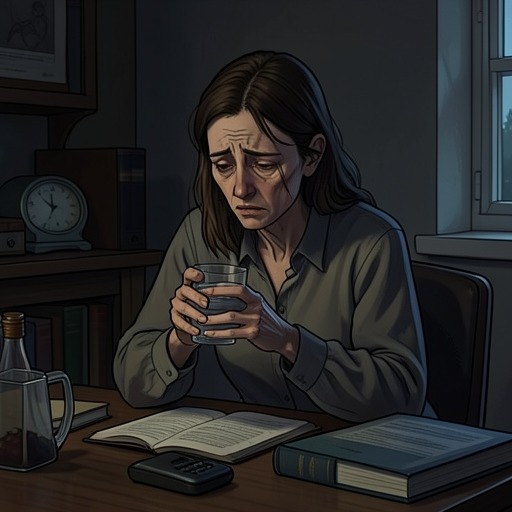
Emma Nieuwenhuis
UpEmma Nieuwenhuis is the first-person narrator and central character, whose intensely convincing inner realities repeatedly collide with the interpretations of the people trying to care for her. Her story moves between depression, elation, suicidal danger, and growing understanding of her own symptoms. Its hard-won change is not a promise that she is cured: Emma comes to see that she can respond differently when a crisis returns, and that living with illness requires both other people’s support and her own participation.
Identity and the emerging diagnosis
At twenty-eight, Emma gives her birth date at a hospital pharmacy, noting that she is two years older than when she first stood there. The quiet, almost ordinary errand is charged with feeling: while the assistant checks her prescriptions, she watches the sun fill the hospital hall and feels happiness rise at the sight of a young woman entering with her small son and a scruffy dog. Emma’s sense that life is wonderful stands in sharp contrast to the despair and danger described elsewhere in her story. The contrast matters: her experience is not a steady movement from illness toward wellness, but a life in which emotional states can change dramatically.
Rajid Panjani, after hearing Emma and her boyfriend’s account and reading her medical file, raises the possibility that she is manic-depressive. He explains that mood can swing not only from ordinary levels down into depression but also excessively upward. Emma initially resists the prospect of a new diagnosis. Her own sense of being well can feel so complete that illness seems like an erroneous judgment made by others. When asked how she feels, she struggles to translate the change: it is like the fog lifting and the world becoming visible as it really is. To Rajid, however, that assurance does not settle the question of her safety.
Elation, suicidal intent, and admission
The crisis becomes visible when Emma discloses that she plans to take her accumulated pills the following morning, at breakfast, with yoghurt. Rajid asks whether she intends to die by suicide. Emma laughs at the interpretation. She says that she feels the opposite of depressed, has work to do, and is editing a text; the solid, awkward shape of her laptop in her bag reassures her. In her understanding, taking the pills would preserve her extraordinary well-being rather than destroy her life. The danger lies partly in that separation between the action and its consequence: she can name the pills and the time she means to take them without experiencing the plan as a suicide plan.
Later, Emma explains that she had been depressed for months before a sudden conviction appeared while she was making breakfast. She felt that the time had come to die and understood it as a task to complete, so that she could move on to what mattered: work, productivity, and doing things without the obstruction of feeling. The fact that taking the pills would end her life had, in that state, receded from view. Death seemed inevitable in any case, and the thought that everything was one brought her a feeling of calm, clarity, and illumination. She did not experience this as an ending but as a beginning that would make the feeling permanent.
When Rajid arranges for her to go downstairs, Emma hesitates and looks toward the corridor where Sergei has just disappeared. She imagines that a few steps might set her free, then chooses to continue with Rajid. She treats the PAAZ admission as a way to test what she believes is a misunderstanding: after twenty-four hours, she thinks, there will be evidence that she is not ill. She insists internally that she feels no problem and feels wonderful. Her decision to go in is therefore not yet an acceptance of the diagnosis; it is an action taken while she still trusts her own certainty more than the concern around her.
Hallucinations, delusions, and the force of belief
In a later conversation, Emma tries to describe what she means when she says that she thought strangely. Rajid distinguishes hallucinations, in which a person perceives something inaccurately, from delusions, in which perception may be accurate but is given a false meaning. He says Emma seems to experience hallucinations regularly and that such experiences can fit a manic-depressive picture. The distinction gives her a vocabulary, but it does not make her experiences feel unreal while she is having them.
Emma recalls that when Rajid told her that Doctor Visser’s husband had died, she felt nothing—not grief for Doctor Visser, who had been her psychiatrist for more than two years, nor concern about her absence. She was surprised that Doctor Visser had children and found that fact absurdly funny. Emma understands this emotional blankness as part of the way one immense idea had absorbed her thoughts and feelings. The suicide conviction did not feel, from inside the episode, like a plan that needed weighing. It felt self-evident, as though the ordinary fact that the pills would kill her had lost its force.
She offers another example through her belief that she could fly. Emma insists that this was not a passing thought that she could easily distrust: she knew it as something true, felt it in her bones, and experienced the world as finally normal. She describes delusion as a conviction that reorganizes reality around itself; once the belief is present, the mind tries to fit the rest of the world into it. Her account preserves the difference between knowing that something is impossible and still feeling, at a deeper level, that it is true. The certainty does not announce itself as strange from within; it arrives with the authority of reality.
Recurrence, crisis, and the choice to seek help
During a night on the ward, Emma tries to keep herself from feeling, thinking, or remembering. When the light of a nurse’s flashlight passes over her, she raises a hand and manages a strained smile. Once the room darkens, panic returns. She begins to cry before the nurses have even reached the next room, because what she is fighting is not only present emotion but a memory that seems to have followed her throughout her life: the depression that leaves her reduced to fragments, clinging to life while being pulled deeper. The image of the depth beyond a balcony makes the crisis feel recurring rather than safely past.
Later, at a balcony railing, Emma recognizes how easily another attempt could make Gwen carry the question of whether she had said or done something wrong. The thought of leaving Gwen with that burden does not make the suicidal pull disappear, but it changes what Emma does next. She finds the phone in her pocket and reminds herself that although she has returned to the same point, she is not unchanged: she is in the PAAZ to learn another way of responding. She tries Sergei’s number and reaches voicemail, then calls Vera Nieuwenhuis. She walks away from the bridge and back toward life while the phone rings. The turn is concrete and limited: Emma does not claim that the crisis has been solved, but she refuses to face it alone.
Relationships, responsibility, and an unfinished recovery
Emma’s relationship with Sergei includes a painful disagreement about the medication she has stockpiled. At Rajid’s request, Sergei is supposed to remove the pills, but Emma says it takes more than three weeks and two conversations with her psychiatrist before he finally does so, reluctantly. She worries that his resistance means he does not take her difficulties seriously. Another patient suggests a different possibility: Sergei may be trying to defend himself against the frightening implication that Emma’s illness could have been life-threatening. The exchange leaves room for the hurt Emma feels without treating Sergei’s hesitation as proof that he does not care.
Emma also comes to recognize the weight of being seen primarily as a patient. She imagines how Rajid sees her: as someone for whom he is responsible, someone he would like to cure, and someone who may need protection from herself. She understands that concern, but insists that the patient is not a temporary role separate from the rest of her life; it is part of who she is. She asks to be allowed to go, while acknowledging that things will get worse again. This is not confidence in permanent recovery. It is a claim to take part in her own life even when recurrence remains possible.
In a conversation with Beatrice, Emma confronts a kind of suffering she has not understood. Beatrice says that after beginning medication she lost her sense of God, which had sustained her even through the grief of losing her child; the loss has left her feeling profoundly alone. Emma remembers the joke on Michiel’s slogan T-shirt linking God and depression, and feels ashamed that she had never tried to understand Beatrice. She cannot claim to share the experience, but suggests that depression may consume the energy needed to feel or believe, and that Beatrice’s sense of God might return as the depression recedes. Emma’s response is tentative rather than authoritative. It shows her attempting the kind of listening and companionship she herself needs.
The story’s movement is from certainty that illness is a mistake toward a more difficult understanding: Emma’s feelings and beliefs can become compelling without being reliable, and a later crisis cannot be ruled out simply because she has survived an earlier one. Her progress lies in naming experiences, accepting help, and acting differently at a dangerous point—not in declaring the illness finished. The hospital pharmacy’s sudden brightness and Emma’s delight in ordinary life remain real, but so do the memories, delusions, and recurrent despair. Her account holds those truths together.