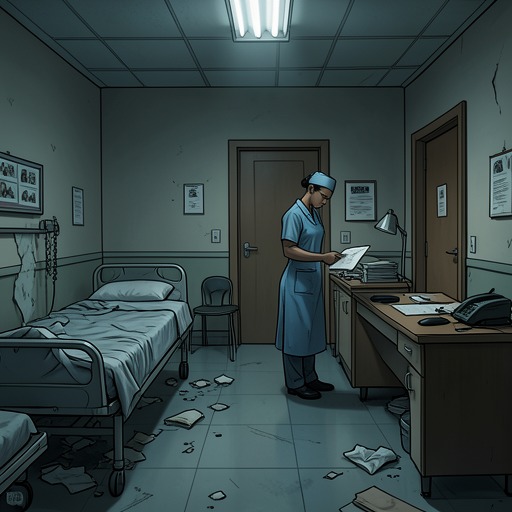
Gwen
UpGwen is a nurse on the PAAZ whose role in Emma’s readmission and later crisis is defined by attentive, practical care. She knows Emma from an earlier admission, but does not treat that familiarity as proof that she already understands her: she notices when Emma is distressed, asks what has happened, and takes her account seriously. Her support is neither a grand rescue nor a promise that everything will be all right. It is a series of concrete acts that make it possible for Emma to speak, remain reachable, and consider what might help.
Identity and introduction
Gwen enters the readmission meeting after a knock interrupts Emma’s wish to collect her prescription and leave without treatment. Rajid Panjani introduces Emma as twenty-eight and as someone previously admitted two years earlier; Gwen recognizes her and says they remember her. Emma feels relief mixed with discomfort at being known. Gwen sits near Rajid, and he explains that he will be Emma’s clinician while she stays to settle. Gwen welcomes her and begins outlining changes to the PAAZ, including its planned merger and division into two separate wards. Emma immediately objects to the prospect of the locked ward, establishing that Gwen’s work begins amid the ward’s changed arrangements and Emma’s fear of what they may mean for her.
Gwen’s familiarity with Emma is specific rather than abstract. She remembers that Emma was frightened of treatment and medication during the earlier admission. Later, when Emma worries about a new diagnosis, new pills, and possible side effects, Gwen acknowledges that history and reassures her that staff now know what to watch for. She asks who Emma’s psychiatrist is. On hearing that it is Rajid, she tells Emma that she is in good hands and notes that he has returned after two years away and previously worked there. The exchange offers reassurance through remembered experience and practical information, not through a claim that Emma has nothing to fear.
Care within the ward routine
Gwen also appears within the ordinary, regulated rhythm of inpatient life. During the evening medication queue, she calls Emma into the pill room ahead of the others. The room’s humming fluorescent tube, yellow light, and smell of crushed medication give the routine an oppressive material presence. Emma is already preoccupied with whether her stockpiled pills are still at home and whether Sergei has removed them. Gwen’s place in the medication process therefore sits beside Emma’s fear of treatment and her concern about access to the tablets she had kept there.
The nurse’s care is not limited to administering medication. When Emma is upset after meeting Lars, Gwen encounters her on the stairs and sees that she is crying. She asks what happened, then leads her to a conversation room, marks it occupied, and sits opposite her. The private setting matters: Emma can explain, in broken speech, that the conversation left her feeling judged as someone repeatedly admitted for nothing, and that she has begun to doubt whether anyone will believe her. Gwen listens and writes notes, but does not let the paperwork substitute for responding to Emma. She sets her pen down, looks at her directly, and says that this is not how she knows her and that she believes something has happened. She does not presume to know what it was; she says she wants to investigate and asks what Emma wants her to do.
Responding to crisis without taking over
Gwen’s response combines belief with follow-through. She proposes contacting Lars to describe Emma’s current state and ask what occurred, and suggests that they meet again to discuss it. Emma cannot identify a clear solution and says she wants to get away for a walk because she feels unable to breathe inside. Gwen hesitates, then agrees. She asks Emma to take her mobile phone so she can reach her after speaking with Lars. This decision gives Emma space while preserving a line of contact; it neither dismisses her distress nor makes her choice for her.
That balance becomes significant when Emma leaves the ward and approaches a bridge during a suicidal crisis. Emma recalls the damage that a suicide after a therapist’s conversation could cause to the people treating her, and turns back. Gwen is not shown at the bridge, and the return should not be mistaken for a rescue performed by her. Her earlier response nevertheless belongs to the chain of care surrounding the crisis: she heard Emma’s account, offered to pursue what had happened, and kept the possibility of contact open when Emma asked to leave for a while.
Understanding and supporting others
Gwen’s approach also appears in conversations about what care should feel like. When Emma discusses stopping the voluntary recovery program, Gwen challenges the idea that therapy must be a struggle that Emma endures simply because she thinks it is required. She distinguishes her own view from a general condemnation of the program or its facilitator: she says she has no problem with Pieter or recovery, but asks whether the program is helping Emma. More broadly, she encourages Emma to consider whether she is doing something because it is good for her or because duty and habit make it seem obligatory. If Emma feels unsafe with a therapist, Gwen says, she should ask what she can still gain from that treatment. The advice gives weight to Emma’s experience without turning it into a universal judgment about care.
In another conversation about Sergei’s reluctance to remove Emma’s stored medication, Gwen offers a possible interpretation rather than declaring his motives known. She suggests that his resistance may protect him from recognizing how serious Emma’s illness has been: if he does not fully accept the danger, he need not face how close he came to losing her. Emma hears the suggestion as potentially casting her as the danger, and Gwen carefully clarifies that she means Sergei may be trying to ward off fear. Her tentative language leaves room for the relationship to be complicated rather than reducing Sergei to indifference or Emma to a burden.
Narrative significance
Gwen’s importance lies in how she makes institutional care personal without pretending it is simple. The ward has rules, medication routines, changed divisions, and decisions about treatment; Emma, meanwhile, fears being misread as normal when unwell and later doubts her own credibility. Gwen’s response is to notice the mismatch between outward appearance and distress, to listen when Emma says something has gone wrong, and to make the next step specific. When Emma looks well enough to be mistaken for someone ready to go home, Gwen explains that Emma had previously been visibly depressed and withdrawn, whereas now she seems so ordinary that staff can forget she has no leave privileges. She admits this is no excuse. The observation exposes how appearance can shape a patient’s treatment even within a setting meant to provide care.
Gwen is not portrayed as able to resolve Emma’s illness, repair every relationship, or determine what treatment will work. Her steadier contribution is to resist easy assumptions: familiarity does not make Emma’s fears trivial, an ordinary appearance does not mean she is well, and a distressing account deserves investigation even when the listener does not yet know what happened. In these scenes, taking Emma seriously is not merely a sentiment; it changes what Gwen does next.