Karel
UpKarel is a long-serving nurse at the PAAZ whose care for Emma is expressed less through clinical explanations than through attention, time, and small practical acts. He meets her return with an awkwardly cheerful greeting, makes room for her distress without demanding that she explain it, and takes her walking when she cannot find a way through a crisis. His quiet reliability stands out in a strained and understaffed ward: he helps Emma feel that she is worth the effort, while the book also shows the personal demands and institutional neglect surrounding that work.
Identity and Place at the PAAZ
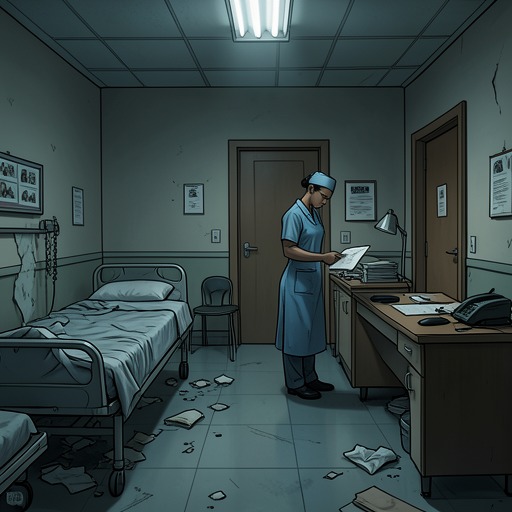
Karel is an energetic man around fifty who has worked as a nurse at the PAAZ for fifteen years. Emma is glad to see him when she is readmitted, though his greeting briefly misfires: he says he has heard she is back and is pleased to see her, then realizes how that might sound and hastily qualifies it. Emma laughs at his embarrassment. The exchange introduces a nurse who is warm without being polished, and whose concern is not hidden behind perfect professional phrasing.
His presence also belongs to the ordinary structure of ward life. When Emma asks whether someone can accompany her outside, Karel first offers to find out who has time, then asks whether she is forbidden to go alone or would simply rather not. Emma says she has no leave privileges. The distinction matters: he does not assume what she needs, but checks what is behind the request. He returns wearing a coat and takes her for a short walk, explaining that understaffing means they can only go across the parking lot and back.
Care Through Action
The walk offers Emma a brief release from the ward. As the wind catches her hair, her attention shifts away from the immediate demands of being a patient; for a moment she feels like nothing but air. The outing is limited, and Karel locks the garden door again behind them. That door is damaged, and a dispute between hospital departments over maintenance has left responsibility unresolved for months. The neglected setting makes the walk modest in scale but significant in effect: Karel cannot repair the institution around Emma, yet he can accompany her through its restrictive threshold.
Later, when Emma has completed a puzzle and sits in the suddenly large, empty lounge, Karel notices her and asks how she is. She manages to tell him that she is not doing well. When her sense of reality collapses and she cannot explain what is wrong, he does not keep asking questions. He gets up, tells her to take her coat, and invites her to walk. The action recalls his earlier offer, but its timing is more urgent: companionship becomes a response when words and explanations are no longer available to her.
On that walk, Karel talks about his family. They celebrate Christmas together; bringing the family together has become difficult as the children have grown and formed households of their own, which makes the occasion more important to them. He describes the early preparations, the decorations, the tree, and the poems. Emma has rarely heard him speak about his own life during the months she has spent at the PAAZ. His disclosure gently redirects the conversation from her illness without dismissing her, offering a subject that can be shared rather than an interrogation about what is wrong.
Relationships and Regard
Karel’s care is remembered by Emma after the walk is no longer immediately available to her. When Gwen asks what helped during an earlier low point, Emma recalls that Karel took her outside, did not question her about what was wrong, and simply brought her around the building. What mattered was not a particular piece of advice but being accompanied without having to produce an explanation. Emma also remembers his reassurance that people do what they can, that she is worth making the effort for, and that she should not worry so much.
Gwen’s account gives a wider view of the person behind this attentiveness. She describes Karel as a colleague who has worked at the PAAZ longer than anyone else and who does not complain, even amid the merger and relocation difficulties. He used to travel with his son and loved mountain climbing; after his son was injured in an accident, Karel and his wife began caring for him full-time. Gwen admires his persistence at work while carrying that responsibility at home. Her account does not make his kindness effortless: it places it beside pressures he rarely discusses.
The Christmas conversation also acquires added meaning through Gwen’s description of the family effort Karel and his wife make to gather everyone. Emma has been worrying about whether she can ask Sergei for support. Karel’s example, as Gwen interprets it, suggests that family and friendship are not measured by whether someone is ill or by who is giving help at a particular moment. His actions embody that idea without turning it into a lesson: he makes time for Emma because she matters, not because she has first proved that she can manage alone.
Narrative Role and Significance
Karel’s importance lies in the contrast between the scale of Emma’s inner experience and the plainness of his response. Emma can struggle to explain how depression strips her down, how a manic state makes the world seem newly clear, or how hallucinations unsettle her confidence in what is real. Karel does not claim to settle those experiences. His most useful interventions are smaller: noticing that she is not all right, offering a walk, speaking about family, and allowing company to do some of the work that language cannot.
The story also presents him as part of a care system under strain. The ward is understaffed; the garden door remains unrepaired amid administrative wrangling; and the PAAZ itself appears worn and vulnerable to institutional change. Against that background, Karel’s willingness to accompany Emma is both personal and material. It takes time from a busy shift and depends on his being there, in his coat, able to open the door. His care does not erase the ward’s limits, but it makes a human difference within them.
As Emma leaves the PAAZ, Karel gives her an awkward pat on the shoulder and tells her not to worry. She thinks of him as both a nurse and someone whose experience gives his encouragement weight. Gwen must leave when her pager sounds, but she offers Emma a long handshake and tells her that help is available if she needs it. Karel remains part of that promise: not a figure who guarantees recovery, but a steady person whose earlier walks have shown Emma what support can look like when she cannot explain what she needs.