Sergei
UpSergei is Emma’s boyfriend and a recurring presence at the edge of her psychiatric crises: he brings clothes to the hospital, shares the limited hours of visiting time, and eventually agrees to try couples therapy. The relationship is neither portrayed as effortless understanding nor reduced to a source of conflict. Sergei’s practical assumptions about Emma’s medication sit uneasily beside the seriousness of her illness, while his later openness to therapy offers a way for them to know one another more fully. Their final closeness, after the PAAZ has vanished, signals continuation rather than cure.
Identity and Introduction
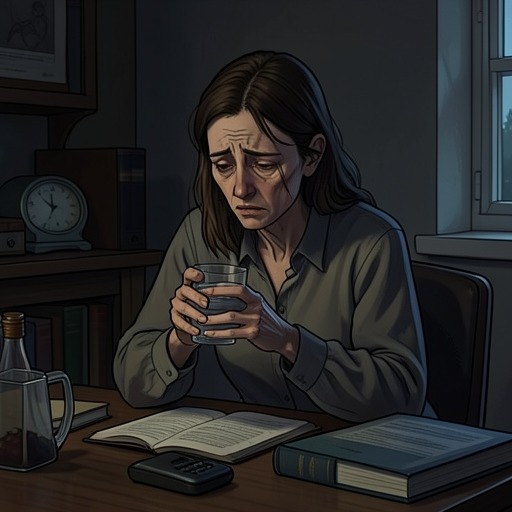
Sergei enters the account through Emma’s return to psychiatric care. She describes the admission as humiliating, especially because she is accompanied by her boyfriend; the admission itself is treated as something that must be explained away as normal and not shameful. Sergei brings her clothes, and the two are present for a brief conversation with Rajid Panjani about the readmission. His practical role is immediate and intimate: he is not merely a person Emma might tell about the hospital later, but someone beside her as she goes back in.
That presence does not mean he can see what Emma experiences from within. The narrative’s accounts of depression and altered perception make clear how difficult those states are to convey: an apparently familiar world can suddenly feel rearranged, while depression can leave Emma feeling reduced to fragments of herself. The book does not establish that Sergei comprehends those experiences in their full intensity. Instead, it lets their relationship take shape through specific gestures, misunderstandings, questions, and decisions.
Admission and Practical Disagreement
The sharpest glimpse of a difference between Sergei’s perspective and Emma’s circumstances comes in a conversation about her medication. When she is in the hospital, he pulls his hand from hers with some irritation and questions whether it is necessary to get rid of the supplies. He reasons that she is already receiving care and, if she comes home only once she is better, she could use them later rather than make another trip to the pharmacy. His argument is practical and oriented toward a future return home; it does not engage with the possibility that keeping the medication could itself be dangerous.
The contrast matters because the discussion concerns more than household convenience. Emma’s admission is happening amid serious psychiatric distress, while Sergei frames the medication as something that may be useful after recovery. The scene records a mismatch in how the situation is being understood, without showing a resolution or establishing exactly what Sergei knows about Emma’s risk. Another character later offers a possible explanation for his minimizing of her problems: perhaps treating them as less serious helps him ward off the thought that they might have been life-threatening. That remains an interpretation offered by someone who admits not to know Sergei as well as Emma does, not a confirmed account of his motives.
Presence, Disclosure, and Distance
Sergei’s visits give the hospital scenes a domestic counterpoint. One evening, while Lonneke and Seb are outside walking Bor and Beatrice is again complaining to her husband about the ward, Sergei sits opposite Emma and searches intently for the final piece of an elephant puzzle. The visiting period has only fifteen minutes left, and Emma does not want him to go. The puzzle and the dwindling time make his presence concrete: companionship consists, for the moment, of sitting together and trying to finish a small shared task before the visit ends.
At the same time, the story raises the question of what Emma has told him. Rajid Panjani asks whether Sergei knows about her hallucinations, and later asks whether she has told her boyfriend about the hallucinations and delusions she has experienced. These are questions, not proof that Sergei knows nothing; the evidence does not supply Emma’s answer. Their recurrence nonetheless marks a gap between being physically present during an admission and being included in the most frightening parts of Emma’s account. Emma’s difficulty communicating the force of her inner experience is part of that distance: the distress is not only what she sees or believes, but the shock and fear of finding that reality has changed again.
A separate recollection of Emma’s emotional numbness underscores how illness can alter her access to ordinary responses. She remembers feeling almost nothing on learning that her long-time psychiatrist’s husband had died, and describes her attention as consumed by one immense idea. The narrative does not connect Sergei to that particular moment, but such passages establish the wider emotional world in which intimacy has to operate: Emma’s feelings can be blunted or overwhelmed, and closeness cannot be measured simply by whether she displays a familiar response.
Gifts, Therapy, and a Shared Future
Sergei’s care also appears in quieter gestures. He brings Emma something he found in Greece, having thought it might suit her. The object itself is not identified in the account, so the significance lies in the act of remembering her while away and selecting something with her in mind. In another scene, the visit is organized around a jigsaw; elsewhere, a gift carries their connection beyond the hospital. These are modest acts, not evidence that he can solve her illness, but they give the relationship a texture distinct from clinical care.
Couples therapy becomes an explicit possibility after Rajid Panjani raises it. Emma brings the suggestion to Sergei and asks whether it appeals to him. He says that he does want to go to therapy and is interested in getting to know her better. His answer frames therapy not only as a response to strain but as a means of learning: even as her partner, he recognizes that there is more to discover about Emma. The book offers no session or outcome, and does not claim that agreement erases their earlier misunderstandings. What it records is a willingness to enter that work together.
Change and Narrative Significance
The closing scene gives that willingness a future-facing form. Sergei gets his bicycle off its stand and hopes aloud that many more years will be added. Emma jokes that they are going to couples therapy and that it will be interesting. His laughter rings out above the clatter of the pony’s hooves; she strokes Siem’s mane, looks once more at the sandy expanse where the PAAZ used to stand, then puts an arm around Sergei’s waist and leans her head against his coat.
The PAAZ is gone, but Emma says she is going on. Sergei is beside her in that movement, not as proof that her illness has ended but as the person with whom she is choosing to continue. The final physical closeness answers the earlier image of his hand withdrawn during the medication disagreement without pretending the conflict never happened. Sergei’s role is defined by that unresolved combination: he can misunderstand the gravity of a situation, yet remain present, accept the prospect of therapy, and share a future Emma does not present as guaranteed or uncomplicated.