Rajid Panjani
UpRajid Panjani is the psychiatrist who assumes responsibility for Emma during her return to the PAAZ and helps turn an apparently inexplicable crisis into a course of psychiatric assessment and treatment. He recognizes the danger in her plan to take her accumulated medication even while she insists that she feels exceptionally well. His role grows from urgent intervention into continuing care: he considers a bipolar diagnosis, addresses hallucinations and delusions, adjusts medication, and later works with Emma and Sergei on both their relationship and the unresolved safety plan at home.
Identity and Introduction
Rajid first appears as a psychiatrist meeting Emma at the hospital. After introducing himself, he proposes that they go directly to his office. His manner is formal and observant, but the scene quickly puts his clinical attention to the test: Emma’s words and her understanding of them do not match. She describes having medication set aside and intending to take it the following morning with breakfast. Rajid pauses to process this, then asks directly whether she means to kill herself.
Emma laughs at the suggestion and insists that she is not depressed. She points to work she still has to do and describes feeling so good that she wants to prevent the feeling from ever being ruined. The contrast between her expansive certainty and the concrete plan to take the pills is central to Rajid’s introduction. He does not accept her reassuring interpretation as proof that she is safe; instead, he asks what has led to the idea and whether something has happened. His first defining action is to take the suicidal meaning of her plan seriously even when Emma herself denies that meaning.
Taking Responsibility for Emma’s Care
When Emma questions how she can be admitted without her usual clinician, Rajid explains that her psychologist, Lars, is away and Dokter Visser is absent. He offers to become her treating psychiatrist, noting that he works both in outpatient care and in the clinic and can present her case to his colleagues if she agrees. The offer gives Emma a route into care, but it does not make admission something she wants: she is focused on collecting her prescription, completing her list, and ending her depression on her own terms. Rajid’s willingness to take responsibility therefore meets a patient who is not yet prepared to accept the purpose of that responsibility.
His involvement continues as Emma’s condition develops. He becomes concerned about the progression of her symptoms, particularly because she had a severe physical reaction to new medication during an earlier admission. He consults Dokter Valk, who agrees with his concern. For Emma, the consultation carries its own emotional weight: Dokter Valk had supported her through earlier treatment, and she feels ashamed that he will see her back in the PAAZ rather than the recovered patient she hoped to become. The contrast is revealing. What Rajid treats as a reason for caution and consultation, Emma experiences partly as a public return to a role she believed she had escaped.
At their next Monday appointment, Emma is in Rajid’s office for her second Monday at the PAAZ. The most severe side effects have passed, but a heavy depression and fear remain, especially around the prospect of diagnosis. Rajid first tells her that she is not pregnant, then listens as she tries to explain that the previous week she had not merely seemed agitated: she had been thinking strangely. His response places physical and psychiatric symptoms in the same clinical picture. He had already connected her agitation with the strong bodily reaction to Tegretol and her elevated heart rate; now he invites her to describe what else has been happening.
Diagnosis, Symptoms, and Treatment
Rajid has reviewed Emma’s file and considered what she and her partner have told him. On that basis, he raises the possibility that she has bipolar disorder. When Emma asks why, he explains that mood in the condition can move not only from ordinary levels down into depression but also too far upward. The diagnosis is presented as a possibility grounded in her history and current presentation, not as a label Emma has requested. She rejects the need for a new diagnosis, while Rajid continues to investigate what her symptoms may mean for treatment.
That investigation reaches experiences Emma has largely kept to herself. She admits that she sometimes sees snakes. She describes a narrow bike path beside a busy road where apparent snakes repeatedly turn out, on close inspection, to be branches. The disturbing part is not simply seeing the wrong thing: concentrating can briefly restore the ordinary object, but when she stops concentrating the snake seems to return. Rajid’s questions give her an opening to report the experience, although speaking about it remains difficult and frightening for her.
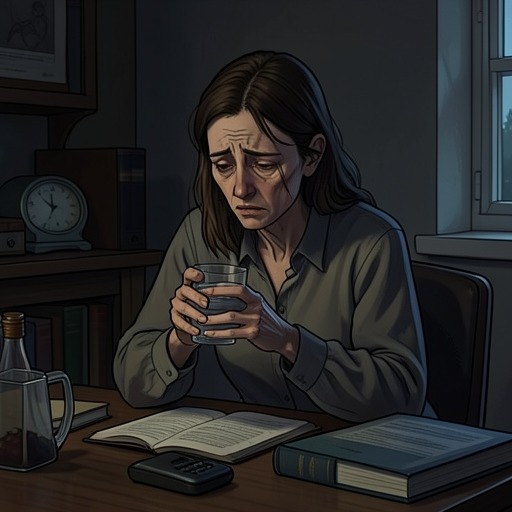
Emma also describes the conviction that led to her admission. During months of depression, an idea suddenly became absolute: it was time to die, and removing herself would let her get on with what mattered, especially work and productivity, without being impeded by feeling. She recalls feeling almost nothing about the news that Dokter Visser’s husband had died; her attention had been consumed by the single idea that she had to kill herself. Rajid identifies that idea as a suicide plan, while Emma had experienced it not as an emotionally charged intention but as something that simply had to happen. Their exchange makes clear why her own confidence that she was not suicidal could not settle the clinical question.
At the end of one discussion, Rajid proposes waiting until the side effects have completely disappeared before starting Depakine. He explains that it can work in combination with Lithium against manic periods, including delusions and hallucinations. In the meantime, Emma can complete Stemmingsformulieren so they can establish how often her episodes occur and whether particular triggers are involved. He also encourages her to talk about what she has disclosed rather than carrying it alone, and asks whether she has discussed it with Lars. The plan joins medication with observation and conversation: treatment is not limited to choosing a drug, but also requires a clearer account of the pattern and impact of Emma’s experiences.
When the subject turns to rapid cycling, Rajid explains that frequent mood changes are described by that term and that this variant can respond less well to treatment. He rules out antidepressants, explaining that they can turn an otherwise typical manic-depressive course into a rapid-cycling one, and indicates that another approach is preferable. This information complicates the prospect of a straightforward remedy: the frequency of Emma’s mood shifts matters, and treatment decisions must take account of how one intervention may affect the pattern.
The Limits of Clinical Language
Rajid’s effort to understand Emma does not always meet the need she is trying to express. When he asks about experiences that are not real, Emma objects to making the discussion chiefly about whether she sees a snake or a cat, hears people speaking Polish, or believes she is being followed. She describes the deeper injury as the repeated alteration of a world she thought she understood, like leaving a room and finding that a television guide has inexplicably moved. The shock, fear of another disturbance, anger, and helplessness matter to her as much as the perceptual event itself; so does the effort to conceal that anything has happened, for fear that a misplaced guide may mean something worse than a misplaced object.
Emma wants help understanding how to live with that repeated loss of certainty. Rajid answers that losing a television guide is different from having a hallucination. His distinction preserves the clinical difference between an everyday mistake and a psychiatric symptom, but it also exposes a gap between classification and lived experience. Emma is not claiming that the two are identical; she is using the missing guide to convey the sudden stress and self-doubt that accompany altered perception. The conversation shows both Rajid’s attempt to keep diagnostic categories clear and Emma’s insistence that the consequences of the experience cannot be reduced to naming what was seen.
A related disagreement emerges when Lars questions the bipolar diagnosis. Lars says he has not seen the condition in Emma and is wary of psychiatric labels. Emma argues that the symptoms occur in her mind, where other people cannot necessarily observe them, and that a diagnosis could make better treatment possible if it prompts people to look more closely. This exchange takes place between Emma and Lars, not Rajid, but it makes the stakes of Rajid’s assessment visible: a working diagnosis can be a tool for investigating suffering, or it can be dismissed as an outside label before the patient’s account has been fully heard.
Continuing Care and Shared Responsibility
Rajid’s relationship with Emma extends beyond individual psychiatric appointments. When he begins couples therapy with Emma and Sergei, Emma wonders why she needs to attend when Rajid already sees her each week and Sergei could speak with him alone. Rajid says that the immediate purpose is for them to get to know one another, and that he wants to hear about their relationship as well as give Sergei an opportunity to ask questions. Emma’s reluctance marks the difference between being treated as an individual patient and participating in a conversation about the couple; Rajid frames the session as a chance to understand the relationship rather than as an administrative extension of her weekly care.
The meeting also brings a practical safety failure into view. Rajid understands that Emma’s accumulated medication was supposed to have been removed, but learns that it is still at her home. Emma clarifies that she has left the PAAZ, not returned home. Later she explains that removing the pills took more than three weeks and two conversations with Rajid, because Sergei initially refused to do it. The disagreement is not simply about a household task: the medication is connected to Emma’s earlier plan to die, and the gap between an agreed safeguard and its implementation leaves the danger present after discharge. Rajid’s follow-up makes the plan concrete, while Emma’s account shows how slowly agreement within a relationship can become action.
Rajid also oversees the continuing adjustment of Depakine. He reviews Emma’s response and asks about side effects; she reports trembling hands and occasional dry mouth, but says she can tolerate them. He proposes increasing the dose again that week to reach the appropriate level. The decision follows the earlier plan to wait out the worst effects and then titrate the medication, while Emma’s report supplies the practical information needed to judge how treatment is proceeding.
When Emma asks whether she can keep Rajid as her psychiatrist after Dokter Visser returns, she explains that autistic people do not tolerate change well. Rajid asks whether that is her only reason, and his disappointment is briefly visible when she insists that it is. The exchange is teasing, but it also records an important form of continuity: Emma is willing to remain with a clinician whose care began in crisis, even as she frames that preference through her difficulty with change rather than openly expressing trust.
Narrative Role
Rajid occupies the point where Emma’s private account meets the structures of psychiatric care. He identifies a suicide risk that Emma does not recognize in the same terms, offers to take over treatment when her usual clinicians are unavailable, and turns uncertain impressions into questions about diagnosis, medication, frequency, and triggers. Yet the narrative does not make clinical attention equivalent to complete understanding. Emma’s image of the displaced television guide shows what can be lost when a symptom is treated only as a category; her insistence on its emotional consequences asks Rajid to hear not merely what appeared, but how the world changes for her when it does.
His care is consequently defined by both continuity and negotiation. He makes room for a possible diagnosis without treating Emma’s resistance as the end of inquiry, recommends medication while monitoring its effects, and revisits a safety agreement after Emma has left the ward. At the same time, the conversations expose limits: Emma does not readily disclose her experiences, and clinical distinctions do not automatically answer her question about how to endure them. Rajid’s significance lies in this ongoing work of assessment and return, where care depends on keeping the danger in view while trying to understand the person who experiences it differently.