Dimitri Kaminski
UpDimitri Kaminski reappears at the PAAZ during Emma’s readmission, turning a routine ward gathering into an unexpected reunion. A former patient with a history of serious alcohol dependence, he recognizes how easily someone can minimize what is happening to them; when he sees Emma doing exactly that, he pushes her toward a concrete act of communication rather than letting the denial pass unchallenged.
Identity and Background
Dimitri’s earlier admission followed a struggle with alcohol. His wife had made him stop drinking, but withdrawal symptoms drove him back to it; he eventually arrived at the PAAZ with a severe drinking problem and an even greater denial of its seriousness. After leaving the ward, he went to an addiction clinic. The account presents the cycle plainly—pressure to stop, withdrawal, relapse, and treatment—while Dimitri cautions against assuming that a diagnosis or a person’s history is always as simple as it first appears.
Return to the PAAZ
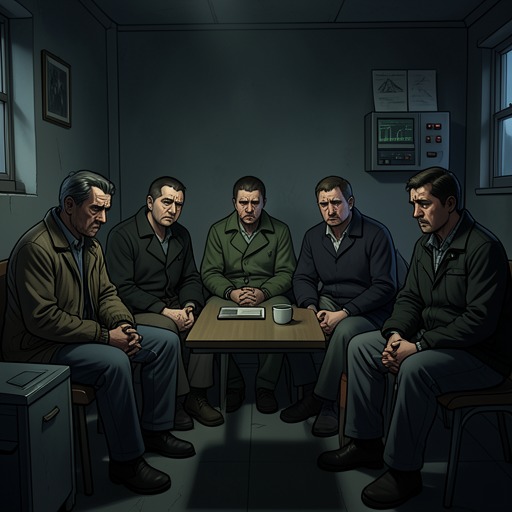
At a Monday morning ward gathering, someone asks where Mr. Kaminski is. Emma, half asleep and trying to disguise it with a drink of lukewarm tea, has not yet made the connection between the question and her former fellow patient. When she turns and recognizes Dimitri, surprise replaces her apprehension that another nurse from her past has arrived. He greets her with a firm embrace, then holds her at arm’s length, shaking his head as he asks what she is doing there. She has no clear answer, and asks whether he has been admitted or is merely visiting. Their reversed questions establish an immediate equality: neither is simply the observer of the other’s crisis, and each knows what it means to find oneself back in the ward.
Alcohol, Diagnosis, and the Limits of Simplification
When Emma recalls that Dimitri’s previous admission was connected to drinking and that he later attended an addiction clinic, she treats the history as if it should make his diagnosis straightforward. Dimitri draws on his cigar and blows a small, carefully formed ring before answering that matters can be less simple than they seem. Emma’s narration complicates his correction: in his case, the account of vodka, withdrawal, and denial may look simple even when the meaning of a diagnosis is not. The exchange gives Dimitri a perspective shaped by treatment experience without making him a clinical authority; his role is to resist the assumption that a visible problem tells the whole story.
Relationship with Emma and Practical Concern
Dimitri’s concern becomes especially direct when he learns that Emma has not told her family she is in the PAAZ. She says she had intended to tell them but completely forgot. He responds with alarm, urging her to call at once before she forgets again, then shakes his head at the contrast between her earlier reassurance that nothing was wrong and the obvious extent of her distress. His rebuke is comic in its bluntness, but it also makes the risk of isolation concrete: Emma’s admission is not even known to the people close to her because she has failed to follow through on telling them.
The reunion therefore gives Emma a companion who can meet her with familiarity rather than pity, and who is willing to challenge her self-minimization. Dimitri’s own past does not make him immune to misunderstanding or denial; instead, it gives his insistence a practical force. He notices what Emma has left undone and presses her toward the next necessary step, while the scene leaves his own present circumstances—whether he is on the ward or visiting—unresolved.