Director Wulicke
BuddenbrooksDirector Wulicke is the principal who remakes the Old School in the image of Prussian authority, turning education from a humane pursuit of classical learning into a system of duty, obedience, and career advancement. His physical presence and sudden inspections make that transformation concrete: students and teachers alike learn to anticipate judgment, perform submission, and fear the consequences of being seen to fail.
Identity and Appointment
Wulicke succeeds the warmhearted old gentleman who had led the school when Hanno Buddenbrook’s father and uncle were students; the former principal died early in 1871. Before taking the post, Wulicke had been a professor at a Prussian secondary school. His appointment marks a decisive change in the Old School’s character, not merely a change of leadership.
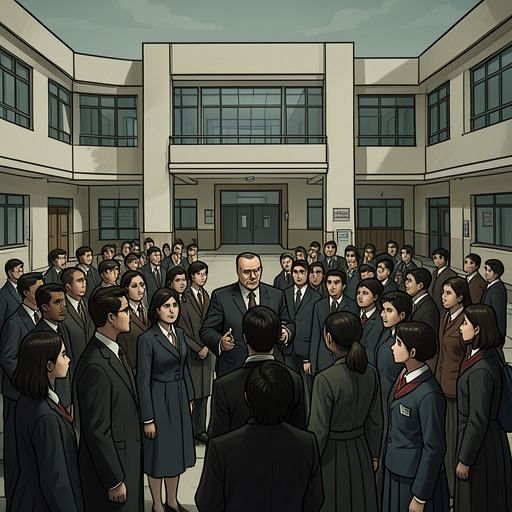
The narrative presents him as an imposing, grotesque figure. He is extraordinarily tall, with a black slouch hat, a short full beard, a potbelly, trousers too short for him, and sleeves ending in funnel-shaped cuffs that are perpetually dirty. He strides rapidly across the red-brick courtyard, pointing and snarling. His appearance combines the trappings of office with an almost monstrous theatricality: authority arrives not as an abstract rule, but as a body that can fill a doorway, command a room, and make its occupants fall silent.
The Old School Under His Rule
With Wulicke’s arrival, the school’s former ideal of classical learning as a joyful end in itself gives way to the language of authority, duty, power, service, and career. In his official speeches he invokes Kant’s categorical imperative. The school becomes, in effect, a state within the state: teachers and pupils alike come to think of themselves as civil servants, attentive to advancement and to how they appear in the eyes of those in power.
The institution is renovated and modernized according to the latest hygienic and aesthetic standards, and the work is completed successfully. Yet physical improvement does not settle the question of what the school has lost. The contrast between modern comfort and the earlier atmosphere of kindness, sentiment, serenity, benevolence, and good cheer leaves the old school’s more generous character in doubt. Wulicke’s reform therefore carries an irony: an institution can become more modern and efficient while becoming less sympathetic to the people within it.
His personal rule makes the official values feel less like an orderly educational program than an unpredictable exercise of power. He is described as enigmatic, wilful, jealous, and duplicitous, with a smile as frightening as his anger. He may tell a joke and then turn in rage on anyone who laughs. His subordinates cannot reliably judge how to behave; they resort to abasement and hope that submission will keep them from the force of his wrath. The atmosphere is not simply strict. It is unstable, because the person wielding authority can change the meaning of an action without warning.
The “Lord God” and the Students
Hanno and Kai call Wulicke “the Lord God” in private, a nickname that expresses both fear and irreverent resistance. They are careful not to let their classmates overhear it, since they know the school’s cold, incomprehending look. Their humor distinguishes them from the ordinary student responses of revenge or obstinacy: rather than adopt familiar mocking nicknames for teachers, they use titles and formal language with a deliberately ironic chill. Their private name for Wulicke gives his authority a mythic scale, while their guarded use of it shows how thoroughly the school’s power reaches beyond the classroom.
The nickname becomes especially apt when Wulicke appears in the courtyard during an incident involving running water at the pump. He points out the water and barks at the students, who hurry to shut off the tap but then stand distraught, looking between the pump and the principal. He continues to terrorize the school, directing his anger at discarded sandwich papers and turning faces ashen. Kai responds with elaborate bows to the pale, shabby teachers-in-training passing through the gate, and calls the elderly mathematics teacher Herr Tietge an “old corpse.” The episode sets Kai’s theatrical mockery against the fear Wulicke produces: humor survives, but as a risky performance conducted in the shadow of authority.
Surprise Inspection and Its Consequences
Wulicke’s power is at its most consequential during his unannounced inspection of Herr Modersohn’s English class. The lesson has dissolved into disorder. A music box plays “Du, du liegst mir am Herzen,” boys make noise, and the recitation and lewd joking have unsettled the room. Then the door is flung open without a knock and Wulicke enters. The students rise together, press their arms to their sides, bow their heads, and fall silent; Modersohn, turned ash-grey, drags his chair down from the platform and wipes it with his handkerchief.
The inspection is an examination of Modersohn as much as of the pupils. He is meant to demonstrate his teaching and show what the class has learned, and his future depends on the lesson. Wulicke orders the class to continue. Modersohn calls on a student to recite “The Monkey,” but the performance falters; the class cannot rely on reading directly from its books in the director’s presence. When they move to Ivanhoe, only young Count Mölln can translate a little, because he has taken an interest in the novel. The others cough, stammer, and struggle over the words. Hanno cannot get beyond the first line, and Wulicke answers with a roar likened to a violent scrape on the lowest note of a contrabass.
When the bell rings, Wulicke remains standing, crosses his arms, and looks disdainfully over the students. He takes the attendance book and enters demerits beside the names of six or seven students whose work has been unsatisfactory or worse. Hanno is among them. Modersohn cannot be assigned a demerit, but the inspection leaves him a pale, broken figure, and Wulicke declares, “I will destroy the careers of every one of you,” before departing. The punishment reaches beyond an individual classroom performance: Wulicke can make a teacher’s professional future and a student’s school progress feel subject to his judgment.
Narrative Role and Significance
The inspection exposes the gap between the school’s official language of education and the career system Wulicke administers. The class is supposed to demonstrate learning, yet the surprise examination makes fear and performance decisive; the teacher is evaluated alongside his pupils, and a single failed demonstration carries institutional consequences. Wulicke’s order, the attendance book, and the demerit are instruments by which authority becomes routine and personal: the threat of being assessed shapes conduct even before judgment is delivered.
For Hanno, the outcome seems to confirm that he will be held back at Easter. He leaves with a weary look and rubs his tongue against a bad molar. Kai puts an arm around him, apologizes for translating instead of staying silent and receiving a demerit too, and tries to console him with bitter jokes about the system’s career distinctions between teaching assistants and professors. Hanno tells Kai to forget it; Kai replies that Hanno must submit to his fate and calls the director’s will unsearchable. Their exchange does not undo the punishment, but it restores the private companionship and ironic language that the school’s public discipline cannot entirely control.
Wulicke is therefore more than a severe headmaster. His grotesque physical entrance, the students’ private divine nickname, and the inspection’s sequence of silence, failed performance, and recorded penalties make him the human face of the Old School’s authoritarian transformation. The narrative also preserves the cost of that transformation in its contrast with the kinder institution that preceded him: modernization and official ideals of service coexist with fear, humiliation, and a narrowing of education into a test of obedience and prospects.