Ladies Buddenbrook
BuddenbrooksThe Ladies Buddenbrook—Gotthold Buddenbrook’s daughters Friederike, Henriette, and Pfiffi—are a recurring family trio whose watchful commentary links private domestic life to the Buddenbrooks’ larger history. They do not direct the family’s affairs, but they continually interpret its marriages, status, children, and decline; their combination of affectionate attention and sharp judgment makes them a small, persistent chorus within the multigenerational narrative.
Identity and Family Position
The sisters belong to the branch of the family headed by Gotthold Buddenbrook, the estranged elder half-brother of Jean Buddenbrook. At the wedding of Antonie “Tony” Buddenbrook and Bendix Grünlich, Gotthold appeared with his wife and their daughters. The sisters were described as unlikely to marry, a prospect presented as regrettable within the family’s assumptions about women’s futures. Their continued presence in later family gatherings keeps this branch visible even as the central Buddenbrook line accumulates wealth, public honors, and new heirs.
Their position is intimate but peripheral: they attend major family occasions and know the household’s personal history, yet they are not among those who manage the firm or decide questions of inheritance. Their attention instead falls on conduct, appearance, and reputation. Through them, the novel shows how family history is not only recorded by the Buddenbrook chronicle but also continually discussed, evaluated, and passed around in everyday conversation.
Weddings, Children, and Domestic Judgment
The sisters’ reactions to family ceremonies reveal their habit of pairing participation with skeptical commentary. At Tony’s second wedding, to Alois Permaneder, they attended the small gathering and offered the guarded hope that the marriage might last. The remark registers both Tony’s previous divorce and the family’s uncertainty about the new match, even as the ceremony proceeds with dignity and close relatives present.
They also scrutinize the younger generation. At the baptism of Tony’s son Johann, they were among the family members assembled for the ceremony. Pfiffi observed that the baby looked sickly, and her mother and sisters felt obliged to agree. The comment turns a joyful family occasion into an instance of anxious assessment: the child’s appearance is read against the family’s expectations for its continuation.
Their attention to Hanno’s development becomes still more pointed. The sisters noticed that, at fifteen months, he had not taken an independent step and could not pronounce their names intelligibly, although he could say the names of other relatives with reasonable accuracy. They concluded that he might remain unable to speak or walk. The prediction is a particularly severe example of their tendency to turn observed particulars into judgments about the family’s future, and it contrasts with the hopes invested in Hanno as the male heir.
Gossip and Social Performance
The sisters find amusement in the habits and vulnerabilities of relatives. As Thomas Buddenbrook’s career advanced, they had few diversions beyond mocking their poor cousin Klothilde and discussing the foibles of Elisabeth Buddenbrook and Tony. They could needle Elisabeth over her claim to wear her hair simply, despite the longstanding reddish-blond hairpiece beneath her bonnet. The joke depends on the difference between respectable self-presentation and what the family knows to be true, a distinction that repeatedly informs the sisters’ social judgments.
Tony provided another favored subject. When prompted to recall people who had affected her life, she would raise her shoulders and pronounce the names of Pastor Trieschke, Grünlich, Permaneder, and the Hagenströms in succession. The sisters delighted in drawing out this response. Their amusement does not erase the serious history behind the names—Tony’s unhappy first marriage, her second marriage, and her rivalry with the Hagenströms—but turns those experiences into familiar family talk.
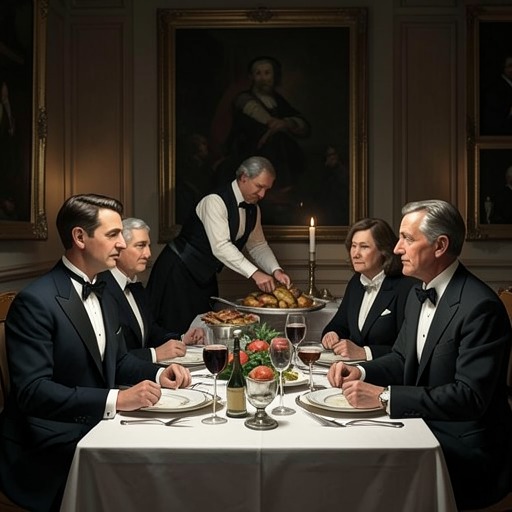
Their own social behavior is similarly expressive. When the Buddenbrooks encountered the Hagenströms at breakfast in a hotel, Elisabeth, Thomas, and Gerda exchanged reserved greetings. Tony answered with conspicuous hauteur, and the sisters exchanged knowing looks at her response. Their silent exchange shows how closely they monitor the family’s public manners, and how readily an ordinary greeting becomes evidence in the ongoing contest over standing and respect.
Public Ambition and the Family Chronicle
The sisters’ attention extends from domestic manners to civic advancement. After the death of Senator James Möllendorpf, Tony privately entertained the hope that Thomas might succeed him. At a family dinner, she signaled her expectation with a sly look; the sisters answered with a knowing exchange of glances. Thomas recognized that the town was discussing the same possibility, although he changed the subject rather than allowing Tony’s eagerness to dominate the conversation.
Tony’s interest in the election took a more studious form as well. She had examined the constitutional provisions governing the selection of senators, discussing electoral chambers, candidates, ballots, and the required oath. The sisters were present in the family’s social world as these ambitions circulated, while their own role remained that of observers who registered the significance of such advances. Thomas’s eventual election and the family’s pride in his public standing form part of the contrast between their scrutiny of individual success and the uncertainties surrounding the family’s longer future.
That longer view is sharpened by the Buddenbrook family records, which preserve births, illnesses, schooling, marriages, and business milestones across generations. Tony reads the chronicle as evidence that even modest events belong to a continuing family history, and the record gives her a sense of responsibility as one link in a chain. The sisters’ recurrent presence supplies a more conversational counterpart to this written record: they recall, judge, and circulate the meanings of family events, though often through gossip or skepticism rather than formal commemoration.
Inheritance, Decline, and Narrative Role
The family’s material history complicates the sisters’ attention to status. After Jean Buddenbrook’s death, Thomas explained that the family’s fortune, apart from real estate, stood at roughly 750,000 marks courant. Losses from the Bremen bankruptcy and political unrest had been offset by profits over the preceding fifteen years, but Thomas was troubled by the division of family capital among dowries and other payments. The sisters are not the decision-makers in this financial discussion; their significance lies in the surrounding family culture, where fortune, marriage, and social position are repeatedly weighed together.
That culture comes under greater strain when Thomas’s will orders the firm to be dissolved within a year. Tony is deeply hurt that her brother has not preserved the business for his sole heir, Hanno, and she mourns the end of a firm whose history reached across four generations. She nevertheless comforts herself with the belief that the family can outlive the business and that Hanno may establish a new enterprise. The sisters’ habitual attention to marriageability, health, appearance, and advancement belongs to the same world of inherited expectations that makes the firm’s ending so consequential.
As a group, the Ladies Buddenbrook are neither merely comic gossips nor authoritative chroniclers. Their remarks can be petty, as when they relish teasing relatives, but their persistent interest in the family’s ceremonies and children also exposes the standards by which its members are judged. In their glances, comments, and predictions, the narrative lets family prestige appear as a social performance continually inspected by its own kin—and lets private anxieties about the next generation surface before the family can know their full consequences.