Siegismund Gosch
BuddenbrooksSiegismund Gosch is a small-business broker in Lübeck and one of the novel’s most theatrically self-fashioned figures. His respectable commercial occupation sits beside a private life devoted to literature and dramatic gesture: he cultivates the appearance of a schemer, delights in a theatrical reversal, and turns ordinary business into performance. Yet his posturing does not erase his practical place in the Buddenbrooks’ affairs. He brokers the sale of their houses, champions Thomas Buddenbrook in civic politics, and, as age weakens his body and his work, remains a sharply drawn witness to the distance between imaginative ambition and everyday life.
Identity and Self-Invention
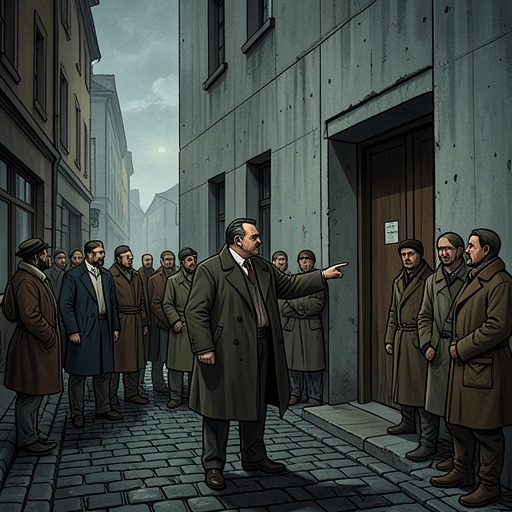
Gosch is about forty when introduced, a bachelor with a modest brokerage business conducted in a respectable middle-class fashion. His appearance is carefully made to suggest a sinister character: sharp features, a pointed chin, downturned mouth, and grey hair combed over his brow. He wants to resemble a crafty villain somewhere between Mephistopheles and Napoleon, and the narrator notes that he succeeds in the part. His wish that he were hunchbacked makes the artifice especially plain: he treats his own body and manner as materials for a chosen role.
That performance coexists with qualities unlike the villain he imitates. The narration calls him, despite appearances, honest and kindhearted, and describes him as an aesthete and original thinker. He avoids vulgar language, even when speaking about business, and his dark, narrow office contains a large bookcase of poetry in many languages. For twenty years, it is rumored, he has been working on a translation of Lope de Vega’s complete plays. He has also played Domingo in an amateur production of Schiller’s Don Carlos, a high point of his life. The contrast between modest brokerage and expansive literary aspiration defines him: he belongs to the town’s commercial world, but imagines himself in a more dramatic one.
Political Excitement and the Buddenbrooks
On the way to a council meeting during a period of civic tension, Gosch tells Johann Buddenbrook that the times are tempestuous. Johann speaks of the meeting and restricted voting rights as matters of public concern; Gosch instead dwells on the crowd’s excitement. He has been out observing its members and admires the intensity in their eyes. He recounts seeing a butcher’s apprentice throw a stone at a man’s window, describing the act as that of a panther, and calls the unrest powerful and extraordinary even while acknowledging the crowd’s ignorance. Johann dismisses the disturbance as childish troublemaking; Gosch is captivated by its force and novelty.
When Johann goes out to address the crowd, Gosch catches up with him and declares his intention to speak to the people himself. Johann insists that he is better placed to do so because he knows more people outside. Gosch accepts his judgment but insists on accompanying him and standing at his side. The episode turns his taste for political spectacle into action: he willingly approaches a potentially dangerous gathering, not as its leader, but as the dramatic companion of a man he admires.
Years later, Gosch’s support for Thomas Buddenbrook’s election to the Senate is equally fervent. During the debate over the vacant seat, he roams about threatening to throttle anyone who will not vote for Thomas. He invokes his own presence at Johann’s side in 1848, when, as he remembers it, a single word from Thomas’s father calmed the crowd. In his view, the family’s claim to distinction reaches back even further: justice, he declares, would have elevated Johann’s father and grandfather to the Senate. His public advocacy is thus bound up with a family memory of authority and civic standing.
The narrator also reveals a more private motive for this political devotion. Gosch has never been introduced to Gerda Buddenbrook and has scarcely spoken to her, but when she arrives in town he immediately regards her as an extraordinary presence capable of giving meaning to his unfulfilled life. He makes himself her devoted admirer from afar, imagining grand acts of homage that the conventions of their society will not permit. The vote for her husband becomes the practical token available to him; he also imagines dedicating his long-delayed Lope de Vega translation to her. His support for Thomas therefore carries a personal idealization of Gerda, not merely respect for the candidate.
Broker and Performer
Gosch’s theatricality finds its clearest expression in small commercial disappointments. After losing six and a half thalers courant on a few speculative stocks, he sinks onto a bench in a pose of defeat, presses a fist to his brow, rolls his eyes, and repeats his curses. The loss is small, but its dramatic shape delights him; the steady commissions of his ordinary business bore him, while a setback gives him a tragic role to inhabit. When a well-wisher offers sympathy, Gosch answers with a Latin maxim about suffering and remaining a child. His response is so learned that no one understands it, reinforcing the gulf between his private literary performance and the practical world around him.
His professional dealings with Thomas over the old family house on Meng Strasse offer a longer, more consequential performance. Gosch visits Thomas in his office to discuss the asking price. He argues that twenty-eight thousand thalers courant is already a generous offer, warning that the large, centrally located property could be difficult to resell. As he describes the risk, he imagines himself left ruined, his business finished and his grave dug. Thomas counters that the lot could be divided and insists on thirty thousand thalers, citing his responsibility to his brother and sister.
The negotiation lasts about two hours. Gosch shifts from grim warnings to a show of guileless generosity, offering eighty-four thousand marks courant in a sweet voice and with a trembling hand, while the narration makes clear that the pose is deceptive. Thomas does not accept immediately, saying that he must consult his siblings. Gosch then returns the discussion to business and, after speaking of Thomas’s good fortune, proposes twenty-nine thousand thalers, or eighty-seven thousand marks courant. Thomas accepts. The scene lets Gosch’s roles—broker, comic villain, and admiring subordinate—compete within a real transaction, but the outcome remains a concrete sale rather than a theatrical triumph.
Age, Decline, and Later Transactions
By the time Thomas and Christian Buddenbrook encounter him at a seaside hotel, Gosch has stayed behind as a guest. He needs the sea air because of trembling in his limbs; he can barely hold his glass, and he can hardly write. The condition threatens his translation of Lope de Vega’s collected dramas, which is progressing painfully slowly. His repeated outbursts have lost their former pleasure, and he is described as depressed. The change is measured against the younger Gosch who made even a modest stock loss into a source of weeks of theatrical enjoyment: now the body that sustained his performance also obstructs the literary work he has pursued for decades.
His professional life continues despite this decline. When Thomas’s widow Gerda prepares to sell the large house Thomas built, Gosch is admitted to her salon and allowed to negotiate face to face with her. He offers 85,000 marks, a reasonable proposal in light of the loss involved in selling the house. Gerda does not conclude the sale, however, and Kistenmaker rejects Gosch’s offer, insisting that more can be obtained. The house ultimately sells for 75,000 marks to an aging bachelor who has decided to settle in town. Gosch does not control the result: his access to Gerda is personally momentous to him, but the sale proceeds through another broker’s judgment and ends below his offer.
Gosch’s importance lies in the tension between his modest station and his extravagant inner staging of experience. He is at once an honest local broker and a would-be villain, an observer of civic upheaval and a partisan of the Buddenbrooks, a literary aspirant whose work is repeatedly deferred by the demands of life and finally hindered by physical decline. His scenes make public politics and private commerce feel theatrical without removing their material consequences: votes decide a Senate seat, and bargaining determines what the family can recover from its houses. The comic distance between Gosch’s grand imagined roles and his limited practical power gives that contrast its force.