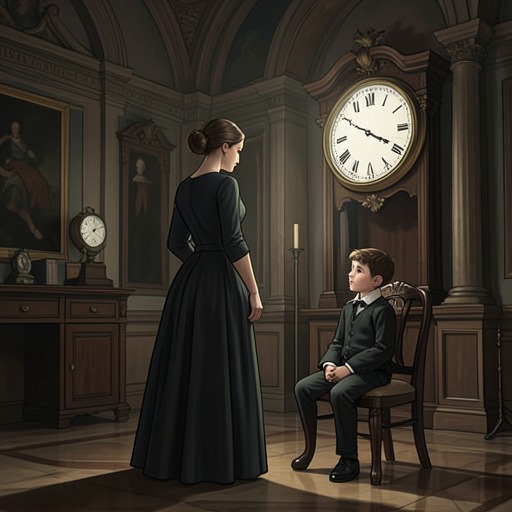
Klothilde Buddenbrook
BuddenbrooksKlothilde Buddenbrook, called Thilda, is a poor cousin of the Buddenbrook family whose life is marked by financial dependence and the absence of marriage prospects. Her modest place within the household contrasts with the family’s wealth and its concern for status: she belongs to its history and daily gatherings, yet must look to a charitable pension and makeshift lodging for her future. Her long association with Clara, and her recurring presence in family scenes, give her a steady but marginal place in the novel’s account of generational change.
Identity and Circumstances
Klothilde is twenty-one in the early autumn of 1848, though the narrator describes her as having the appearance of an old maid. Her long face already bears pronounced lines; her mousy-grey hair is parted and drawn tightly back. The description links her settled appearance to the life she expects rather than to a passing mood: she is content with her unmarried condition and does nothing to alter it.
Her poverty makes that future materially precarious. She knows that, as a penniless woman, she is unlikely to find a husband, and looks instead toward living in a small parlour on a pension her powerful uncle might obtain for her from a charitable foundation for poor women of good family. The modesty of this prospect sets her apart even among relatives who share the Buddenbrook name: family connection offers her recognition, but not financial independence.
Place in the Household
Klothilde is included in the intimate and public life of the family despite her dependence. When Tony returns home, Klothilde is among those waiting on the landing to welcome her, alongside Elisabeth, Christian, Clara, and Ida Jungmann. A letter from the family to Tony carries greetings from Klothilde as well as from her mother and siblings. These small gestures establish her as part of the household’s circle, not an outsider, even when her means distinguish her from its more privileged members.
She also appears in the record of family life. The Buddenbrook chronicle preserves events as modest as illness and schooling, and records Tony’s birth, childhood illnesses, first day at school, and confirmation. Klothilde is named among those sending family greetings, while later scenes place her beside relatives at home and at family gatherings. Her presence is thus maintained both through domestic company and through the family’s habit of recording its own continuity.
Companionship with Clara
At home, Klothilde is closest to Clara, her equally pious cousin. Their shared religious disposition offers a point of closeness within the household, although their circumstances and temperaments differ. Clara speaks to relatives and servants in an imperious, sometimes hard tone; Klothilde, by contrast, is characterized by patient, methodical humility and hunger. The pairing places the poor cousin beside a member of the immediate family while making visible their unequal resources and positions.
Klothilde’s father dies, and she considers establishing herself with the few pennies and pieces of furniture she has inherited, finding lodgings somewhere of her own. Her situation is not presented as a settled escape from dependence: the prospect of a separate household remains defined by the smallness of her inheritance. Her bond with Clara therefore exists against an ongoing practical uncertainty about where and how she can live.
Family Gatherings and Social Exposure
Klothilde’s poverty becomes especially visible at the family’s Thursday children’s-day gatherings on Meng Strasse. After Tony’s divorce, Gotthold and his three unmarried daughters take a quiet satisfaction in her misfortune, and the cousins question whether the divorce has left Tony no better off than before—or in a worse position. The scene places Klothilde within a family conversation shaped by women’s marital prospects and social standing. She is not the target of their remarks, but her own unmarried state and limited means make the judgments around Tony’s marital history an immediate part of the atmosphere she inhabits.
At another family gathering, Klothilde sits among relatives as they discuss weddings, trousseaux, and honeymoons. Christian turns toward her and proposes that they marry, then qualifies the remark as meaning separately. The joke singles out their shared position outside the paired couples’ celebrations: Klothilde is present at the family’s arrangements for marriage, but not as a bride or a participant in the plans. Its lightness does not alter her circumstances; it underscores them through contrast.
Continuity and Narrative Significance
Klothilde’s role is one of persistence at the margins of family prosperity. The Buddenbrook inheritance is repeatedly measured through estates, dowries, and business losses, while her own future is framed in terms of a small pension, a few inherited possessions, and possible lodgings. She belongs to the family’s social and religious world, but the substantial resources that shape its fortunes do not translate into security for her.
Her recurring presence also helps register the difference between family continuity as an ideal and the uneven lives lived within the family. Buddenbrook records and rituals gather relatives into a shared history; Klothilde is among those remembered and welcomed. Yet her anticipated future—a charitable pension for a woman of good family—shows that belonging does not erase economic vulnerability. Through her, the family’s collective identity includes a dependent relative whose place is real, but whose prospects remain narrow.