Kai Mölln
BuddenbrooksKai Mölln is an impoverished count whose shabby appearance conceals a strikingly aristocratic face and a fierce imaginative independence. He becomes Hanno Buddenbrook’s one close school friend, and their companionship—sustained by stories, music, humor, and mutual loyalty—offers Hanno a rare refuge from the school and family expectations that weigh on him. As Kai grows from an exuberant storyteller into an aspiring writer, his creative ambition also throws Hanno’s uncertainty and vulnerability into sharper relief.
Identity and Background
Kai belongs to an aristocratic family, but his circumstances are poor. He lives with his father, Count Eberhard Mölln, on an isolated, nearly worthless farmstead beyond Burg Gate. Its modest surroundings and the warning on the door that the count lives alone, needs nothing, buys nothing, and has nothing to give away express the household’s withdrawal from ordinary social contact. Kai’s mother died giving birth to him, and an elderly woman keeps house; he grows up amid the farm’s dogs and chickens, moving about with the unselfconscious energy of a child at home in the open air.
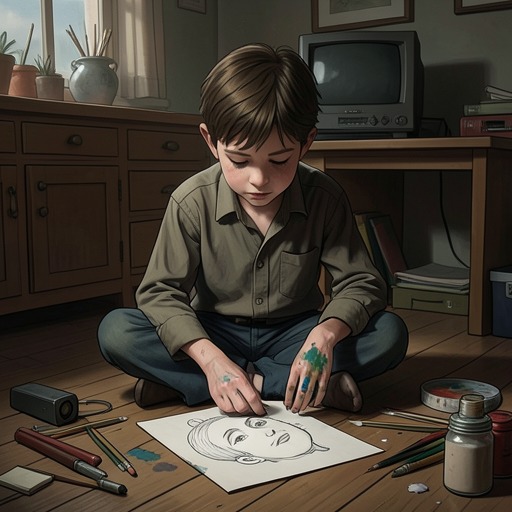
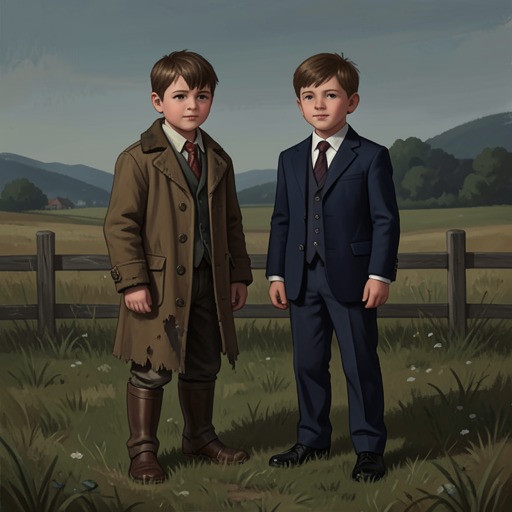
At school, the contrast between Kai’s title and his condition is immediately visible. His suit is dirty and worn, with missing buttons and a conspicuous patch, and his hands are often unclean. Yet the narrator emphasizes his fine, narrow fingers, long nails, pale forehead, and keen blue eyes, while his distinctive features suggest the noble lineage that his clothing does not advertise. Kai is socially untidy, but neither timid nor ashamed: when he enters Hanno’s grand home, he admires it openly without becoming self-conscious.
Friendship with Hanno
Hanno first sees Kai on walks beyond the town, where he watches the boy play among the animals. They meet again at school. Kai’s wild appearance initially makes Hanno nervous, but Hanno quickly looks past it and feels sympathy for him. Hanno is too reticent to approach; Kai, by contrast, courts the withdrawn boy with conspicuous enthusiasm. His initiative turns mutual recognition into friendship.
The boys share little interest in conventional schoolwork. Kai cannot help Hanno with lessons because he dislikes multiplication tables as much as Hanno does. Instead, he gives Hanno what he values: marbles, wooden tops, and even his battered tin pistol. They spend recess hand in hand, and Kai talks about the farm and its animals. He learns that the family calls his friend Hanno and adopts the name at once, continuing to use it thereafter.
Their friendship also crosses the boundaries between their very different homes. Kai takes Hanno to the farm to see newborn guinea pigs, where they encounter Count Eberhard eating and reading in his rustic room. Ida Jungmann is reluctant to repeat the visit and prefers that Kai come to Hanno’s house instead. He does so more and more often, walking into town each afternoon except when deep winter snow prevents the journey. The difference in their circumstances does not weaken their ease together: Kai is frank in his admiration of Hanno’s home, while Hanno’s reserved manner gives Kai a steadier companion.
Storytelling and Music
Kai’s early talent appears in the playroom, where the boys listen as Ida Jungmann reads fairy tales. Once they know the printed stories, Kai begins making up his own. His tales develop from simple beginnings into intricate fantasies that borrow some basis in reality but transform it with mystery. One favorite concerns a powerful magician who imprisons the clever prince Josephus in the form of a bright-colored bird. A boy destined to lead an army of dogs, chickens, and guinea pigs is to defeat the magician and free both Josephus and Hanno; the rescued prince will then make Kai and Hanno powerful figures in his kingdom. The fantasy places their friendship inside its own structure of rescue and reward, with Kai as teller and Hanno as an intimate participant in the imagined adventure.
As the boys grow older, their collaboration takes on a more deliberate artistic form. Kai tells a developing story about a ring found in a dangerous, uncanny landscape, a black castle under a reddish fog, and the release of the castle from its spell. Hanno supplies music for important moments, and when the practical staging allows, they act out the stories in an upper theatre with musical accompaniment. Their different gifts meet without becoming the same: Kai invents the narrative, while Hanno answers with chords and themes.
Kai’s childhood storytelling matures into an aspiration to write. He reads Edgar Allan Poe’s story of Roderick Usher and wishes he could write something as remarkable. He has already finished a fantastic fairy tale set both in mysterious workshops beneath the earth and in the human soul, where natural forces and inner life are imaginatively blended. The work is described as fervent and suggestive, its language marked by yearning. Kai’s ambition does not end with the role of the boy who invents stories for his friend; he tries to make a literary work of his own.
School, Conflict, and Mutual Loyalty
The boys’ friendship is set against their shared dislike of compulsory discipline. Kai avoids gymnastics because he despises the rules, and Hanno would rather hear another story than join the exercises. When Hanno’s father and Dr. Langhals expect physical training to make him sturdier, the contrast between their expectations and the boys’ inclinations becomes plain. Kai’s presence does not turn Hanno into a robust schoolboy; instead, it gives him a companion who accepts the refuge of storytelling and music.
Their avoidance is not merely a matter of taste. The Hagenström boys make schoolyard and physical activities threatening for Hanno, mocking and bullying him during gymnastics, skating, and swimming. On one occasion, when Hanno is being bullied in the swimming area, Kai appears unexpectedly and intervenes. Kai is hurt in the confrontation, but one of the older boys limps away. The incident makes visible what their quieter routines already establish: Kai’s loyalty is active, and his spirited defiance can defend a friend where Hanno cannot comfortably defend himself.
The same loyalty appears in their response to the school’s authority. When Hanno receives a demerit after a humiliating classroom episode, Kai puts an arm around him and apologizes for having translated rather than accepting a penalty too. He tries to soothe Hanno with banter, turning from the demerit to the absurdities of the institution and its fixed timetable. Kai imagines the open courtyard door and asks what freedom can mean in a place where even stepping outside during recess seems impossible. His humor gives Hanno a way to listen and momentarily forget his setback, even though it cannot remove the school’s power over him.
When Hanno speaks of his fear of failure, his inability to imagine a future, and his despair about his health and prospects, Kai does not answer by insisting that the fears are groundless. Instead, he redirects their conversation toward what each boy can still do: Hanno can play, and Kai can write. Hanno sees Kai as more courageous, able to laugh at authority and hold on to his pride; Kai responds by encouraging him to talk about piano playing and asking whether he will improvise that afternoon. The exchange reveals both their closeness and their difference. Kai’s confidence helps him imagine a future in writing, while Hanno experiences his music as an impulse he cannot simply abandon, even when he thinks it may worsen his distress.
Change, Separation, and Narrative Role
The friendship persists as the boys grow older. When Hanno returns from a four-week stay by the sea, the thought of seeing Kai again is among the things that lift his spirits. The sand he wants left in his shoes will preserve a trace of the shore, but he also looks ahead to music lessons and to meeting his friend. School and its humiliations will resume; the prospect of Kai’s company is part of the comfort Hanno carries back with him.
Later, Kai still finds Hanno at school and greets him with the same intimate familiarity. He appears from the back row, dusts his hands, and approaches Hanno, who is startled to see him. His patched clothing and striking features remain recognizable, while his changing voice and the boys’ growth mark the passage of time. Kai’s humor survives that change, and so does his instinct to notice Hanno’s distress: he takes a ruler and carefully frees Hanno’s wet hair from his forehead after Hanno has rushed in late.
Near the end of the novel, Hanno’s illness leaves their friendship with a final, painful separation. During a later family conversation, the account of his last illness remains guarded and sorrowful. Kai had come to visit while Hanno lay dying, almost forcing his way into the room. Hanno smiled at the sound of Kai’s voice although he no longer recognized anyone; Kai kissed both his hands repeatedly. The gesture completes a relationship first formed through Kai’s bold approach to a shy child. At the end, Hanno cannot return the recognition or sustain a conversation, but the sound of his friend’s voice still draws a smile.
Kai’s narrative importance lies not in changing Hanno into a conventional successor or schoolboy, but in offering him an enduring relation organized around imagination rather than achievement. His stories, his accompaniment of Hanno’s music, his comic resistance to school authority, and his defense of Hanno all make their friendship a counterworld to the demands pressing on the Buddenbrook boy. Their artistic exchange also sharpens the contrast between Kai’s confidence in becoming a writer and Hanno’s uncertainty about what he can become. The final visit does not resolve that difference; it shows how much their bond persists when Hanno’s other forms of response have nearly fallen silent.