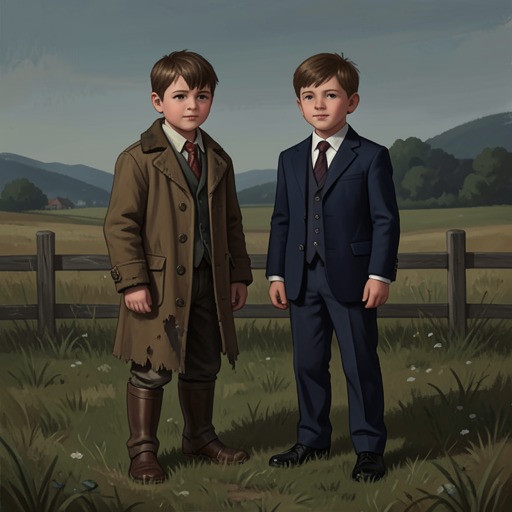
Eberhard Mölln
BuddenbrooksEberhard Mölln is Count Eberhard Mölln, the reclusive father of Kai Mölln and the remnant of a once powerful aristocratic family. Living on a tiny, nearly worthless farm beyond the Burg Gate, he has withdrawn from society so completely that his isolated household becomes a striking counterpoint to the wealth, domestic order, and public manners surrounding the Buddenbrooks. His brief appearance at his farm, where Hanno and Kai visit him, gives this withdrawal a human scene rather than leaving it as local legend.
Identity and Background
Eberhard belongs to a noble family whose branches have dwindled away. At the time of the narrative, he and Kai are the only Möllns left in the country; Eberhard is estranged from his sole surviving sister, a novelist who publishes under an unusual pseudonym in family magazines. The family’s former wealth and power survive chiefly as a contrast to its present isolation and decline.
His circumstances are materially modest. The Mölln property is a small, almost worthless farmstead with no name, situated outside the city near the first village. From the gate, a visitor sees a manure pile, chickens, a doghouse, and a wretched cottage with a low red roof—the manor house. The grandeur of Eberhard’s title and lineage is thus set against a landscape of practical rural poverty.
The Recluse Beyond the Burg Gate
Eberhard has forsaken the world for the farm, where he breeds chickens and dogs and grows vegetables. He is tall and bald, wears top boots and a green frieze jacket, and has a large, grizzled beard. A riding crop is habitually in his hand although he owns no horse, and a monocle sits beneath his bushy brow. These incongruous details make him both memorable and self-contained: the trappings of rank persist, but without the social world that would ordinarily give them a setting.
His refusal of contact was once made explicit by a notice on the low front door: "Here lives Count Mölln, all alone. He needs nothing, buys nothing, and has nothing to give away." The sign remained until it had achieved its purpose and passersby stopped bothering him; only then did he take it down. Its blunt inventory turns solitude into a public boundary, rejecting not merely commerce but the ordinary approaches through which neighbors might enter a household’s life.
Encounter with Hanno and Kai
Before Hanno Buddenbrook and Kai become schoolmates, Hanno catches glimpses of Kai playing freely among the chickens and puppies at the farm. Later, when the boys arrive to see newborn guinea pigs, they find Eberhard eating and reading at a low rustic table in a long, low room on the ground floor. He asks gruffly what they want. The brief encounter confirms the distance suggested by his sign: the count receives visitors without transforming his austere home into a hospitable social space.
Kai’s childhood reflects the isolation of the household. His mother died giving birth to him, an old woman keeps house, and he grows up among the farm animals. Eberhard’s withdrawal therefore forms the setting of his son’s early life, though the narrative’s account of their encounter does not describe the count’s feelings toward Kai or explain the history of his retreat. Ida Jungmann will not bring Hanno back to the farm; instead, Kai visits Hanno’s splendid home in town, making the contrast between the two households part of the boys’ friendship.
Social Contrast and Narrative Significance
Eberhard’s farm offers a pointed contrast to the stately interiors and social rituals of Lübeck’s affluent families. The Buddenbrooks’ spacious landscape room, with its carefully coordinated furnishings and painted pastoral scenes, presents cultivated rural life as domestic decoration; Eberhard’s real farm is marked by a manure pile, working animals, vegetables, and a low cottage. The difference is not simply between town and country, but between wealth that can arrange and display its surroundings and an aristocratic remnant that has retreated from public life.
His title and his material decline remain side by side. Eberhard is a count, yet his property is nearly worthless and his household has narrowed to himself, his motherless son, and an old housekeeper. Through that disjunction, the character makes inherited status visible without equating it with present prosperity. His reclusion also provides the background against which Kai’s passage into Hanno’s grand home acquires force: the boys’ friendship crosses between two sharply unequal domestic worlds, even as Eberhard himself remains apart from the social life of the town.