Erika Weinschenk
BuddenbrooksErika Weinschenk, born Erika Grünlich, is the daughter of Antonie “Tony” Buddenbrook and Bendix Grünlich. Her marriage to Hugo Weinschenk is meant to give her a secure and respectable future while linking the self-made insurance director to one of Lübeck’s leading families. Instead, his conviction and imprisonment overturn that promise: after his early release he leaves for London and disappears, and Erika remains in Lübeck with her mother and daughter. Her life repeats aspects of Tony’s marital disappointments, but without the same expectation that another marriage will restore the family’s standing.
Identity and Family Background
At twenty, Erika is presented as tall, pretty, and in full health. She has been brought up under the watchful care of Sesame Weichbrodt, but her social prospects have been narrowed by her mother’s isolation. Tony believes that society regards her as inferior because she has been divorced twice; she avoids the company of people such as Hermann Hagenström and keeps Erika outside her uncle’s social circle. Erika consequently attends none of the senator’s balls and has little opportunity to meet eligible young men.
Tony’s hopes for her daughter are therefore both personal and familial. Having withdrawn from what she calls the marriage business, she wants Erika to marry happily and advantageously, bring honor to the family, and counter the impression that its good fortune has run out. Tony has seventeen thousand thalers ready for Erika’s dowry, returned by Alois Permaneder, and she watches closely for signs of a possible courtship.
Courtship and Marriage to Hugo Weinschenk
The prospective match takes shape through repeated encounters in the family home. Hugo Weinschenk, director of the Municipal Fire Insurance Company, catches Erika’s attention as he passes through the building. His admiring greetings leave her confused and in tears; Tony, by contrast, sees the beginnings of a courtship and hopes that he will visit. Hugo is nearing forty, has a steady position and a good salary, and is a self-made man without significant family connections.
Tony regards the match as a meeting of complementary interests. Erika will gain a husband with regular employment, unlike Bendix Grünlich, while Hugo will gain entry to a prominent local family, potentially strengthening his position and career. In January 1867, after further visits, he asks Erika to marry him. He is welcomed into the family, although his social awkwardness and limited cultural knowledge make him an uncomfortable presence at family gatherings. Erika’s marriage thus carries public and practical meaning beyond the couple: it is also supposed to repair her mother’s hopes for family respectability.
During the engagement, Hugo offers Christian Buddenbrook a job at the insurance office. Christian works there for two weeks, but his ailments flare up and Hugo’s strict supervision contributes to his leaving. Tony, meanwhile, becomes absorbed in the preparations for the wedding. With Hugo’s agreement, she is to live with the newlyweds for the time being and help Erika manage a household. Tony takes part in selecting furnishings and renting an elegant apartment, and she enters Erika and Hugo’s names in the family records. The arrangements make Tony feel, for a time, as though she too were beginning a new life; the distinction between her daughter’s wedding and her own hopes for renewed domestic standing grows blurred.
The Fraud Trial and Family Crisis
That anticipated stability is threatened when Hugo is indicted for an offense connected with his insurance work. Thomas Buddenbrook fears that the proceedings will end in conviction. He considers the case difficult to separate from local commercial customs and rivalries, but expects the court to reject Hugo’s defense and worries that a guilty verdict will bring public disgrace upon the family. He is especially concerned for Erika and Tony, whose place in Erika’s household he understands to be at stake.
At Christmas, Erika is the youngest adult in a family gathering shadowed by the indictment. Her thoughts are occupied by accounting practices, witnesses, prosecutors, lawyers, and judges. The presence of a son-in-law accused of violating law and commercial standards gives the family celebration an uneasy character. Erika’s youth and marriage stand in sharp contrast to the older relatives’ gathering, but she is already burdened by the possibility that her household will be broken apart.
Tony appeals to Thomas for help, asking what will become of Erika, the child, and herself if Hugo is convicted. Thomas promises to provide bail and says that the trial may still end favorably. Tony anticipates the opposite: Erika’s dowry has been spent on her trousseau and household furnishings, Hugo has saved nothing from his salary, and a sale of their possessions would recover only a fraction of their cost. She fears that the three women will have to return to the Buddenbrook household and that the family’s recent hopes will end in another failure. Her distress makes clear how little financial independence Erika has outside her husband’s income and her mother’s support.
Release, Departure, and Disappearance
In early 1873, the Senate grants Hugo a pardon, releasing him six months before his sentence is due to end. Tony asks Erika whether she loves her husband enough to take their child and follow him wherever he goes, since he cannot remain in Lübeck. Erika breaks into tears and gives a dutiful answer, but her response does not establish a clear desire to leave; it instead leads others to assume that separation is imminent.
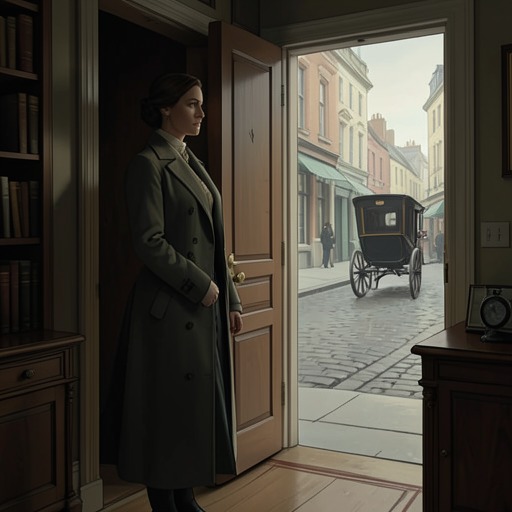
Tony collects Hugo from prison in a closed carriage and brings him to the apartment on Linden Platz. He greets Erika and their daughter in a dazed and helpless manner, then withdraws to a room, smoking and avoiding both public life and, usually, family meals. Although prison has not damaged his physical health, the conviction and imprisonment have shattered his confidence. After some weeks he says indirectly that a position may be available in London and that he will go ahead alone, intending to send for Erika and their child when he has arranged a home.
Erika accompanies him by carriage to the railway station, where he departs without seeing his other in-laws. A few days later, a letter to Erika says that he has decided not to have her and their daughter join him—or even hear from him—until he can offer them a suitable home. No further word arrives. Tony makes efforts to locate him, hoping to establish willful desertion as grounds for divorce, but Hugo remains missing. Erika and her daughter therefore continue living with Tony in the bright apartment on Linden Platz.
Later Life and Narrative Significance
At thirty-one, Erika is described as accustomed to bearing hardship with resignation. Her tired, watery-blue eyes and composed, sometimes complaining manner suggest that the disappointments of her marriage have become part of her ordinary life. Unlike her mother, she does not become upset when Gerda Buddenbrook prepares to leave Lübeck; she has already learned to endure losses without expecting them to be reversed.
Erika’s marriage begins as a carefully judged alliance, one that is supposed to unite economic security with family prestige. Its failure exposes the limits of that calculation: Hugo’s professional respectability cannot protect his household when his business conduct is prosecuted, and his release does not restore the marriage. Through Erika, the family’s repeated hopes for women’s marriages appear alongside the practical vulnerability created when a woman’s dowry is spent and her husband’s income disappears. By the time Gerda leaves, Erika remains with Tony among the few relatives still gathered around the family papers, a surviving member of a household whose ambitions have repeatedly failed to secure lasting stability.