Dr. Langhals
BuddenbrooksDr. Langhals is the younger physician who becomes the Buddenbrook family’s doctor after Dr. Grabow’s long service. He brings professional authority, diagnostic vocabulary, and prescribed routines to the family’s illnesses, but his role is defined as much by the limits of nineteenth-century medicine as by its procedures: he can examine, diagnose, and care for patients, yet cannot guarantee what illness will do. His appearances connect the household’s ordinary management of frailty to its gravest crises, including Elisabeth Buddenbrook’s death and Hanno Buddenbrook’s fatal typhoid.
Identity and Introduction
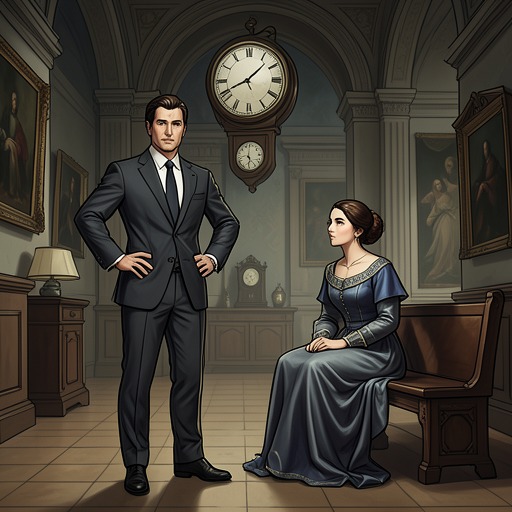
When Dr. Langhals first appears in the evidence, he has practiced for about a year and is accompanying the older Dr. Grabow on a visit to Elisabeth Buddenbrook. He is physically described as square-built, with striking eyes, a pointed beard, and brown hair combed back until it stands almost on end; the narrator also notes that his expression suggests vanity and that he examines his small, black-haired hands. Those details establish a contrast between the formal authority of his profession and the self-conscious manner that recurs in later scenes.
Dr. Langhals is eventually said to have taken over Dr. Grabow’s practice and to be the Buddenbrooks’ family physician. The succession matters within the household’s chronology: the family moves from an older adviser, whose consultations reach back to Christian Buddenbrook’s childhood, to a younger doctor responsible for the next generation’s examinations and illnesses. Langhals’s professional continuity with Grabow does not erase the difference between diagnosing a condition and being able to alter its course.
Medical Practice and Diagnosis
During Elisabeth’s illness, Dr. Langhals confirms that pneumonia has affected her right lung. As her condition worsens, he identifies the disease as bilateral; Dr. Grabow explains that the spread makes the case precarious and that the family should take it seriously. Langhals’s concise confirmation gives the diagnosis its clinical name, while the surrounding exchange shows how carefully the physicians qualify their prognosis. They cannot say that death is imminent, but acknowledge that an unexpected turn is possible.
His care of Hanno is more prolonged and routine. After Hanno’s seaside holiday, Langhals examines him at the family residence, conferring first with Gerda Buddenbrook before inspecting the boy’s muscles, chest, heart, and account of his bodily functions. He draws blood for later analysis and remains dissatisfied with the examination’s overall findings. The scene presents clinical practice as an accumulation of observation and tests, but also through the child’s experience of being examined and assessed by adults.
Langhals explains Hanno’s pallor and poor health as a shortage of red blood corpuscles. He prescribes cod-liver oil twice a day, administered by Ida Jungmann under Thomas Buddenbrook’s explicit instructions. Hanno initially vomits after taking it but gradually becomes accustomed to the dose; chewing rye bread while holding his breath helps ease the nausea. Langhals calls Hanno’s other ailments secondary phenomena and recommends further interventions, including treatment of his teeth and castor oil for digestion. The regimen gives the family concrete tasks, yet its burdens are borne by a frail child whose digestive difficulties and dental treatment compound his distress.
Langhals also visits Hanno after the boy returns from the shore. He examines him again and remarks that he is tanned but still looks unhappy. When Gerda explains that Hanno misses the sea, the doctor asks whether he likes being at the shore. The exchange registers a tension between a physician’s attention to bodily condition and an emotional need that medical examination does not itself resolve: Hanno’s longing is acknowledged, but the scene offers no assurance that his circumstances can be changed.
Care of the Buddenbrook Household
Langhals’s position places him inside the family’s practical arrangements as well as its moments of alarm. When Thomas Buddenbrook is advised to rest, the physician attributes the senator’s difficulties to his nerves and adds that his circulation is occasionally unsatisfactory. He recommends a period of relaxation and suggests a stay at Travemünde for two or three weeks, noting that the resort remains open at the end of September. Thomas accepts the recommendation, and Christian offers to accompany him. The advice thus helps set a family decision in motion, even though the narrative does not present rest as a cure for the larger pressures surrounding Thomas.
At Elisabeth’s bedside, Langhals’s work is part of the household’s sustained attention to a worsening illness. She monitors her pulse and temperature, struggles with a worsening cough and shortness of breath, and receives concentrated nourishment and medication on carefully observed schedules. Her family physician is among the people whose judgments shape the family’s understanding of her condition. When her pneumonia reaches both lungs, he explains the seriousness of the development and advises Thomas that sending for Christian would not be unreasonable, while cautioning him against drawing an exaggerated conclusion from the warning.
The account of Hanno’s recurring night terrors also places Langhals within a longer history of family care. Dr. Grabow had named the disorder pavor nocturnus and tried blueberry juice before bed, without success. This earlier treatment belongs to the period before Langhals takes over the practice, but it establishes the medical and domestic pattern he inherits: recurring symptoms prompt a physician’s intervention, while the family continues to live with what treatment cannot resolve.
Medical Limits and Death
The most direct test of Langhals’s authority comes as Thomas is dying. Tony, who has asked him for an unvarnished prognosis, wants to know whether her brother will live until the next day. Langhals turns his eyes away and says that no frail human being can answer whether Thomas will survive the night or die within minutes. His response is not a prediction but a limit: the physician can observe a critical condition without commanding its timing or outcome.
Langhals is present at Thomas’s bedside as the illness reaches its end. He examines Thomas’s chest and pulse, then returns after the senator has died and listens to the body with his stethoscope. After completing the examination, he confirms that life is over; Sister Leandra closes Thomas’s eyes. The scene makes medical verification one step in the household’s transition from attempted care to the recognition of death, rather than a rescue from it.
The narrative’s treatment of typhoid broadens this tension between medical knowledge and uncertainty beyond Langhals’s individual practice. It describes a recognizable progression of symptoms, the signs that can establish a diagnosis, and the care a physician such as Langhals might prescribe: a ventilated room kept below sixty-three degrees, cleanliness, frequent repositioning, oral care, medication, nourishing food, and repeated baths. Yet the account insists that such therapies work under conditions of uncertainty. Until the crisis in the third week, the physician cannot know whether the disease is a recoverable infection or an irreversible process. Langhals’s competence can organize care; it cannot disclose in advance which course the patient will take.
Narrative Role and Significance
Across the family’s generations, medical scenes make bodily vulnerability visible alongside inherited expectations of composure, work, and continuity. Langhals encounters Hanno as a child whose pallor, digestive difficulties, and night terrors demand repeated care; he attends Elisabeth and Thomas at the threshold of death. His professional routines register illness in pulses, examinations, symptoms, and prescriptions, while the narrative attends to what those routines mean to patients and relatives: treatment can be unpleasant, anxiety persists, and the family must sometimes face uncertainty without a decisive answer.
The contrast between diagnosis and outcome is central to Langhals’s characterization. He can name pneumonia, identify Hanno’s low red-cell count, recommend a seaside rest, and oversee the examination of a dead patient. None of those acts makes him omniscient. At Thomas’s bedside, his inability to give the requested timetable for death is not a failure of attention but the boundary of the knowledge available to him. Through this recurring family physician, the novel presents medicine as consequential care conducted within uncertainty, not as mastery over the body’s decline.