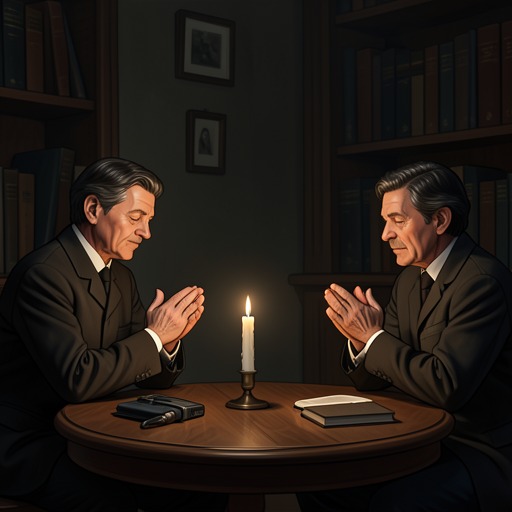
Trieschke
BuddenbrooksTrieschke is a Berlin pastor, known as Teary Trieschke because he regularly weeps during his Sunday sermons. His visit to the Buddenbrook household exposes a sharp contradiction between his clerical persona and his conduct: he becomes interested in Tony, sends her an inappropriate letter, and loses his welcome in the house when she brings the letter to light.
Identity and Visit
Trieschke stays for eight or ten days with the Buddenbrooks, sharing the household’s attention with Klothilde in an eating contest. The narration describes him as pale, red-eyed, and horse-faced, a comic portrait that accompanies his reputation for tears. His nickname is not merely a reference to public emotion: the episode makes his visible piety part of a larger pattern of performance and contradiction.
Conduct Toward Tony
During his stay, Trieschke falls for Tony—not, the narration pointedly observes, for her soul, but for her appearance. He uses Anton to carry a letter to Tony’s bedroom on the third floor. Its mixture of biblical verses and obsequious endearments invokes religious language in the service of a personal advance, undercutting the moral authority associated with his office.
Tony answers not by concealing the letter or treating the matter as a private embarrassment, but by carrying it downstairs to Madame Buddenbrook’s bedroom on the mezzanine. She reads it aloud without embarrassment. Her response turns Trieschke’s attempt at secrecy into a matter witnessed by the household and ends his access to it: he is no longer welcome on Meng Strasse.
Narrative Significance
The episode sits within a broader portrait of Tony’s distrust of sanctimonious visitors. She has already answered a missionary who criticized her curls by telling him to worry about his own, and later recounts an encounter with a church dignitary whose behavior she judges more objectionable than Trieschke’s. Her comic retort and public reading of the letter make her an active judge of religious hypocrisy rather than a passive target of clerical attention.
Trieschke’s brief appearance also sharpens the novel’s contrast between religious display and ethical conduct. His tears in the pulpit supply his public identity; his letter supplies the counterexample. Tony’s decision to expose the letter, and her family’s resulting exclusion of him, gives that contrast a concrete consequence within the household.