Pastor Pringsheim
BuddenbrooksPastor Pringsheim is the clergyman summoned during Thomas Buddenbrook’s final illness and the preacher at his funeral. In these two appearances, he moves from private bedside ritual to a public ceremony staged before the city. His religious words help the family acknowledge that Thomas is dying, while the novel’s close attention to his gestures and delivery places clerical performance alongside genuine grief and civic display.
Identity and Role
Pringsheim is identified as a pastor and appears in the family’s final crisis as a minister called for spiritual support. The evidence also associates him with Thomas’s funeral, where he stands at the head of the casket and speaks to the assembled mourners. His part in the narrative is brief but concentrated: he enters at moments when the family must confront mortality, first at the bedside and then in the formal observance that follows Thomas’s death.
The two scenes give his office distinct functions. At the bedside, he addresses a dying man and frames the situation as one in which the family should no longer ask for recovery, but for a gentle passing. At the funeral, he gives public form to mourning, speaking in the Buddenbrook home before a large gathering that includes civil servants, grain workers, family members, and other visitors. The movement from intimate prayer to crowded ceremony makes him a mediator between private loss and public remembrance.
Thomas’s Illness and the Call for the Pastor
Thomas’s sister, Tony, asks the physician Dr. Langhals directly whether her brother will survive the night. The doctor avoids a definitive answer, saying that a frail person cannot know whether death will come within minutes or whether Thomas will live until morning. Tony takes his response as sufficient reason to act: she leaves the room and sends for Pringsheim. The scene presents the pastor’s summons not as a routine formality but as a decision made amid medical uncertainty, when the family can no longer rely on reassurance.
Pringsheim arrives in a long robe without his clerical ruff. He first asks Thomas to recognize him and listen, but when that request produces no response, he turns directly to God. His prayer is delivered in a stylized Franconian dialect, with deliberately modulated vowels and emphatic stresses. The narration registers the formality of this performance through Johann’s perception: the pastor’s rolling pronunciation gives the boy an incongruous impression of someone who has just finished coffee and buttered rolls. That detail does not erase the scene’s solemn purpose; it sets the ceremony’s carefully fashioned language against the child’s sharply particular, almost comic view of the adult ritual.
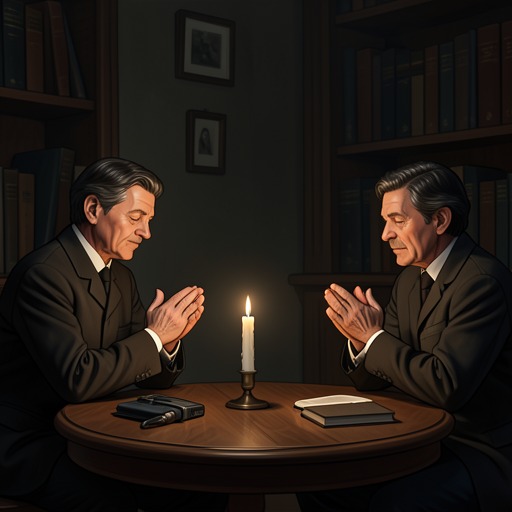
The substance of Pringsheim’s prayer is a formal acceptance of the impending death. He says that those gathered no longer petition for Thomas’s life, since they understand it to be the Lord’s will to take him; they ask instead for mercy and a gentle passing. He then recites two prayers suited to the occasion. The service makes explicit what the physicians’ caution has left uncertain in words: the family’s hope for recovery is giving way to preparation for death.
Presence at the Bedside
After the prayers, Pringsheim rises and presses the hands of Gerda Buddenbrook and Tony. He holds young Johann’s head between both hands and looks at the boy’s lowered eyelashes for about a minute, then greets Fräulein Jungmann. Before departing, he directs one last cold glance at Sister Leandra. These gestures place him within the bedside circle of relatives and attendants, but they also preserve distinctions among those present: he offers personal contact to the family and the child, while his final look at the nurse is notably unsympathetic.
Pringsheim does not remain through Thomas’s final hours. Dr. Langhals returns after going home for a time, and Dr. Grabow also visits, attends to what can still be done, and leaves. Thomas’s condition remains unchanged as dusk arrives. The pastor’s visit therefore belongs to the transition from medical care to religious acknowledgment, not to an ongoing vigil or a recovery. His prayer cannot alter the course of the illness; it gives the family a ritual language for facing the outcome.
The Funeral and Public Mourning
Pringsheim reappears on the day of Thomas’s burial. The metal casket has been sealed and covered with flowers, candles are lit, and the house fills with mourners. He stands at the head of the casket, upright and majestic, ready to conduct the service. The setting enlarges his role: where the bedside prayer was spoken to a small group in a private room, the funeral draws together people from the family, the firm, municipal offices, and the wider city.
When the house falls silent, Pringsheim begins to speak. His voice is described as elegant and resonant, filling the crowded house. He stands beside a figure of Christ, wringing his hands before his face or spreading them in blessing. Outside, a hearse drawn by four horses waits beneath the winter sky; a long line of carriages reaches down the street toward the river, soldiers stand in two rows, and Lieutenant von Throta leads the company with his drawn sword. The funeral’s religious observance is thus framed by military honors and a civic spectacle visible to a large street crowd.
At the procession’s departure, the lieutenant gives a command and the soldiers present arms. Pringsheim lowers his sword? No: the sword belongs to Lieutenant von Throta, who lowers it as the casket is carried through the door. Pringsheim’s documented role is as the preacher beside the casket, not as a participant in the military command. Christian Buddenbrook rides in the first carriage with the pastor; young Johann follows in the next with relatives from Hamburg. The procession then makes its slow way through the streets, with officials and grain workers marching on foot. Pringsheim’s place in the first carriage carries the funeral service outward from the house, accompanying the family’s passage from private loss to public burial.
Narrative Significance
Pringsheim’s two appearances contrast the limits of religious ritual with its social importance. At Thomas’s bedside, his prayer openly relinquishes the plea for continued life and asks only for a gentle death. At the funeral, his measured voice and gestures organize grief into a public ceremony. Neither appearance suggests that he can resolve the family’s loss; instead, he gives that loss forms the family can inhabit, first through prayer and then through burial rites.
The narration also refuses to treat ceremonial dignity as simple or unexamined. Johann’s impression of Pringsheim’s manner at the bedside introduces a child’s mundane perspective into a solemn religious moment, while the funeral’s carefully assembled honors place clerical speech beside military display, crowded rooms, and the city’s attention. Pringsheim is therefore both a minister within the family’s crisis and a figure in the public staging of Thomas’s status. His brief presence marks the passage from expectation of life to acknowledgment of death, and from the sickroom to the funeral procession.