Hermann Hagenström
BuddenbrooksHermann Hagenström’s rise makes him the Buddenbrooks’ most visible local rival and a measure of how Lübeck’s social order is changing. He combines commercial success, civic ambition, and the wealth and connections that bring him into the town’s leading circles; eventually, he wins a Senate election against Thomas Buddenbrook and acquires the Buddenbrook ancestral house on Meng Strasse. His story is not simply one of personal advancement: it shows established family prestige losing ground to a newer, more adaptable power.
Background and Rise
Hermann continues the profitable export business of his father, Hinrich, working alongside Herr Strunck. Within a year of succeeding to the business, he marries the daughter of Consul Huneus, whose lumber fortune gives each of his three children two million marks. That marriage connects Hermann with both the Huneus and Möllendorpf families and helps place him among the town’s small circle of ruling families. He is at once a successful merchant and a beneficiary of the social alliances through which commercial wealth acquires standing.
His younger brother Moritz’s success adds to the family’s public visibility: despite poor lungs, Moritz excels as a student, establishes a law practice, and is regarded as astute. But Hermann’s own position rests particularly on business performance and civic involvement. The brothers’ progress contrasts with Tony Buddenbrook’s abiding hostility toward the Hagenströms, whom she regards as upstarts; their prosperity is itself a source of resentment for her.
The family’s advancement is visible in the way other citizens describe it. Larger business houses say that the Hagenströms and Buddenbrooks complement one another, and the sentiment is repeated by dock and warehouse workers and other townspeople. The remark registers a relationship that is both competitive and mutually legible: the older family’s standing and the newcomer family’s momentum are increasingly discussed together.
Public Image and Social Standing
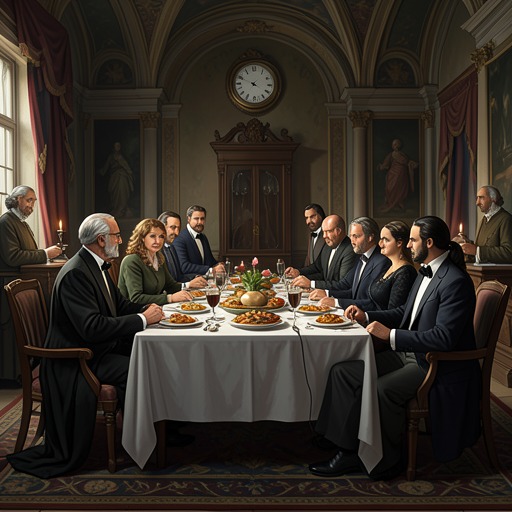
Hermann becomes a substantial presence in town: broad and increasingly stout, with a short reddish beard and a prominent nose. He lives luxuriously, has a grand house, and is known for eating pâté de foie gras at breakfast. Such details accompany a more consequential reputation: he is devoted to civic affairs, and the rapid prosperity of Strunck & Hagenström has made a strong impression. His marriage further secures his place among influential families, despite the social suspicion that had once surrounded his father’s marriage to a wealthy woman.
His new house on Sand Strasse distinguishes him from the patrician tradition in both design and use of space. Its painted façade and efficiently arranged interior avoid the wasted space and architectural conventions of old family mansions; its furnishings are luxurious, elegant, and comfortable. Hermann’s home thus expresses not just wealth but a different manner of inhabiting it: modern comfort and practical design rather than inherited forms. He also hosts a grand evening party at which a soprano from the municipal theatre sings after dinner, bringing public culture into a display of hospitality and status.
The novel identifies liberalism and tolerance as the distinctive qualities that make him attractive to many of his fellow citizens. He stands apart from the constraints of custom and reverence for the past, and that independence helps make him a conspicuous candidate for leadership. His social authority therefore draws on more than money or marriage: it also depends on a public image of openness to the new.
Rivalry with the Buddenbrooks
Hermann’s competition with the Buddenbrooks becomes especially clear in the contest for a Senate seat. Thomas Buddenbrook and Hermann emerge as the strongest candidates. Hermann’s candidacy is supported by the speed with which Strunck & Hagenström has prospered, his engagement in civic affairs, and his social connections; Thomas’s family regards the contest as a test of its own position in town. The election makes a private rivalry visible as a civic choice between two successful merchants whose routes to influence differ.
The rivalry also shapes an episode involving a crop that the Buddenbrooks might purchase. Tony hopes to act as intermediary in a deal connected with her friend Armgard von Maiboom, partly because she fears Hermann will buy the crop if it is offered in town. She expects him to take the opportunity and speaks of him with bitterness. Thomas instead uses the personal connection and the circumstances of the offer to arrange the transaction for his own firm, keeping it from Strunck & Hagenström. This is not an ordinary purchase conducted without regard to relationships: discretion and personal obligation help determine who gets the business.
Thomas’s resentment at Hermann is also sharpened by a public exchange involving Christian Buddenbrook. After Christian makes a disparaging generalization about businessmen in the presence of business and professional men, Hermann responds that he thinks highly of his profession. Thomas rebukes Christian, arguing that Hermann’s answer was aimed beyond him at the Buddenbrook family and its reputation for business integrity. The episode shows how Hermann’s public defense of commercial respectability can turn a rival’s indiscretion into a criticism of the older firm.
Senate Election and Civic Power
The election campaign presents Hermann as a serious contender for public office, not merely a wealthy merchant seeking recognition. His supporters point to his civic devotion, the growth of his firm, his comfortable way of life, and his place among the town’s influential families. His modern house and social ease reinforce an image of a man unencumbered by old conventions. Those qualities make him appealing to voters who see him as representative of a changing town.
The contest narrows to Hermann and Thomas as election day approaches. On the day of the vote, the outcome is announced as Hermann’s victory. The news reaches the people waiting for the result and leaves one woman in tears; the announcement is received as a settled fact, not a close contest still awaiting resolution. His election confirms that commercial success and modern social connections can translate into civic authority, and it marks a public setback for Thomas.
The rivalry continues after the election. Thomas’s new house is described by a family member as a dream realized, with Hermann’s home made to seem small beside it. Yet the comparison of houses cannot settle the larger contest: Hermann’s influence is sustained by business, marriage, and civic position, while Thomas’s apparent material triumph does not prevent his family and firm from declining.
The Ancestral House and the Reversal of Fortune
The most consequential reversal comes when the Buddenbrook house on Meng Strasse is put up for sale. Hermann expresses interest in the property and comes to inspect it with Siegismund Gosch. Tony opposes the sale because she sees the Hagenströms as enemies with a long history of hostility toward her family. In her account, the conflict reaches back to the older generation, and she remembers childhood antagonism as part of a continuing pattern. Her protest turns a property negotiation into a struggle over family memory and standing.
Hermann nevertheless buys the house. He outbids another prospective purchaser from Bremen, and ownership passes definitively to him. The contrast is sharp: the Buddenbrooks’ old home, a material emblem of their inherited position, becomes the property of the family they considered an upstart rival. Once the house is vacated, workers begin tearing down its rear building, and the old mortar gives way to the practical work of alteration.
By early spring Hermann and his family have moved into the main house. He retains it largely as it is, making only minor repairs while ordering modern improvements, including the replacement of the old bell ropes with electric bells. His approach joins respect for the usable structure with a readiness to update it. The changes are concrete signs of the difference between inherited attachment and modern adaptation: he occupies the Buddenbrook house, but makes it serve his own family’s present.
Hermann’s trajectory culminates in a transfer of power rather than a personal reconciliation with the Buddenbrooks. He rises through successful trade, marriage into wealthy circles, a reputation for civic engagement, and election to the Senate; later he acquires the house that had embodied the older family’s authority. The Buddenbrooks’ commercial losses and eventual liquidation form the broader context of that transfer. His significance lies in the contrast between the continuity the old family tries to preserve and the energetic, adaptable success that enables the Hagenströms to take its place in the town’s public and domestic landscape.