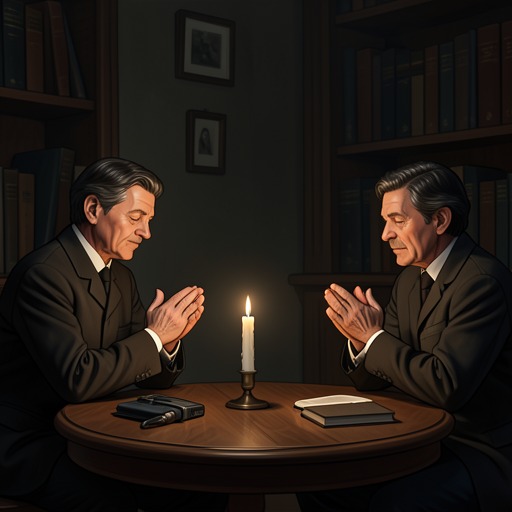
Pastor Wunderlich
BuddenbrooksPastor Wunderlich is a portly, powdered-haired clergyman and long-standing friend of the Buddenbrook family, at ease among its merchants and guests but also a keeper of its difficult memories. His defining contribution is a story he tells at a family dinner: during the French occupation, he stopped Antoinette Buddenbrook from attempting to drown herself after soldiers began taking the household silver. The episode makes him at once a witness to political upheaval, an effective mediator, and a genial narrator who can bring the family’s history into the sociable present.
Identity and Place in the Family’s World
Wunderlich appears as an elderly widower who counts himself among the confirmed bachelors. He arrives at the Buddenbrook home with the broker Grätjens, whose habit of examining things as though through a telescope marks him as a connoisseur; Wunderlich himself is described through a different combination of qualities, his fair, merry face animated by alert grey eyes. His portliness and long black coat give him the settled appearance of a familiar local figure, but his alertness and social ease make him more than a ceremonial guest.
His intimacy with the family is established through custom and shared history. At a gathering in the landscape room, he joins other old friends of the household, including Senator Dr. Langhals and the wine merchant Köppen. The room’s carefully arranged decoration—pastoral scenes, yellow upholstery, a small harmonium, and a fire behind an ornate stove door—places him within the substantial domestic world whose histories he helps recall. The setting is not simply a backdrop: the family’s silver, later made central to his story, belongs to a household defined by the material objects and rituals of prosperous civic life.
Witness to the Occupation
At dinner, Wunderlich turns from the comfortable present to an episode from the French occupation. He recalls an afternoon in November, cold and rainy, when he was returning from a pastoral visit along Alf Strasse. The French were in town, Prince Blücher was gone, and the streets seemed quiet, though the quiet concealed violence: a butcher named Prahl had just been shot in front of his own door. Wunderlich was on his way to visit the Buddenbrooks, knowing that soldiers were quartered in their house and that Jean Buddenbrook was ill with erysipelas.
Before he reached the house, he encountered Antoinette in the street. She had no hat, had thrown a shawl over her shoulders, and was stumbling through the rain with her hair dishevelled. She told him she was on her way to drown herself in the Trave because the soldiers were taking her silver and Jean could neither protect her nor intervene. The danger is rendered through a domestic object rather than a battlefield scene: the spoons and the chest that held them represent a household under occupation, while Antoinette’s panic makes the loss feel immediate and personal.
Wunderlich held her back and led her home, where he found more than twenty soldiers upstairs in the dining room, gathered around the large silver chest. He addressed them politely and asked to speak with the person in charge. The men laughed and called out that he could speak with all of them, but a tall, black-moustached sergeant stepped forward, introducing himself as Lenoir while holding five or six silver spoons. Wunderlich appealed to Lenoir’s sense of honour and asked how his rank could be reconciled with taking such things. Lenoir replied that war was war and that his men needed tableware.
The pastor then tried a different argument. He presented Antoinette as French, almost a compatriot of the soldiers, and Lenoir asked whether she was an émigrée and therefore an enemy of philosophy. The encounter shows Wunderlich working within the precarious limits of the situation: he cannot command the soldiers, so he uses courtesy, moral appeal, and Antoinette’s French identity to make a case for restraint. His recollection preserves the absurdity of the exchange alongside its menace, without turning the occupation into a harmless anecdote.
The Storyteller at the Dinner Table
Years later, Wunderlich’s account becomes part of a family gathering. When he picks up a heavy silver spoon, he explains that such objects make him think of Lenoir, the sergeant who held the Buddenbrooks’ spoons during the occupation. Antoinette looks down at her lap with an embarrassed, remembered smile. The children, Tom and Tony, eagerly ask their grandmother to tell the story, while Wunderlich recognizes that she does not like repeating it. His role is therefore not merely to supply information: he manages a shared memory, attending both to the children’s appetite for the tale and to Antoinette’s reluctance to revisit it.
The shift from the spoon on the dinner table to the silver chest in the occupied house compresses the distance between ordinary prosperity and historical danger. The family is once again gathered around fine tableware, but the object carries an earlier crisis within it. Wunderlich’s performance restores the event to the room through its details—the rain, the shot, Antoinette’s disordered appearance, and the soldiers around the chest—while the dinner guests’ response makes the past part of the family’s present sociability. The story has been told before, perhaps many times, yet its repetition is itself meaningful: the household’s security is remembered as something once threatened, not simply inherited.
Composure, Sociability, and Historical Memory
Wunderlich’s manner combines tact with a certain relish for conversation. At another dinner, he questions the consul’s interpretation of Dietrich Ratenkamp’s business failure, asking whether the outcome would have been the same without Wilhelm Geelmaack’s dealings. The question is circumspect rather than confrontational, but it presses the consul to distinguish between Geelmaack’s role and the deeper mismanagement that had already placed the firm in danger. Wunderlich thus appears as an attentive participant in the family’s discussions, willing to test an explanation without disrupting the social ease of the table.
That ease also has a physical and ceremonial form. He is among the guests at the wedding celebration for Tony and Bendix Grünlich, where half the town has gathered and the rooms and corridor have been prepared for dancing. Later, when a party breaks up near eleven, Elisabeth Buddenbrook goes upstairs to see how the ailing Christian is doing, while the consul accompanies guests to the street. The scene places Wunderlich within the recurring rhythm of family hospitality, where public fellowship and private worry occupy the same house.
His conviviality should not obscure the historical weight he carries. At the table he recalls the silver’s seizure during the French occupation; in later generations, family life unfolds amid political disputes, riots, new constitutions, and arguments over civic rights and commercial policy. The narrative does not make Wunderlich a political leader or assign him a formal role in those later conflicts. Instead, his presence and his remembered intervention provide a human scale for history: the larger upheaval enters the family home through a frightened woman, a sick husband, a chest of spoons, and a clergyman who refuses to let the crisis end in the river.