Gerda Buddenbrook
BuddenbrooksGerda Buddenbrook, born Gerda Arnoldsen, is the musician and heiress whose marriage to Thomas Buddenbrook brings both an intimate attachment and substantial capital into the family. She becomes Hanno’s mother and his first musical guide, yet remains an inward, socially remote presence in the Buddenbrook household. After Thomas’s death and the winding up of the firm, she leaves Lübeck for Amsterdam, ending her connection to the town and its family name.
Identity and Introduction
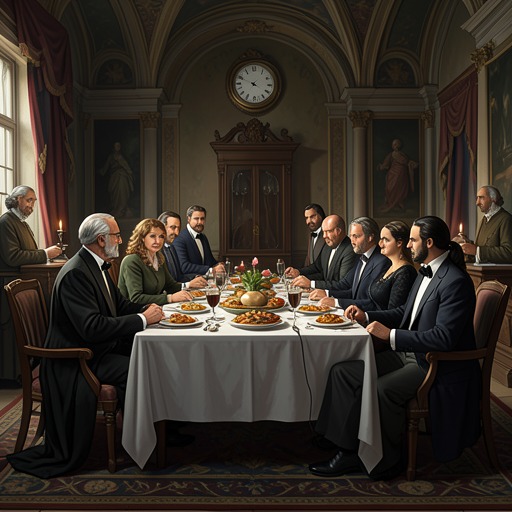
Gerda first enters the story through Thomas’s account of his business journey to Amsterdam. In the city, where he had gone to establish a valuable commercial connection, he encounters her again through the acquaintances they had made as pupils at boarding school. At a banquet held in his honour by his former chief, Herr van der Kellen, Thomas is seated beside Gerda, then Fräulein Arnoldsen. Her father, Herr Arnoldsen, is a notable figure, and the encounter swiftly joins Thomas’s social and commercial worlds to a possible marriage.
Music defines Gerda’s presence from the beginning. After dinner her father plays concert pieces, and she performs as well. Thomas, who admits he cannot judge the technical niceties of violin playing, is nonetheless moved by the sound of her genuine Stradivarius. At a garden party and later at a musical soirée at the Arnoldsen home, he becomes convinced that he wants her alone. Herr Arnoldsen tells him that his daughter has so far resisted marriage and that separating himself from her will be difficult; Thomas replies that she has already given him reason to hope.
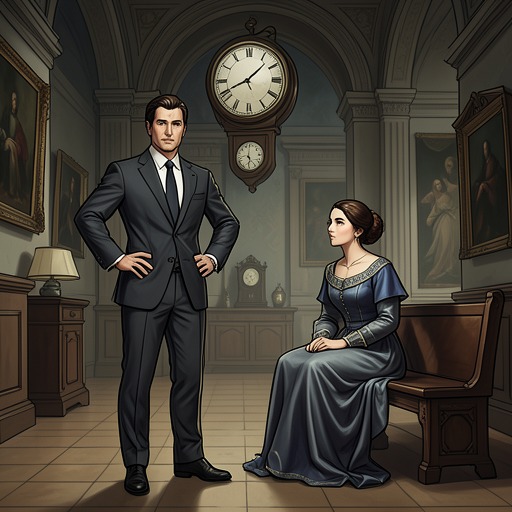
When Thomas brings his fiancée to meet his mother in the landscape room of the Buddenbrook house on Meng Strasse, the narrative presents Gerda as tall, full-figured, and strikingly elegant, with heavy chestnut hair, close-set brown eyes, and a composed, somewhat proud bearing. She crosses the room with easy assurance, but bows her head as Madame Buddenbrook takes it in her hands and kisses her brow. The scene makes her welcome into the family visible while preserving the reserve that will distinguish her from its domestic world.
Marriage, Money, and Household
Thomas’s choice is emphatic: he tells Tony that one look at Gerda settled the question for him. Marriage, he explains, gives him a household of his own and supports his ambitions in business and politics; to be a family man is also, in his view, to win the world’s trust. His account presents personal attachment and public standing as compatible aims. He insists that Gerda is the woman he wanted, while acknowledging that a large dowry will provide valuable capital for the firm. The marriage therefore carries both emotional conviction and a plainly stated economic consequence.
The town can see that double significance. Gerda’s inheritance is given as three hundred thousand, and observers suspect that money played a part in the match, although they judge it secondary to the couple’s attachment. Yet their married manner is notably correct and respectful rather than demonstratively intimate. In the longer view, the marriage is remembered as a union chosen with sudden certainty by both: Thomas had declared his resolve, while Gerda had turned away suitors in Amsterdam until she accepted him at twenty-seven. The story does not convert that decisive choice into a portrait of open domestic closeness; courtesy, privacy, and difference remain its prevailing terms.
Gerda’s habits set her apart from the routines of the Buddenbrook household. She lives in the twilight of curtained rooms, seldom goes out, and dislikes the sun, dust, crowds, and the bustle of a Sunday excursion. When a trip to the Riesebusch Inn in Schwartau is arranged for a guest from Munich, she objects that she is made for the quiet of everyday life rather than novelty and disturbance. On the morning of the outing she is late to rise and plainly reluctant to join the party. Her withdrawal is not a passing mood but a settled preference for privacy over social activity.
That preference contrasts with the family’s attention to convention and appearance. At a family gathering, Gerda reclines in her chair, her pale face turned upward and her close-set, blue-shadowed eyes catching the chandelier light; she seems physically present without sharing the gathering’s sociability. Years later, people describe her as scarcely changed while Thomas has grown stout and prematurely worn. Her coolness, private manner, and unreadable gaze become part of how others understand her, although the narrative supplies no simple explanation that would reduce her to those impressions.
Motherhood and the Heir
The birth of Gerda’s son is a moment of intense relief for Thomas. Dr. Grabow tells him that mother and child have survived a close call; Thomas cannot bring himself to ask how dangerous it was. The infant had entered the world in near silence, and the family’s memory of another daughter’s death makes the danger especially stark. Thomas bends tenderly toward Gerda as she rests beside Elisabeth Buddenbrook. The survival of both mother and child establishes the emotional weight attached to the birth of the long-awaited boy.
The child, Hanno, visibly carries traits from both sides of his parentage. His broad, short-fingered hands and the shape of his nose recall the Buddenbrooks, while his long, narrow lower face and mouth belong to his mother’s side. That divided resemblance matters in a family preoccupied with its name and continuity: Hanno embodies both the line Thomas hopes to continue and the maternal inheritance that shapes his sensibility.
Gerda’s influence is most legible in Hanno’s music. A passionate admirer of new music, she faces the organist Edmund Pfühl’s vehement resistance to it; in the salon, Pfühl argues that Bach developed counterpoint rather than mere harmonic experimentation. Gerda, smiling at the piano, listens to his animated case, but she remains devoted to the newer music that has provoked him. Her musical commitments are thus not simply an ornament of household life: they place her in a genuine artistic disagreement with a respected teacher.
When Hanno is seven, he begins trying to reproduce combinations of sound that have caught his attention. Gerda watches him at the keyboard, corrects the finger positions he has devised through silent eagerness, and shows him how a note changes one chord into another. His ear confirms what she teaches. Thomas recognizes that his son’s improvisations reveal notable talent, though Hanno has made no extraordinary progress in ordinary lessons with Pfühl. He attributes the boy’s love of improvisation to Gerda’s influence and resolves to draw Hanno closer to himself, fearing that the mother’s influence has prevailed in early childhood. Their differing expectations make music a point of conflict as well as a bond between mother and son.
The pressure to produce an heir also exposes how little control Gerda’s marriage gives her over the family’s priorities. When the perpetuation of the Buddenbrook name remains uncertain, she responds with indifference approaching repugnance. Thomas is distressed but says nothing; his mother consults Dr. Grabow and asks what more can be done after earlier stays in Bad Kreuth, Glücksburg, and Travemünde. The doctor recommends Pyrmont and Schlangenbad. The episode sets Gerda’s private disinterest against a household that treats descendants as a matter of dynastic urgency.
Music, Distance, and Later Life
Gerda’s music gives her a form of companionship that the family’s everyday conversation often cannot provide. The eccentric young officer René Maria von Throta, who plays piano, violin, cello, and flute, becomes acquainted with her through music. His visits are announced to Thomas by the sight of the officer’s aide carrying a cello case past the green windowsill of the senator’s private office; Thomas then waits as music rises from the salon above. The melodies swell, lament, and subside into silence, while Thomas remains below, aware of a musical intimacy in which he is not a participant.
The contrast between Gerda’s musical world and the household’s more practical conversation appears in her dealings with others as well. Thomas’s acquaintance gets on best with the senator, whose talk can be steered toward politics and business, but finds Gerda difficult to approach. Knowing only that she plays violin, he repeatedly asks her how the fiddle is; after the third time, she no longer answers. Her silence marks the failure of a social formula to reach her, not an opening for easy intimacy.
Thomas’s own hopes for a later life reveal the strain beneath their differences. He wonders whether retirement might permit a return to the old days when Hanno’s grandfather was alive, and reconsiders his belief that music is his enemy. The boy’s improvisations still trouble him, but he thinks ordinary lessons have not made Hanno an exceptional pianist and recognizes that Gerda’s influence shaped the child’s early years. He determines that a father must now offer his son different, more masculine impressions. Music thus becomes the terrain on which Thomas tries to recover a paternal influence, while Gerda’s formative place in Hanno’s life remains unmistakable.
Widowhood and Departure
After Thomas’s death, Gerda’s place in Lübeck gradually becomes untenable. The family home and the firm are caught up in the consequences of his death: under Herr Kistenmaker and Friedrich Wilhelm Marcus, the business is liquidated through hurried, disadvantageous sales, and its losses accumulate. Gerda, meanwhile, moves with Hanno into a modest villa beyond the Burg Gate, on a chestnut-lined street among orchards and flower gardens. The house suits her wishes, though its purchase may have been somewhat too expensive. In autumn 1876 she takes the servants and some old furnishings with her; other belongings remain behind, passing to an aging bachelor and distressing Tony.
The move is temporary. At a later family gathering, Tony says that Gerda wishes to leave and that there is nothing to be done. The words acknowledge both affection and distance: Gerda had arrived with Thomas twenty-one years earlier, and the family had loved her, even though she may always have regarded them as a burden. With Thomas gone, Tony recognizes that his relatives can no longer supply a reason for Gerda to stay.
Gerda is preparing to return to Amsterdam, where she will once more play duets with her father. She plans her train journey, and Gosch the broker is handling the sale of the villa and its furniture. She takes nothing with her, leaving as she had come. The departure removes from Lübeck the widow who had brought the family substantial capital and borne its hoped-for heir; it also returns her to the city and the musical companionship that preceded her marriage. Her final movement is away from the Buddenbrooks’ house, business, and social world, not toward a new role within them.