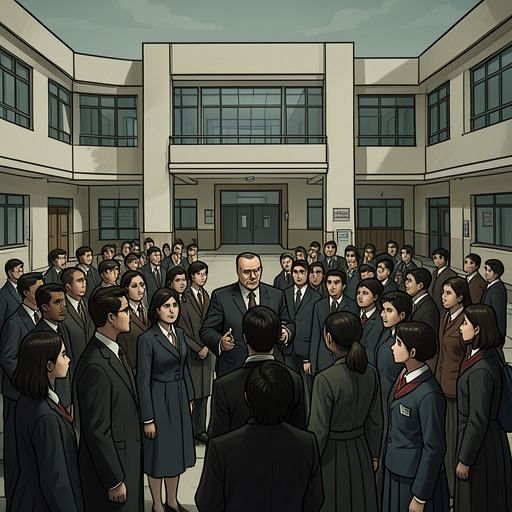
Herr Modersohn
BuddenbrooksHerr Modersohn is a young philologist on probation whose English lessons expose the gulf between humane vulnerability and institutional authority. In a classroom where disorder overwhelms his efforts to teach, he is both the target of the boys’ pranks and, in turn, the teacher who repeatedly disciplines quiet Hanno Buddenbrook. A surprise inspection by Director Wulicke transforms an unruly lesson into a professional examination, ending with Modersohn publicly broken and Hanno penalized alongside his classmates.
Identity and Introduction
Modersohn has been practice teaching at the school for several weeks. The boys regard him as an understudy hoping to become the star, but his chances of being hired appear slim because his classes are too exuberant. English is anticipated as an hour of entertainment rather than a demanding lesson: the students expect high jinks, and Modersohn has little power to impose order even before the class begins.
His physical presence makes that weakness visible. He is small and ungainly, walks with one shoulder hunched forward, and has a peevish-looking face framed by a scraggly black beard. He seems perpetually embarrassed. He blinks, draws breath, and opens his mouth as if to speak, only to falter over the words. His customary stance, with one hand propped on a desk, has become familiar enough for the boys to anticipate and sabotage it.
The Classroom and Its Pranks
Before Modersohn enters, the class is already in uproar. A cross-eyed face drawn on the blackboard, animal noises, and a pine cone wedged in the door’s crack turn his arrival into part of the spectacle. When he manages to enter, he steps on a noisemaker that sounds like an explosion. He winces, smiles in misery, and pretends that nothing has happened. Then he puts his hand on the desk, only to find that someone has spilled ink there; his little hand is stained black. He hides the wet, smeared hand behind his back and, in a low, frail voice, observes that the order in the classroom leaves something to be desired.
The performance continues while Modersohn tries to take attendance. A handful of peas hits the window and rattles across the floor; a student claims that it is hailing. Modersohn apparently accepts the excuse and retreats to his platform for the attendance book. He has taught the class five or six times, yet knows only a few students by name and must call names almost at random. When he calls Perlemann, Kai Mölln announces that Perlemann has gone mad, and the class confirms the joke amid mounting pandemonium. The scene shows how little command Modersohn can establish: even the ordinary apparatus of the lesson, attendance and recitation, becomes material for the boys’ improvisations.
Modersohn and Hanno
Modersohn’s frailty does not make him consistently gentle. Hanno is almost the only student whose name he knows, because Hanno’s quietness makes him stand out from the rest. Modersohn uses that knowledge against him, repeatedly calling him to order and assigning extra homework as punishment. The narrator presents this as an abuse of the very gentleness that distinguishes Hanno: Modersohn dares to exercise authority over the boy because he would not dare to do the same with the loud, impudent students.
The contradiction becomes personal when Kai’s joke makes Hanno laugh. Modersohn warns Hanno that another laugh will bring an extra homework assignment and a demerit. Hanno’s laughter subsides, and he studies the teacher’s forlorn appearance: the beard’s sparse hairs, the hopeless brown eyes, and the cuffs seemingly repeated at his wrists because his sleeves are as long and wide as the cuffs themselves. He feels that he can see through Modersohn with revolting clarity. Yet pity cannot settle into uncomplicated sympathy: Hanno thinks that people can be so mean that they make it impossible to pity them, and resents being treated harshly when he has refused to join the others in tormenting the teacher. The encounter brings together Modersohn’s powerlessness before the class and his smaller, real power over a vulnerable pupil.
The Inspection and Its Consequences
The balance shifts when Director Wulicke enters unexpectedly. Modersohn is supposed to give a model lesson demonstrating his teaching, and the director’s visit will decide his future at the school. The students, like the teacher, are caught unprepared. Modersohn calls for a recitation of the childish poem “The Monkey,” but with the director present the boys cannot simply read from their books. The recitation fails; when the class turns to Ivanhoe, only young Count Mölln can translate a little, because he is the one student with an interest in the novel. Hanno is called on and cannot get beyond the first line. Wulicke responds with a roar, while Modersohn wrings his ink-stained hands and repeats that things have always gone well before.
When the bell rings, Wulicke demands the attendance book and enters demerits beside the names of the students whose performances were unsatisfactory. Hanno is among those marked. Modersohn cannot receive a demerit, but the narrator makes clear that his position is worse than theirs: he stands pale, broken, and ruined. Wulicke threatens to destroy the students’ careers and leaves. The inspection has turned what began as a comic classroom disturbance into a professional disaster for the teacher and an academic setback for the boys.
Narrative Role
Modersohn is drawn through a sharp irony: the class treats him as an easy target, yet the authority he does possess falls most heavily on the student least inclined to bully him. His frail voice and ink-stained hands first invite the reader to see him as helpless; his repeated punishment of Hanno complicates that response. The surprise inspection then exposes a larger institution in which teacher and pupils are both judged, though not on equal terms. Modersohn’s public collapse and Hanno’s demerit emerge from the same disastrous lesson, binding the teacher’s precarious professional standing to the boy’s fear of being held back at Easter.