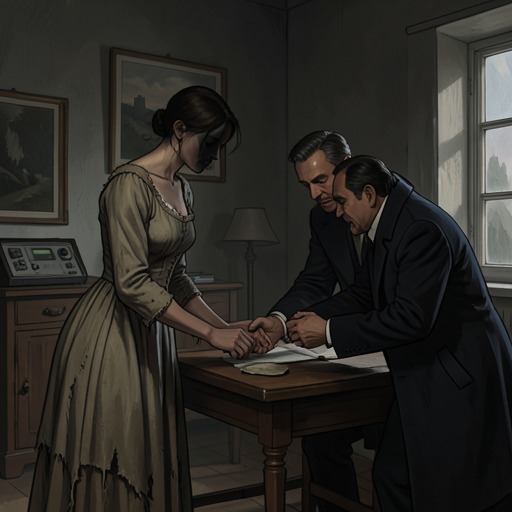
Baroness of Thunder-ten-Tronckh
CandideThe Baroness of Thunder-ten-Tronckh is the powerful presence at the center of the household where Candide first encounters Pangloss’s philosophy of universal optimism. Her weight, rank, and formal hospitality make her a figure of social consequence; her violent death in the attack on the family’s castle turns that sheltered world into one of the story’s earliest and starkest counterexamples to Pangloss’s doctrine.
Identity and Place in the Household
The Baroness is the wife of the Baron of Thunder-ten-Tronckh and the mother of Cunegonde. At about three hundred and fifty pounds, she is described as a person of great consideration. She performs the honors of the house with a dignity that commands still greater respect, a stately domestic authority set amid the Baron’s proudly modest signs of grandeur: his castle has a gate and windows, and its great hall is hung with tapestry.
She belongs to a family whose rank is reinforced by ceremony and by Pangloss’s explanations. The family’s tutor declares that the Baron’s castle is the most magnificent of castles and the Baroness the best of all possible Baronesses. His reasoning turns the household’s comforts and status into supposed proof that everything is ordered for the best. The Baroness herself is not shown advancing this philosophy; she is one of the people and possessions that Pangloss’s argument recruits as evidence.
The Destruction of the Castle
The attack on the Castle of Thunder-ten-Tronckh kills the Baroness along with members of her family and destroys the household. Pangloss later tells Candide that Bulgarian soldiers cut her to pieces, while reporting that the Baron’s daughter was violated and the Baron killed as he tried to defend her. The attack leaves no stone of the castle standing, and the account’s catalogue of ruin extends even to the barns, sheep, ducks, and trees.
Cunegonde’s own recollection gives the attack a different, immediate human perspective. She says that she was asleep when the Bulgarians arrived, that they killed her father and brother and cut her mother to pieces, and that the violence around her became the setting for her assault. Her testimony makes the Baroness’s death part of the family’s lived catastrophe, rather than merely one item in Pangloss’s later summary. The account also places these atrocities within the ordinary practice of war, a bitter contrast to any claim that the world’s events reliably serve a benevolent order.
Narrative and Thematic Significance
The Baroness has no extended personal arc: the narrative establishes her importance through her position, appearance, and role as hostess, then records her death through others’ accounts. That limited presence is consequential. Pangloss first uses her rank and the household’s comforts to illustrate his system; after the castle falls, the same household becomes evidence of how little that system can explain suffering. When Candide hears of the family’s destruction, he faints, and his appeal to cause and sufficient reason cannot make the violence coherent.
Her death also helps define the contrast between Westphalia and the unfamiliar country Candide later encounters. Candide and Cacambo wonder whether a place where all is well must exist, since things so often went badly in Westphalia. The Baroness’s story gives that doubt a concrete origin in the destruction of a home and family. At the conclusion, the Baroness is not brought back into the action; the ending instead turns toward work, as Candide affirms the need to cultivate the garden. The distance between Pangloss’s polished defense of the Baroness’s former comfort and the final emphasis on practical labor marks how far the story has moved from treating status as proof that all is well.