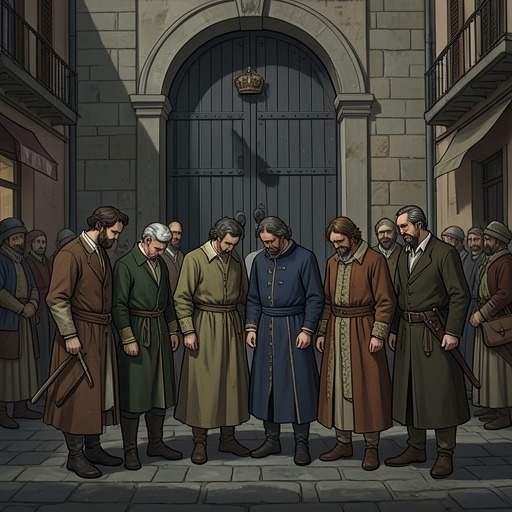
Ivan
CandideIvan is the former Emperor of all the Russias, introduced as a young man whose life has been shaped by dynastic displacement and confinement. His account compresses the distance between imperial title and personal power: he was dethroned in his cradle, and his earliest education took place in prison with his parents.
Identity and Background
Ivan introduces himself by name while seated beside Achmet III. He says that he was once Emperor of all the Russias, but that his removal from power began before he could exercise it: he was dethroned in his cradle. His parents were confined in prison, where he was also educated. The account gives no further detail about his childhood or the circumstances of his deposition.
Confinement and Restricted Travel
Ivan’s life after deposition remains subject to control. He says he is sometimes permitted to travel, but only in the company of people who act as guards. The permission makes movement possible without amounting to freedom: even a journey is organized around his custody. At the time he speaks, he has come to spend the Carnival at Venice, a temporary outing within that guarded existence.
The Venetian Gathering
Ivan’s history emerges during a supper attended by several displaced or fallen figures. Achmet III speaks first, describing his own dethronement and restricted life; Ivan then gives his account, followed by Charles Edward, who recounts his own political defeat and the punishment of his adherents. Their neighboring testimonies place Ivan’s childhood imprisonment within a wider pattern of rulers losing power and living under constraint, while preserving the distinct circumstances of his own story.
Comparative Pity and Narrative Role
After Cacambo recounts the losses and enslavements that have brought the company together, Candide asks Martin who is most to be pitied: Achmet III, Ivan, Charles Edward, or Candide himself. Martin refuses to rank their suffering without knowing what is in their hearts. Ivan thus becomes part of a comparison that the conversation leaves unresolved. His concise testimony supplies concrete grounds for pity, but the scene does not claim that rank, political history, or visible misfortune alone can measure an individual’s pain.