Martin
CandideMartin is the old philosopher who joins Candide on the voyage from Surinam toward Bordeaux, and the journey turns him into the novel’s most consistent countervoice to Panglossian optimism. He interprets the world through suffering and recurrent human conflict, but the conclusion gives his pessimism a practical limit: rather than continue disputing how the world is ordered, he works with the small community to make their life more bearable.
Identity and Introduction
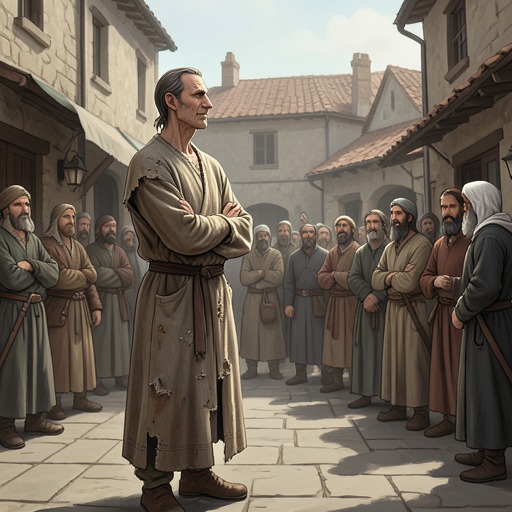
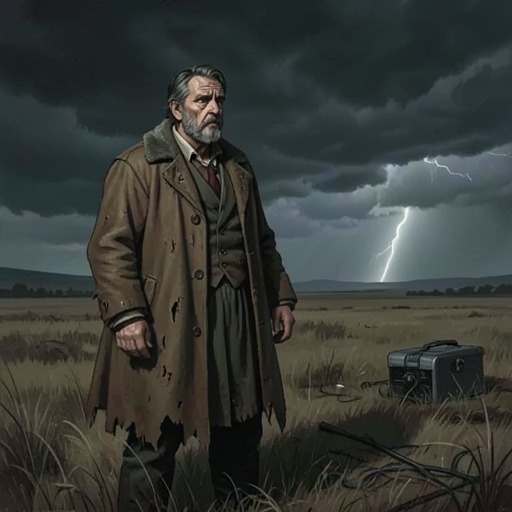
Martin enters the story as an experienced philosopher who, like Candide, has seen and suffered much. Their voyage gives them time to discuss moral and natural evil: Candide supposes that even a much longer sea passage would provide enough material for their conversation. Martin’s introduction is therefore less a biographical account than a declared intellectual position, set against the events the travelers have endured.
He tells Candide that priests have accused him of being a Socinian, but identifies himself instead as a Manichean. He presents this not as a doctrine he has chosen after detached study, but as the conclusion he cannot help reaching when he looks at the world. Candide doubts that Manicheans still exist and suggests that Martin must be possessed by the devil; Martin replies that, given the devil’s presumed involvement in worldly affairs, such a presence would hardly be confined to him.
A Manichean Reading of the World
Martin’s bleak assessment is grounded in social patterns rather than a single catastrophe. He sees cities wishing for the destruction of neighboring cities and families wishing to exterminate other families. The weak curse the powerful while bowing before them; the powerful, in turn, treat the weak as resources to be used. Across Europe, he sees armies organized to earn their bread through disciplined violence when more honest work is unavailable.
Nor does Martin regard apparent peace as proof that people are well. In cities where the arts flourish and public order seems secure, envy, worry, and uneasiness can consume the inhabitants more thoroughly than a besieged town suffers from open calamity. Private grief, in his account, may be more cruel than public disaster. His claim to Manicheanism thus follows from a cumulative judgment: the harm he has witnessed is not confined to battlefields or exceptional misfortune, but recurs in ordinary relations and seemingly peaceful places.
Martin does make one explicit exception to this diagnosis: El Dorado. The qualification matters because it prevents his argument from being merely a claim that every place and circumstance is equally bad. Yet the exception does not persuade him that the wider world is well ordered. His outlook remains shaped by the repeated hostility and exploitation he sees across societies.
Contrast with Candide and Pangloss
The voyage makes Martin’s position clearer by setting it beside Candide’s remaining hopes. Candide expects to see Cunegonde again, possesses money and jewels, and has lost a hundred large red sheep carrying treasure, but still retains considerable wealth. When he thinks of what remains to him—and especially when he mentions Cunegonde—he is inclined again toward Pangloss’s teaching. Martin, by contrast, is described as having nothing to hope for. Their disagreement is therefore not only abstract: Candide’s expectation of reunion and material resources repeatedly pulls him back toward optimism, while Martin interprets experience without that promise of future reward.
Their exchanges also stage opposing ways of explaining suffering. When Candide asks what Martin thinks about moral and natural evil, Martin answers from the repeated evidence of violence, domination, and private distress. Later, after Candide has been hanged, dissected, whipped, and made to row in the galleys, he asks Pangloss whether the doctrine that everything happens for the best has survived those reversals. Pangloss refuses to retract it. Martin’s outlook is placed against that insistence: the events that Pangloss absorbs into a universal explanation are precisely the sort of experience that sustains Martin’s distrust.
Pessimism Tested by Other Lives
Martin’s perspective is reinforced when Paquette and Friar Giroflée arrive at the farm in misery. They have spent their three thousand piastres, separated and reconciled, quarrelled again, gone to prison, and escaped; Friar Giroflée has become a Turk, while Paquette continues her trade without prospering. Their return unsettles Candide and confounds Pangloss. Martin, however, takes it as confirmation of his warning that gifts of money would soon be squandered and would not make their recipients happier.
The episode gives Martin’s philosophy a concrete test. Wealth has not secured lasting contentment for Paquette and Friar Giroflée, just as Candide’s own fortune has not made him happier than they are. Martin does not need to treat their misfortune as an isolated exception: he reads it as another instance of a broader condition in which neither social position nor money guarantees peace of mind.
From Argument to Shared Labor
At the close, Martin concludes that people seem condemned either to agitated distress or to lethargic disgust. Candide does not wholly agree, but cannot offer a firm alternative. Pangloss admits that he has suffered terribly, yet continues to defend the claim that everything goes wonderfully well, though he no longer believes it. The three positions are now distinct: Martin states the bleak diagnosis, Candide hesitates, and Pangloss preserves a doctrine whose confidence has outlasted his conviction.
The arrival of the others at the farm does not resolve their philosophical disagreement. Instead, the small society takes up work suited to each person’s abilities. Martin urges them to work without disputing, presenting shared labor as the only way to make life tolerable. He is part of the community that cultivates the plot and produces plentiful crops. Candide ultimately answers Pangloss’s renewed attempt to explain their circumstances as the best of all possible outcomes by insisting on cultivating the garden. Martin’s contribution is not a competing metaphysical system, but a practical discipline: he helps move the group from endless argument toward useful activity.
Narrative Role
Martin’s place in the story is defined by contrast and recurrence. Candide’s hopes make optimism intermittently attractive; Pangloss repeatedly turns contrary evidence into support for his theory; Martin keeps returning attention to the human costs those explanations leave in view. His examples widen the scope of suffering from war to family hostility, unequal power, urban anxiety, and the failures of wealth to secure happiness.
The ending neither converts Martin to optimism nor leaves his pessimism as the story’s sole answer. His judgment that life oscillates between distress and disgust remains severe, but his call to work gives the travelers a common course of action without requiring agreement about the world’s ultimate design. In that final shift, Martin’s skepticism becomes compatible with participation: the garden does not prove that the world is best, but tending it offers the community something concrete to do.