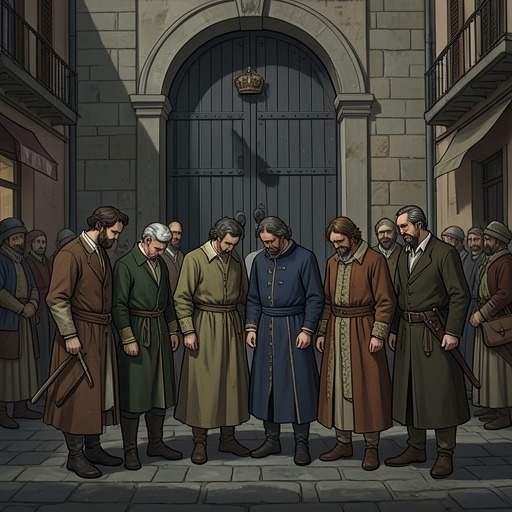
Achmet III
CandideAchmet III appears in Venice not as a reigning sovereign but as one of six strangers who have lost their thrones. His compressed account of political reversals—he dethroned his brother, was then dethroned by his nephew, and saw his viziers beheaded—sets the precariousness of power against the Carnival’s gathering of displaced rulers.
Identity and Deposition
When Candide asks why the strangers claim to be kings, Achmet answers gravely in Italian and identifies himself as a former Grand Sultan. His history turns on a succession of reversals: after he removed his brother from power, his nephew displaced him. Achmet adds that his viziers were beheaded, placing the destruction of his court alongside his own loss of office.
The nephew who now rules as Sultan Mahmoud permits Achmet to travel only sometimes and for his health. Achmet is otherwise condemned to end his days in the old Seraglio. His account thus distinguishes the title he once held from the narrow freedom he retains: he can leave his confinement on occasion, but only by his successor’s allowance.
At the Carnival in Venice
Achmet is among six strangers who have come to spend the Carnival in Venice. Candide first treats their collective claim to kingship as a joke; Achmet’s grave answer changes the encounter from apparent play into a gathering of genuinely deposed rulers. Cacambo waits on one of the strangers during the supper, and the ensuing exchange identifies Achmet as the master whom Cacambo serves.
At the end of the meal, Cacambo quietly tells Achmet that the vessel is ready. Achmet is bound for Constantinople aboard a ship whose skipper has agreed to take Candide and Martin as well. They embark after paying their respects to Achmet, whose former rank remains legible in the formal deference shown to him even while his present circumstances are diminished.
Narrative Role
Achmet’s personal history gives the supper of the six rulers a concrete political dimension. His experience of dethronement is not an abstract warning: it is accompanied by the execution of his viziers and confinement in the old Seraglio. In a few sentences, the account turns royal grandeur into a sequence of reversals and restrictions.
His presence also shapes the journey onward. The ship is bound for Constantinople to conduct Achmet, and Cacambo’s intervention makes room for Candide and Martin aboard. Achmet is therefore both a displaced ruler whose circumstances expose the fragility of power and the practical link through which the travelers continue their voyage.