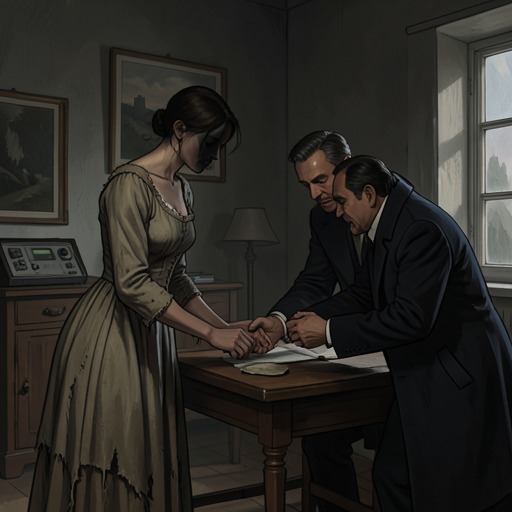
Cunegonde
CandideCunegonde is the daughter of the Baron of Thunder-ten-Tronckh and the figure around whom Candide’s early ideal of happiness takes shape. The destruction of her family overturns the sheltered life of the castle; much later, her reunion with Candide forces their remembered romance to meet the realities of changed appearance, obligation, and social rank. By the conclusion, she is no longer only the object of a quest: she has a place in a small working community and becomes its pastry cook.
Identity and Life at the Castle
At seventeen, Cunegonde is presented as the Baron’s comely, well-regarded daughter. Her family’s standing rests partly on the Baron’s rank, while Pangloss serves as the household’s philosophical authority. Candide, who listens to Pangloss with innocent trust, places Cunegonde immediately after his noble birth in his personal hierarchy of happiness: seeing her every day comes before hearing the philosopher’s lessons. His admiration gives her an importance in his imagination before the story has shown them sharing a sustained relationship.
The castle’s protected order is also the setting for the optimism Candide learns. Pangloss treats its people and arrangements as evidence that the world is organized for the best; Cunegonde belongs to that household picture of comfort and privilege. The abrupt violence that follows exposes how little such apparent security can protect her family.
The Destruction of Her Family
In the account she later gives Candide, Cunegonde recalls the attack on the castle while she was asleep. The Bulgarians kill her father and brother and kill her mother; Cunegonde survives, but is assaulted and left with a wound at her side. She explains that she did not understand the attack as part of the ordinary practice of war at the time. Her account makes the castle’s destruction more than a change in fortune: it is the loss of her family and the end of the sheltered world in which Candide had first idealized her.
When she tells this history, Candide responds with an eager wish to see the mark left by her wound, and she agrees before continuing her story. The exchange briefly reveals the gap between the gravity of what she recounts and Candide’s immediate, personal focus on her. Her narration, meanwhile, gives her experience a place within the novel’s recurring contrast between abstract explanations of events and the injuries those events cause.
Reunion and the Marriage Conflict
Cunegonde and Candide meet again at the house of the Transylvanian prince, where she and the Old Woman are hanging towels out to dry. Cunegonde has changed markedly in appearance. Candide recoils when he sees her, then approaches out of politeness; she embraces him and her brother, and Candide ransoms both women. The reunion thus overturns the beautiful image he had carried of her without dissolving the promise and history that bind them.
A small nearby farm offers the company temporary shelter. Cunegonde does not know that she has grown ugly, since nobody has told her, and she reminds Candide firmly of his promise to marry her. He tells The Baron, her brother, that he intends to do so. The Baron objects both to the match and to the prospect of the children of his sister marrying beneath the rank he demands; he insists that she should marry only an imperial baron. His resistance turns the marriage into a conflict over aristocratic status as well as Candide’s word to Cunegonde.
Candide’s own position is divided. At the conclusion, he has no desire in his heart to marry her, yet The Baron’s impertinence pushes him toward the match, and Cunegonde’s insistence makes him feel unable to withdraw his promise. Pangloss argues that the Baron has no legal right to control his sister’s marriage, while Martin and Cacambo propose different ways of removing the obstruction. The company ultimately arranges for The Baron to be returned to the galley captain, a solution carried out for money and kept from Cunegonde. The episode leaves the proposed marriage unresolved by affection alone: her demand, Candide’s pledged word, the brother’s pride, and the group’s expedient decision all shape its outcome.
Work and the Novel’s Ending
In the final household, Cunegonde becomes an excellent pastry cook, while Paquette embroiders, the Old Woman looks after the linen, and Friar Giroflée works as a joiner. Their small plot produces plentiful crops, and each member of the community contributes according to their abilities. The change is concrete: Cunegonde’s place in the story shifts from the distant goal of Candide’s pursuit to a skilled role in the group’s daily life.
Her presence also connects the ending to the chain of reversals that has defined Candide’s travels. Pangloss later treats Candide’s expulsion for love of Cunegonde, among other disasters and reversals, as part of the sequence that brought the company to its present meal. Candide declines to let that account settle the meaning of their history and returns instead to the necessity of cultivating the garden. Cunegonde’s work as a cook belongs to that ending in practice: the company’s life is sustained not by recovering the castle’s former status, but by useful labor shared among its members.
Narrative Role
Cunegonde’s importance lies partly in the distance between what she represents to Candide and what the narrative shows of her circumstances. At the castle she is the focus of an innocent ideal; her history of family destruction and survival breaks the protected picture of that world. Their reunion then tests the ideal against her changed appearance and his reluctance, while the Baron’s objection exposes the force of inherited rank even after the company has passed through radically different societies.
The novel’s concise, episodic movement makes Cunegonde a recurring point in Candide’s changing account of happiness rather than the center of a continuous romance. Her remembered beauty helps begin his pursuit, but the conclusion gives greater weight to the work that makes a shared life possible. The contrast leaves her neither simply a reward nor the resolution of Candide’s philosophical questions: she is a survivor who insists on a promise and, at the end, a working member of the community.