Pangloss
CandidePangloss is the household philosopher whose confident account of a perfectly ordered world shapes Candide’s first understanding of life. His defining contradiction is that he treats even devastating suffering as confirmation of the doctrine that everything happens for the best: when Candide later asks whether he still believes it after hanging, dissection, whipping, and forced labor at the oar, Pangloss says that he does.
Identity and Doctrine
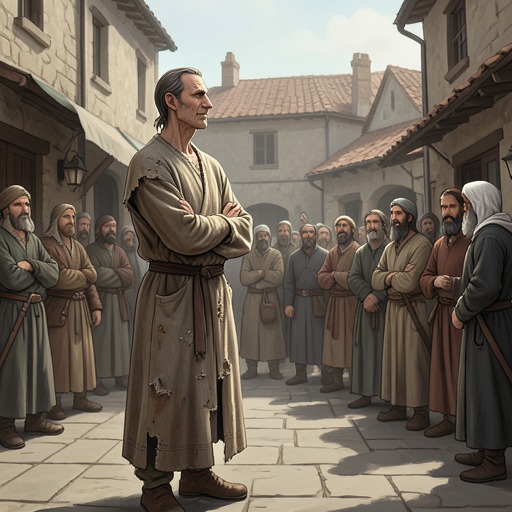
Pangloss serves as the preceptor and intellectual oracle of the Baron of Thunder-ten-Tronckh’s household. His subject is “metaphysico-theologico-cosmolo-nigology,” and he undertakes to prove that nothing happens without a cause and that the world is arranged toward the best possible end. The reasoning is deliberately circular: noses exist to bear spectacles, legs to wear stockings, stones to be cut for castles, and pigs to be eaten. The Baron’s castle and its comforts thus become, in Pangloss’s account, evidence that the world’s design is good.
Candide listens with sincere faith. Pangloss’s influence is therefore not merely a matter of abstract speculation: his teaching supplies the young man with a framework for interpreting what happens to him. The assurance that all is for the best makes misfortune legible as part of a necessary order, even when the explanation does not lessen the pain.
Illness and the Chain of Transmission
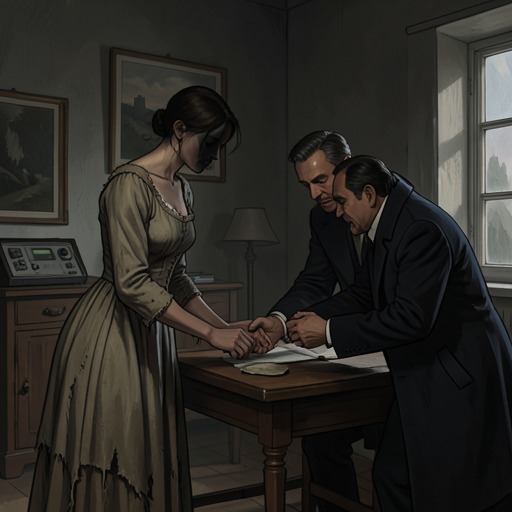
When Candide encounters him gravely ill, Pangloss traces his suffering to Paquette, who had served the Baroness of Thunder-ten-Tronckh. He says that she contracted the disease from a Grey Friar and may herself have died of it. He then recounts a chain of transmission passing through a countess, a cavalry captain, a marchioness, a page, and a Jesuit, whose infection came from a companion of Christopher Columbus. Pangloss presents this genealogy as the history of his illness, while acknowledging that he intends to pass it to no one else.
Even this account becomes material for his philosophy. Pangloss calls the disease an unavoidable ingredient in the best of worlds and links its arrival from America to the presence of chocolate and cochineal in Europe. The grotesque contrast is central to the episode: a chain of bodily suffering is made to serve as a proof of universal benefit. His reasoning can absorb the facts of disease, but only by converting them into another necessity.
Suffering and Persistence
Pangloss’s circumstances continue to worsen. Later, Candide recalls that he has been hanged, dissected, whipped, and made to tug at the oar, asking whether he maintained his optimism through each ordeal. Pangloss answers that he remains of his first opinion because he is a philosopher and cannot retract it. He also invokes Leibnitz and the doctrines of pre-established harmony, plenum, and materia subtilis as grounds for his confidence.
The answer does not show Pangloss revising his beliefs in response to experience; it shows how firmly those beliefs resist revision. His philosophical language persists across illness, punishment, and forced labor, treating no reversal as sufficient evidence against the system. In the contrast between his injuries and his assurances, the character becomes a comic test of optimism: suffering accumulates, while the explanation remains intact.