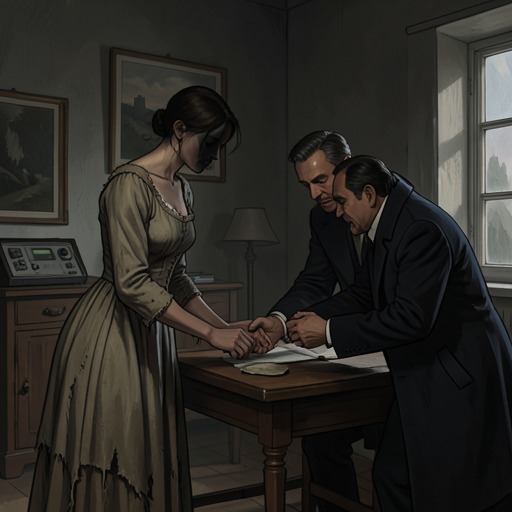
Old Woman
CandideThe Old Woman moves through Candide as both a survivor and a guide: her life story replaces abstract claims about human suffering with an accumulated record of lost status, bodily injury, forced service, and continued attachment to life. She first appears when Candide, bloodied and scarcely able to stand after being preached at, whipped, absolved, and blessed, is mourning Pangloss, the Anabaptist, and Cunegonde. Her brief instruction to follow her turns despair into the next stage of the journey; later, her testimony and practical counsel help shape the company’s response to its troubles.
Identity and Former Status
The Old Woman identifies herself as the daughter of Pope Urban X and the Princess of Palestrina. She recalls being raised in a palace whose scale, she says, made the castles of the German barons seem scarcely fit for stables, and wearing a robe worth more than all the magnificence of Westphalia. In her account, her youth brought beauty, wit, accomplishment, and the homage of others. That former rank stands in sharp contrast to her present service and the physical signs of hardship she names: bleared eyes, red eyelids, a nose that reaches her chin, and only half her posteriors remaining.
Her self-presentation is not simply a tale of lost elegance. By setting a once-privileged identity beside her later condition, she makes social rank no guarantee against suffering. The contrast also gives her a particular authority among the travelers: she speaks not from the security of an abstract philosophical system but from a life repeatedly overturned.
Survival and the Road Through Europe
After her companions could walk, they were sent toward Moscow, while the Old Woman became the gardener of a Boyard who gave her twenty lashes a day. When that nobleman and thirty other Boyards were broken on the wheel after court disputes, she used the upheaval to escape. She then crossed Russia and worked as an inn servant in Riga, Rostock, Vismar, Leipzig, Cassel, Utrecht, Leyden, the Hague, and Rotterdam. The itinerary gives her history the shape of a succession of displacements: escape does not restore her former position, but leads to more service, misery, and disgrace.
She says that she repeatedly considered killing herself but continued to love life. Her reflection turns this persistence into a bleak paradox: people may loathe existence and still cling to it, carrying what they might imagine they could put down. She reports encountering many who hated their lives, but knowing only eight who voluntarily ended them: three Black men, four Englishmen, and a German professor named Robek. The count is precise, but it does not resolve the contradiction she describes. Her own survival is presented as a stubborn human attachment, not as proof that suffering has a just explanation.
Aid, Testimony, and Relationship to Cunegonde
The Old Woman enters the action by approaching Candide at his lowest point and leading him away. Later, she explains that Don Issachar placed her near Cunegonde. She has resolved to share Cunegonde’s fate and says that Cunegonde’s misfortunes affected her more than her own. This allegiance links the older woman’s account of suffering to the younger woman’s ordeal, while making her role more than that of a servant who happens to be present.
During the voyage, the Old Woman explains that she would not ordinarily have told her story; Cunegonde’s provocation and the custom of telling stories aboard ship prompted her to speak. She then proposes that each passenger recount his history, wagering that none has avoided cursing life or thinking himself the most unhappy of mortals. Her own narrative thus helps establish the travelers’ exchange of personal histories. It also shifts the conversation from a single person’s calamity to a broader pattern of misery, without suggesting that all their experiences are identical.
Counsel and Narrative Significance
Near the conclusion, the Old Woman approves the plan for dealing with the Baron after he objects to Candide marrying his sister. Pangloss argues that the Baron has no legal right to prevent the match; Martin favors throwing him into the sea; Cacambo recommends returning him to the galley captain and sending him to Rome. The company accepts Cacambo’s proposal, carries it out for a little money, and takes satisfaction in entrapping a Jesuit and punishing the Baron’s pride. The Old Woman’s approval places her among the advisers whose choices turn a renewed family conflict into a practical, if sharply comic, resolution.
As a character, she counters Pangloss’s confident doctrine that everything is for the best with a history in which privilege gives way to violence, degradation, and precarious survival. Her experience does not supply a competing system that explains suffering away. Instead, she keeps attention on the fact of endurance and on the immediate decisions people make for one another. In a tale that moves rapidly between reversals and philosophical claims, her narrated life gives those reversals a personal history, while her repeated acts of assistance make survival an action shared with others.