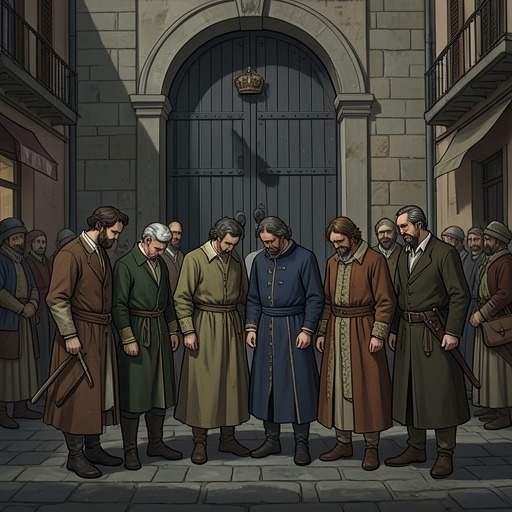
Theodore of Corsica
CandideTheodore of Corsica appears among the dethroned rulers gathered in Venice for the Carnival, a former king whose fortunes have collapsed from a throne to a common jail and near destitution. His brief account turns the gathering’s comparison of lost status into a concrete act of solidarity: five kings give him money for clothes and linen, and Candide gives him a diamond worth two thousand sequins.
Identity and Former Status
Theodore identifies himself as an elected King of Corsica. He presents his former sovereignty through the signs of royal power he once possessed: the title of Majesty, a throne, money bearing his authority, and two secretaries of state. Each detail has a diminished counterpart in his present condition. He is now scarcely treated as a gentleman, his coinage has left him without a farthing, and he has barely a valet.
Fall and Present Circumstances
His reversals have carried him from a throne to straw in a common jail in London. At the Venetian gathering, he fears that he may be treated with the same contempt there. Like the other displaced rulers, he has come to spend the Carnival at Venice, but his account makes the precariousness of that reunion unmistakable: royal rank survives in his name and memory, while his present material circumstances offer little protection.
Reception and Narrative Role
The five other kings listen with generous compassion. Each gives Theodore twenty sequins to buy clothes and linen, while Candide gives him a diamond worth two thousand sequins. Their gifts answer his stated need directly, but their unequal scale also unsettles the gathering’s assumptions about rank and wealth. The kings ask one another who this private person is who can give—and has given—so much more than they can. Theodore’s misfortune thus prompts both practical aid and a revealing contrast between the deposed rulers’ titles and Candide’s capacity to help.
When four more high-ranking exiles arrive after the meal, Candide pays them no attention; his thoughts are occupied by the voyage to Constantinople in search of Cunegonde. Theodore’s encounter with the group remains an episode within that larger journey, yet his speech gives the Venetian supper one of its clearest portraits of political reversal: a king’s past is measured against the clothes, money, and service he can no longer command.