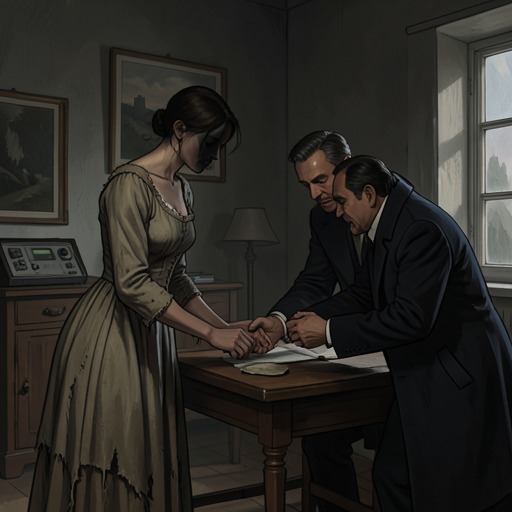
Don Fernando d'Ibaraa, y Figueora, y Mascarenes, y Lampourdos, y Souza
CandideDon Fernando d'Ibaraa, y Figueora, y Mascarenes, y Lampourdos, y Souza, the Governor of Buenos Aires, is a powerful official whose desire to marry Cunegonde makes him a gatekeeper to her freedom. His episode links political authority to personal possession: after offering marriage, he permits her departure only in exchange for two million, while a corsair soon robs the travelers of the rest of their fortune.
Identity and Public Manner
The Governor receives Cunegonde, Captain Candide, and the Old Woman when they arrive at Buenos Aires. His elaborate string of names is matched by a performance of rank: he speaks with disdain, raises his voice, carries his nose high, and stalks with such pride that people greeting him are inclined to give him a drubbing. When Cunegonde appears, however, he regards her as the most beautiful woman he has ever seen. The contrast between his imposing office and his immediate personal interest makes his authority feel both grandiose and arbitrary.
Proposal and Candide's Position
The Governor first asks whether Cunegonde is Candide's wife. Candide cannot truthfully call her either his wife or his sister, and instead presents her as a woman who will marry him, asking the Governor to approve the match. The Governor turns up his moustaches, smiles mockingly, and orders Candide to review his company. Left alone with Cunegonde, he declares his passion and offers to marry her the next day, in church or otherwise, as she wishes. Cunegonde asks for a quarter of an hour to consult the Old Woman and decide. The Old Woman urges her to consider the offer: Cunegonde has noble ancestry but no money, and her previous misfortunes, in the Old Woman's view, remove any obligation to insist on unyielding fidelity. Her counsel makes the Governor's wealth and position central to the choice.
Departure and Consequences
Cacambo later explains that he paid the Governor two million to secure permission for Cunegonde to leave Buenos Aires. A corsair then robbed the travelers of all the remaining money and carried them through Cape Matapan, Milo, Nicaria, Samos, Petra, the Dardanelles, Marmora, and Scutari. By the time Cacambo reports this chain of reversals, Cunegonde and the Old Woman are serving an exiled prince, while Cacambo himself is enslaved to a deposed sultan. The Governor is not responsible for the corsair's robbery, but the episode shows how his permission cost a substantial part of the fortune meant to restore Cunegonde's freedom.
Narrative Role
The Governor is a compact but consequential figure in the novel's sequence of reversals. His proposal appears to offer Cunegonde security, yet her departure requires a vast payment, and money cannot protect the travelers from the next seizure. Through him, romantic pursuit and official power meet in a transaction; the swift transition from his fee to the corsair's robbery turns apparent rescue into another stage of dispossession.